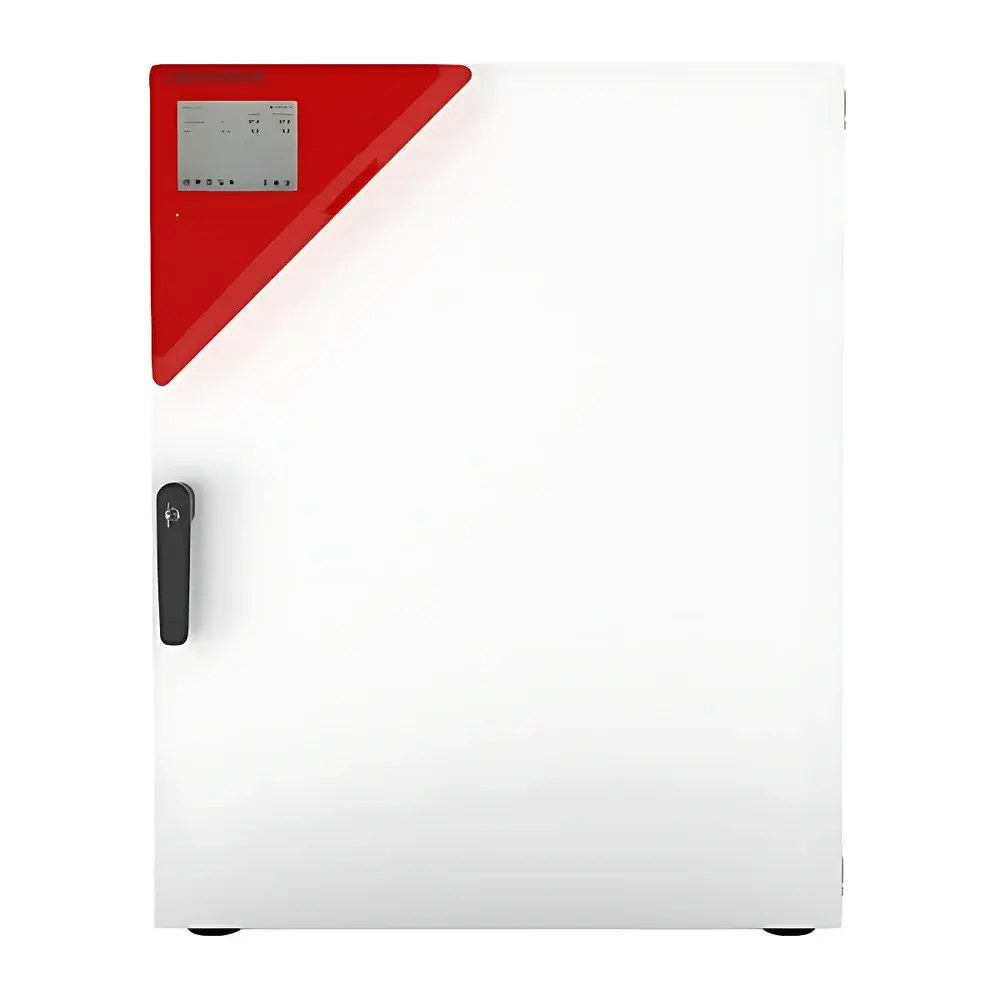
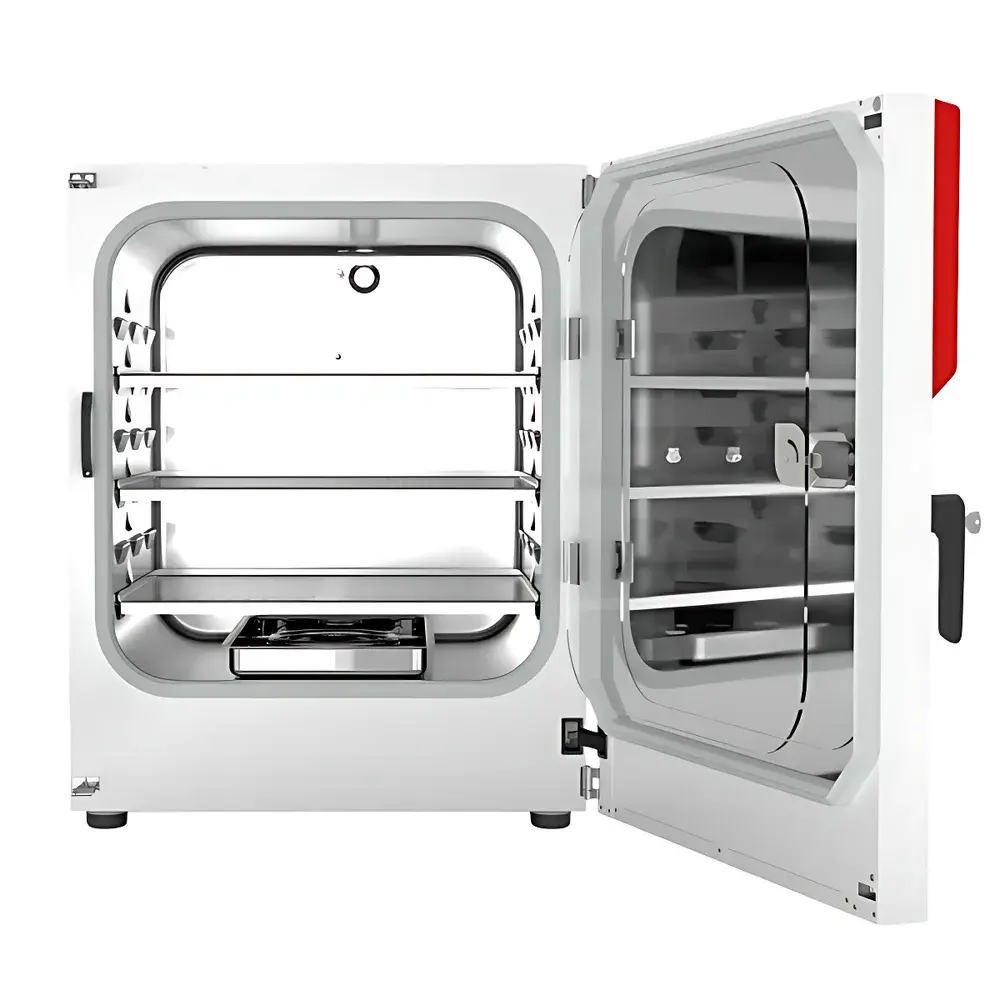
BINDER CB170 Carbon Dioxide Incubator
| Brand | BINDER |
|---|---|
| Origin | Germany |
| Manufacturer | BINDER GmbH |
| Type | Water-Jacketed CO₂ Incubator |
| Model | CB 170 |
| Temperature Range & Accuracy | Ambient +4 °C to 60 °C |
| Temperature Uniformity | ±0.3 °C |
| CO₂ Concentration Range & Accuracy | 0–20 vol.% |
| Humidity Control Range & Accuracy | 90–95 %RH |
| Chamber Capacity | 170 L |
| External Dimensions (W×H×D) | 680 × 870 × 715 mm |
| Sterilization Method | 180 °C Dry-Heat Sterilization |
Overview
The BINDER CB170 Carbon Dioxide Incubator is a precision-engineered, water-jacketed incubation system designed for reliable, contamination-controlled cell culture in academic, pharmaceutical, and clinical research laboratories. It operates on well-established physiological principles—maintaining tightly regulated CO₂ partial pressure (to stabilize bicarbonate-buffered media pH), precise temperature homogeneity (via dual-layer water jacket thermal inertia), and active humidity control (to prevent evaporation-induced osmotic stress)—all critical for long-term viability of primary cells, stem lines, and sensitive co-cultures. As a CE-marked Class II medical device compliant with IEC 61010-1 and EN 61326-1, the CB170 meets stringent requirements for GLP and GMP-aligned workflows, including FDA 21 CFR Part 11–ready data integrity when paired with validated software.
Key Features
- Monolithic seamless stainless-steel inner chamber (AISI 304) eliminates crevices and weld seams where microbial biofilms could accumulate—validated per ISO 14644-1 Class 5 cleanroom-compatible surface finish.
- Venturi-mixed CO₂ inlet system ensures laminar, fan-free gas distribution without turbulence-induced thermal or pH microgradients—critical for spatially uniform monolayer growth.
- 180 °C dry-heat sterilization cycle (EN 285-compliant validation protocol available) fully deactivates spores, mycoplasma, and prion-associated proteins; includes automatic door lockout and thermal ramp monitoring.
- High-stability, non-drifting single-beam infrared CO₂ sensor—fully autoclavable and recalibration-free over ≥5 years under routine use—certified to ASTM E2917 for measurement uncertainty <±0.1 vol.% at 5% CO₂.
- DuoDoor™ dual-glass access system: outer tempered safety glass and inner heated anti-condensation glass enable rapid sample exchange while minimizing ambient air intrusion and humidity loss.
- Condensation-protected dual-tray humidification system with integrated water level sensor and overflow protection—prevents stagnant water accumulation and secondary aerosol contamination.
- Intuitive 7-inch capacitive touchscreen interface with multilingual support (EN/DE/FR/ES), real-time trend graphs, and configurable user permissions (admin/operator/researcher tiers).
Sample Compatibility & Compliance
The CB170 supports a broad spectrum of culture formats—including T-flasks, multiwell plates (6–384-well), roller bottles, and custom bioreactor inserts—without compromising environmental stability. Its chamber geometry accommodates standard laboratory shelving (up to 4 adjustable stainless-steel trays). All materials in contact with the incubation environment comply with USP Class VI biocompatibility testing. The system conforms to ISO 13408-1 (aseptic processing), ISO 5 (cleanroom classification for internal airflow), and EU Directive 2014/30/EU (EMC). Optional O₂ control module enables hypoxic (0.1–15% O₂) or hyperoxic (up to 95% O₂) configurations, extending utility to tumor spheroid modeling, iPSC differentiation, and ischemia-reperfusion studies.
Software & Data Management
Integrated internal data logger stores time-stamped records of temperature, CO₂, humidity, door events, and sterilization cycles for ≥12 months (≥1 million entries). Data export via USB 2.0 (CSV/Excel-compatible) or Ethernet (TCP/IP) supports audit-ready traceability. When connected to BINDER’s optional ecoControl® Lab Suite (v4.2+), the CB170 delivers full 21 CFR Part 11 compliance: electronic signatures, role-based access control, immutable audit trails, and automated backup to network drives. Alarm logic includes predictive failure diagnostics (e.g., heater drift detection, sensor response lag), with visual (LED ring) and audible alerts plus relay-triggered external notifications.
Applications
- Long-term maintenance of human mesenchymal stem cells (hMSCs) requiring strict pH and osmotic stability.
- High-throughput drug screening using adherent cancer cell lines under normoxic and controlled hypoxic conditions.
- Production of viral vectors (AAV, lentivirus) in serum-free suspension-adapted HEK293T cultures.
- Embryonic stem cell colony expansion with minimal spontaneous differentiation risk.
- Co-culture systems involving endothelial–pericyte or neuron–astrocyte interactions demanding low-vibration, ultra-stable microenvironments.
- Regulatory submissions (ICH M3(R2), FDA IND-enabling studies) where equipment qualification (IQ/OQ/PQ) documentation packages are provided upon request.
FAQ
Does the CB170 support validation protocols required for GMP manufacturing?
Yes—the CB170 is supplied with Factory Acceptance Test (FAT) reports, and BINDER provides comprehensive IQ/OQ documentation templates aligned with Annex 15 and ISO 14644-3. Full PQ support is available through certified third-party partners.
Can the infrared CO₂ sensor be recalibrated onsite without service intervention?
No—its design eliminates field recalibration needs. The sensor is factory-calibrated against NIST-traceable reference gases and retains accuracy across its operational lifetime per DIN EN ISO 9001 calibration management procedures.
Is remote monitoring possible without installing proprietary software?
Yes—via standard HTTP/HTTPS web interface accessible from any modern browser; no client installation required. Real-time values, alarms, and historical logs are viewable and exportable.
What is the mean time between failures (MTBF) for the water jacket heating system?
Based on field reliability data from >12,000 installed units, MTBF exceeds 25,000 hours under continuous operation at 37 °C/5% CO₂.
How does the DuoDoor™ system reduce contamination risk compared to single-door designs?
By decoupling ambient air exchange (outer door) from chamber atmosphere disturbance (inner door), it reduces CO₂ loss by ~65% and humidity drop by ~40% per access event—verified via tracer-gas decay studies per ISO 14644-3 Annex B.