
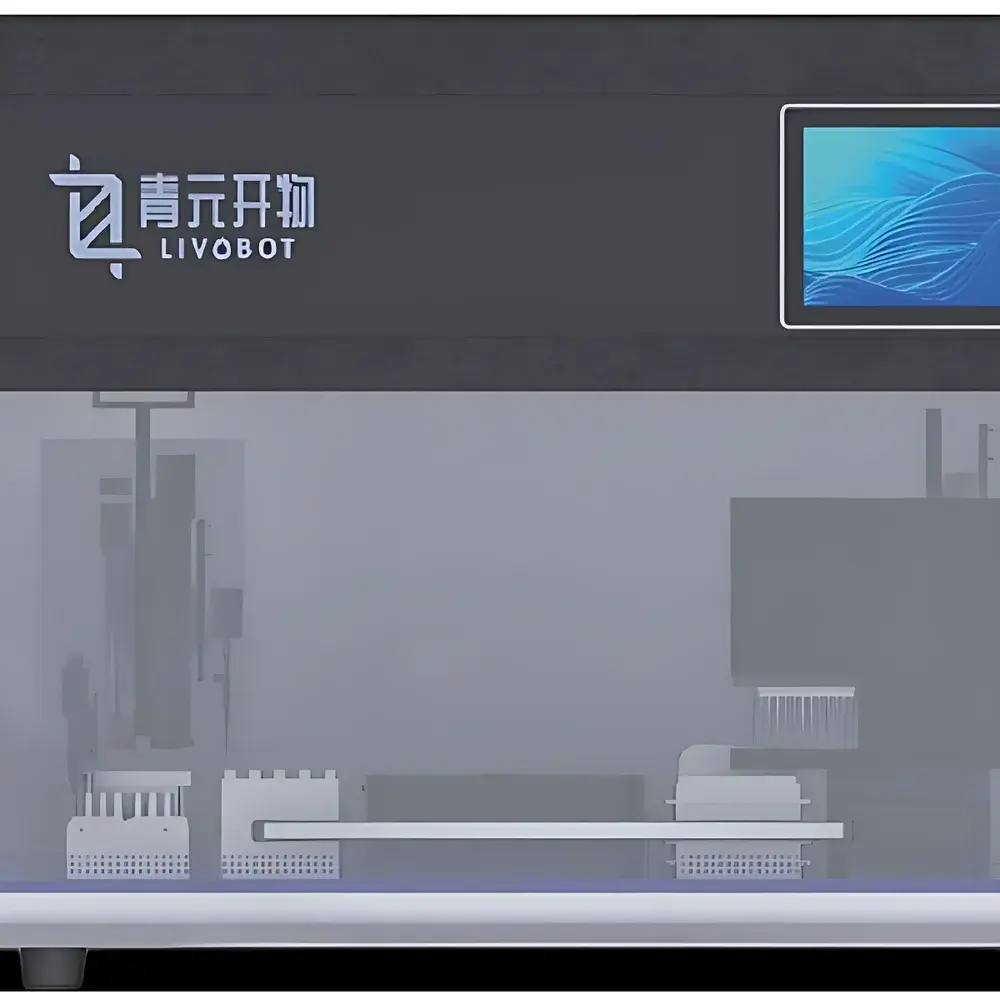
LIVOBOT EosBot Seq24 Automated Nucleic Acid Library Preparation System
| Brand | LIVOBOT |
|---|---|
| Model | EosBot Seq24 |
| Origin | Beijing, China |
| Instrument Type | Integrated Library Prep Platform (Not a DNA Sequencer) |
| Throughput | 8–24 samples per run |
| Regulatory Status | Not a medical device |
| Automation Level | Fully automated, walk-away library construction |
| Compliance | Designed for GLP-compliant laboratories |
| Software Communication | TCP/IP Socket protocol |
| Dimensions | 850 × 1200 × 1050 mm |
| Weight | 260 ± 5 kg |
| Power Supply | AC 100–240 V, 180 VA |
| Operating Environment | 20–30 °C, 20–80% RH (non-condensing), 80–106 kPa |
| Liquid Handling | Single-channel and 8-channel fixed-pitch pipettors (2–500 µL) |
| Positioning Accuracy | ±0.05 mm repeatability |
| Thermal Modules | PCR block (4–100 °C, automated heated lid), incubation (RT +5 to 70 °C), refrigeration (4 ±1 °C) |
| Air Quality Control | HEPA filtration + UV sterilization |
| Safety | Meets Class II biological safety cabinet performance criteria |
| Compatible Platforms | Illumina, MGI/BGI, Thermo Fisher Ion Torrent (via adapter-compatible protocols) |
| Compatible Kits | QIAGEN, Vazyme, TIANGEN, Yeasen, Phalanx, Kangweiji, Abbkine, and other major commercial NGS library prep kits |
Overview
The LIVOBOT EosBot Seq24 is an integrated, fully automated nucleic acid library preparation system engineered for high-fidelity, reproducible next-generation sequencing (NGS) library construction. Unlike standalone sequencers, the EosBot Seq24 does not perform DNA sequencing; rather, it executes end-to-end wet-lab workflow automation—including fragmentation, end repair, A-tailing, adapter ligation, size selection (magnetic bead-based), PCR amplification, quantification (fluorometric or spectrophotometric), and pooling—within a single enclosed platform. Its architecture follows the principles of precision liquid handling, thermal process control, and contamination mitigation, aligning with ISO/IEC 17025 and CLIA-aligned laboratory quality management frameworks. The system employs Couette-flow-optimized magnetic separation, calibrated air-displacement pipetting, and real-time thermal profiling to ensure stoichiometric consistency across reactions—critical for minimizing batch effects in RNA-Seq, whole-exome sequencing (WES), targeted panels, and cfDNA analysis.
Key Features
- Fully integrated workflow engine: Combines library construction, qPCR-grade quantification, normalization, and pooling without manual plate transfers.
- Dual-mode liquid handling: Configurable single-channel (100 µL), 8-channel (200 µL), and optional 24-channel (500 µL) pipettors support flexible reaction volumes (2–500 µL) and diverse kit formats (e.g., dual-indexed Illumina, MGI-compatible adapters).
- On-board thermal modules: Integrated PCR thermocycler (4–100 °C, programmable ramp rates), incubation zone (RT+5 to 70 °C), and 4 °C reagent cooling preserve enzyme activity and reduce thermal degradation during multi-step workflows.
- Contamination-controlled environment: HEPA-filtered laminar airflow, internal UV-C irradiation (254 nm), and sealed deck design meet ISO 14644-1 Class 5 cleanroom-equivalent particulate standards.
- High-precision motion control:龙门-style gantry with servo-driven actuators achieves ±0.05 mm repeatable positioning—essential for consistent magnetic bead pelleting and low-volume transfer accuracy.
- Regulatory-ready software: Full audit trail, user role-based permissions (admin/operator/observer), electronic signatures, and LIS/HIS integration via HL7/FHIR-compliant APIs satisfy FDA 21 CFR Part 11 and EU Annex 11 requirements.
Sample Compatibility & Compliance
The EosBot Seq24 accommodates input nucleic acids from diverse sources: genomic DNA (FFPE, blood, saliva), total RNA (RIN ≥ 7), cfDNA, and amplicons. It supports both double-stranded and single-stranded library protocols—including tagmentation-based (e.g., Nextera XT), ligation-based (e.g., NEB Ultra II), and hybrid capture workflows. All consumables—including 96-well PCR plates, skirted microplates, low-retention tips (20 µL, 50 µL, 200 µL, 1000 µL), and proprietary reagent reservoirs—are certified DNase/RNase-free and endotoxin-tested (<0.03 EU/mL). The system complies with IEC 61000-6-2 (EMC immunity) and IEC 61010-1 (safety for lab equipment), and its operational logs meet GLP documentation standards for clinical research use.
Software & Data Management
EosBot Control Suite v1.0 provides a browser-accessible, icon-driven interface with drag-and-drop protocol builder, real-time thermal curve visualization, and step-level parameter locking. Each run generates a timestamped, immutable .CSV/.PDF report containing tip usage history, temperature deviation logs, pipette calibration records, and sample-level QC metrics (e.g., post-PCR yield, CV% across replicates). Data export supports direct ingestion into Galaxy, BaseSpace, or custom LIMS via SFTP or RESTful API. Version-controlled protocol libraries allow version rollback and change tracking—critical for method validation under ISO 15189 or CAP accreditation.
Applications
- Core genomics facilities: High-throughput library prep for population-scale WGS/WES projects (e.g., biobank cohort studies).
- Molecular diagnostics labs: Standardized cfDNA library generation for oncology MRD monitoring and prenatal NIPT workflows.
- Agri-genomics: Scalable SNP discovery and haplotype phasing in polyploid crop species using multiplexed amplicon sequencing.
- Pharma R&D: Reproducible ChIP-Seq and ATAC-Seq library prep for epigenetic target validation under GCP conditions.
- Academic core labs: Reduced hands-on time for graduate students performing RNA-Seq on non-model organisms with limited starting material.
FAQ
Is the EosBot Seq24 a DNA sequencer?
No. It is a dedicated library preparation automation platform—not a sequencing instrument. It prepares libraries compatible with Illumina, MGI, and Thermo Fisher platforms.
Does it support dual indexing for Illumina platforms?
Yes. The system natively supports i7/i5 index combinations via independent tip channels and plate mapping logic.
Can it be validated for clinical diagnostic use?
While not classified as an IVD device, its software architecture, audit trail, and electronic signature capabilities support validation per CLIA, CAP, and ISO 15189 requirements.
What maintenance is required?
Quarterly pipette calibration verification, annual HEPA filter replacement, and biannual thermal module validation using NIST-traceable reference standards.
Is remote monitoring supported?
Yes. Real-time status dashboards, email/SMS alerts for error conditions, and secure SSH-based remote troubleshooting are enabled by default.




