
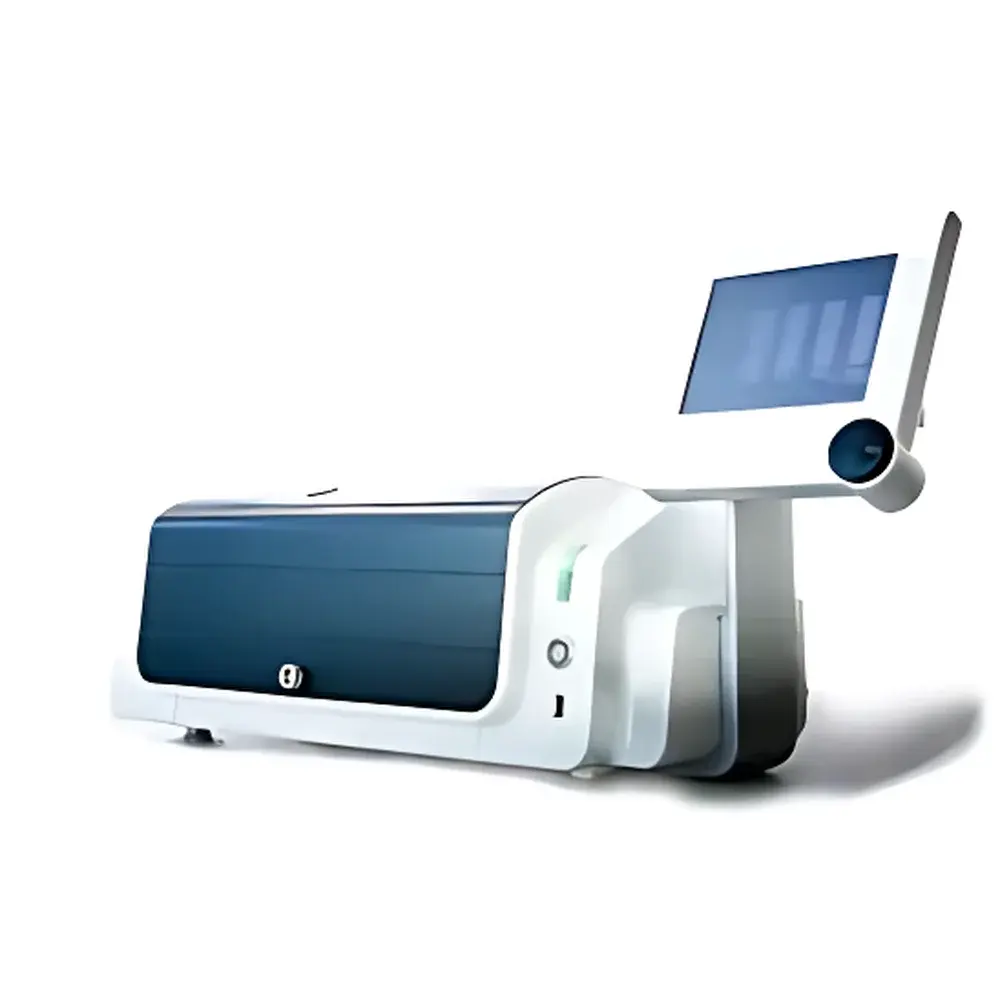
OLS CERO 3D Organoid Culture System
| Brand | OLS |
|---|---|
| Origin | Germany |
| Model | CERO |
| Temperature Control Range & Accuracy | 15–28 °C ±0.1 °C |
| Humidity Control Range | RT+7–45 °C |
| Chamber Capacity | 4 × 50 mL culture vessels |
| Dimensions | 740 × 324 × 245 mm |
| Weight | 14.5 kg |
| CO₂ Sensing | Laboratory-grade IR sensor, 0–18% range, ±0.1% accuracy |
| User Interface | 6.4″ capacitive touchscreen |
| Power Supply | 100–240 V (±10%), 50–60 Hz |
| Communication Interfaces | Ethernet, RS232, USB |
Overview
The OLS CERO 3D Organoid Culture System is a purpose-engineered incubation platform designed for long-term, physiologically relevant 3D cell and organoid culture under tightly controlled environmental conditions. Unlike conventional CO₂ incubators optimized for monolayer adherent cultures, the CERO system integrates dynamic microenvironmental regulation—including precise temperature, humidity, and CO₂ control—with a shear-minimized fluidic architecture to support suspension-based 3D growth models. Its operational principle centers on maintaining stable gas exchange, thermal homogeneity, and mechanical quiescence—critical parameters for preserving stemness, enabling reproducible differentiation trajectories, and sustaining organoid viability over extended durations (up to 12 months in validated protocols). The system operates without impeller-based agitation, relying instead on a patented fin-wing fluid dynamics design that ensures uniform nutrient distribution while eliminating disruptive hydrodynamic shear forces known to impair epithelial polarity and lumen formation in intestinal, hepatic, or neural organoids.
Key Features
- Shear-free culture environment enabled by passive fin-wing fluid circulation—no rotating impellers, no magnetic stirrers, no bubble-induced turbulence
- High-precision environmental control: temperature uniformity ±0.1 °C across the chamber; CO₂ measurement via laboratory-grade infrared sensor with ±0.1% full-scale accuracy
- Dedicated 4-position modular chamber accommodating standard 50 mL conical tubes—designed for scalable, parallelized organoid expansion under identical conditions
- Integrated real-time pH monitoring capability (via optional external probe interface) for non-invasive assessment of metabolic activity and medium acidification kinetics
- Intuitive 6.4″ capacitive touchscreen interface with multilingual OS support, configurable alarm thresholds, and event-logged parameter history
- Comprehensive connectivity suite: Ethernet (for networked lab integration), RS232 (for legacy instrument interfacing), and USB (for firmware updates and data export)
Sample Compatibility & Compliance
The CERO system supports a broad spectrum of 3D culture formats including scaffold-free spheroids, matrix-embedded organoids (e.g., Matrigel®, collagen I, or synthetic hydrogels), and bioreactor-compatible suspension aggregates. It has been validated for use with human induced pluripotent stem cells (hiPSCs), hiPSC-derived cardiomyocytes, HepaRG spheroids, and primary tumor organoids. All hardware materials comply with ISO 10993-5 (cytotoxicity) and USP extractables testing standards. The system’s environmental stability profile meets requirements for GLP-compliant preclinical assay development, and its audit-trail-capable software architecture (when paired with OLS LabLink Suite v3.2+) supports alignment with FDA 21 CFR Part 11 electronic record and signature controls where configured for regulated environments.
Software & Data Management
The embedded firmware enables local parameter logging at user-defined intervals (1–60 min resolution), with timestamped CSV export via USB or network transfer. When connected to the optional OLS LabLink Suite, the CERO integrates into centralized laboratory data infrastructure—supporting automated backup, role-based access control, and cross-platform visualization of longitudinal culture metrics (temperature drift, CO₂ deviation, cycle duration). All logged events—including door openings, setpoint changes, and alarm triggers—are time-stamped and cryptographically signed to satisfy traceability requirements under ISO/IEC 17025 and OECD GLP Principles. No cloud storage is performed by default; data residency remains fully on-premise unless explicitly enabled via authenticated enterprise configuration.
Applications
- Long-term maintenance and expansion of hiPSC lines under feeder-free, xeno-free conditions
- Directed differentiation of hiPSCs into functional cardiomyocyte clusters with synchronized beating onset and electrophysiological maturation
- Sustained culture of metabolically active HepaRG spheroids for up to 28 days—enabling chronic hepatotoxicity assessment and CYP450 induction studies
- In vitro viral infection modeling using air-liquid interface (ALI)-compatible organoids, with controlled humidity gradients supporting mucociliary differentiation
- High-content screening of oncology therapeutics using patient-derived tumor organoids (PDTOs), with integrated viability readout synchronization
FAQ
What types of culture vessels are compatible with the CERO system?
Standard 50 mL conical centrifuge tubes (polypropylene, sterile, low-binding) are the primary supported format. Custom adapters for microplates (e.g., 24-well U-bottom plates) are available upon request and require validation for thermal and gas diffusion equivalence.
Can the CERO system be integrated into existing LIMS or ELN platforms?
Yes—via Ethernet-connected RESTful API endpoints provided in the OLS LabLink Suite, enabling bidirectional parameter synchronization and automated metadata injection into compliant electronic lab notebooks.
Is remote monitoring supported without compromising data security?
Remote status viewing is enabled through TLS 1.2-encrypted web dashboard access; full remote control requires authenticated VPN tunneling per institutional IT policy—no inbound internet ports are opened by default.
Does the system meet regulatory requirements for GMP cell therapy manufacturing?
While the CERO itself is not classified as GMP equipment, its design basis, material certifications, and software audit trail functionality align with Annex 1 (EU) and USP guidance for ancillary devices used in autologous cell processing workflows—subject to site-specific qualification.
How is temperature uniformity verified during IQ/OQ validation?
OLS provides a certified 9-point thermal mapping protocol using NIST-traceable Class A PT100 probes; validation reports include spatial deviation heatmaps and statistical process control (SPC) charts for all critical parameters.




