
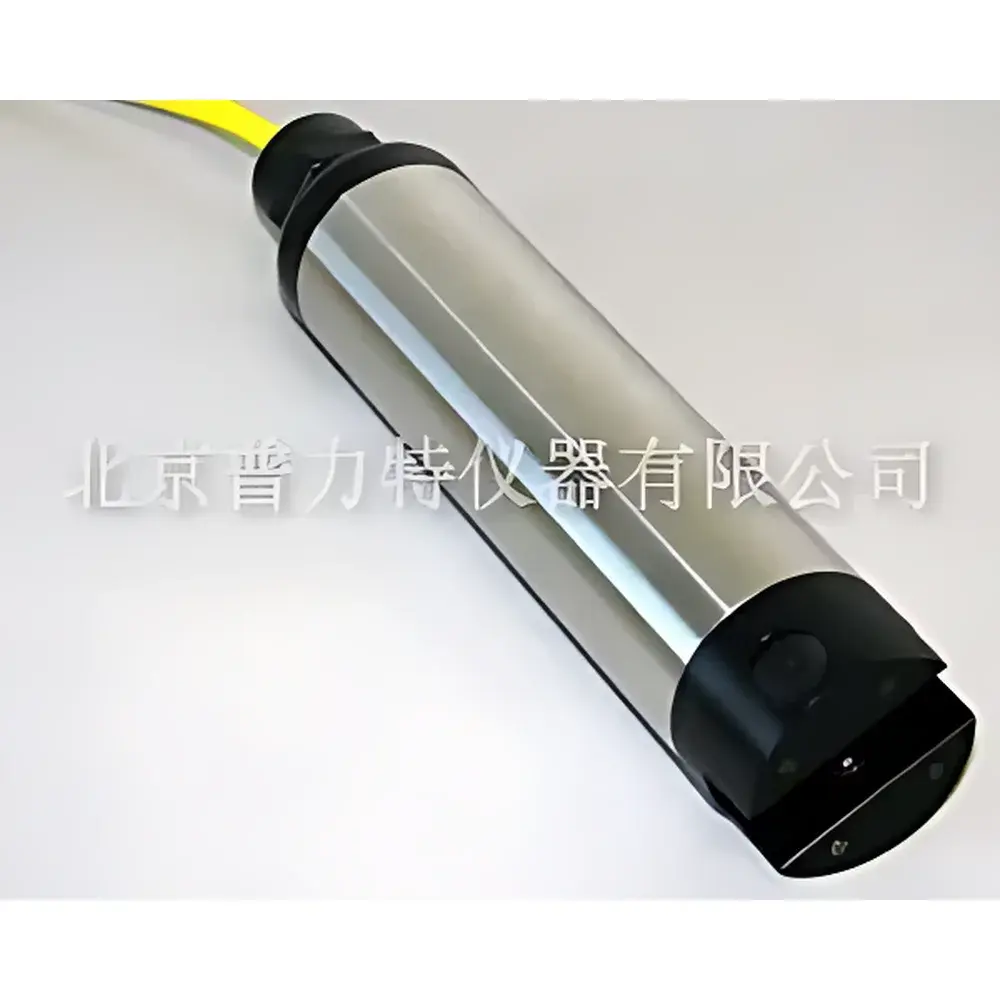
WQ730 Submersible Turbidity Sensor
| Origin | USA |
|---|---|
| Manufacturer Type | Authorized Distributor |
| Origin Category | Imported |
| Model | WQ730 |
| Price Range | USD 1,400–2,800 |
| Product Type | Online/In-line |
| Measurement Range | 0–50 NTU and 0–1000 NTU (switchable or dual-range configuration) |
| Resolution | ±1% of full scale |
| Operating Temperature | −10 to 50 °C |
| Accuracy | ±1% of full scale |
| Output Signal | 4–20 mA |
| Supply Voltage | 10–36 VDC @ 40 ms response time |
| Current Consumption | 30 mA + output current |
| Warm-up Time | ≥5 seconds |
| Housing Material | 316 Stainless Steel or POM (polyoxymethylene) body |
| Cable Sheath | Polyether-based jacket (marine-grade) |
| Max Pressure Rating | 30 psi (≈20 m water depth) |
| Light Source | 880 nm infrared LED |
| Standard Cable Length | 7.6 m (extendable up to 150 m) |
| Dimensions | Ø38 mm × 216 mm |
| Weight | 454 g |
Overview
The WQ730 Submersible Turbidity Sensor is an EPA-compliant, field-deployable optical instrument engineered for continuous, real-time turbidity monitoring in natural and industrial aqueous environments. It operates on the principle of 90° side-scatter detection—a method standardized under U.S. Environmental Protection Agency Method 180.1—where an 880 nm infrared LED emits a collimated beam into the sample medium; suspended particles scatter light isotropically, and a photodetector positioned precisely at 90° to the incident beam quantifies the scattered intensity. This geometry minimizes interference from color absorption and path-length variability while enhancing sensitivity across low-to-moderate turbidity ranges. A secondary reference photodetector compensates for signal drift caused by LED aging, lens fouling, ambient light intrusion, or chromatic shifts—ensuring long-term stability without routine recalibration. Designed for permanent submersion, the sensor integrates a robust pressure-rated housing and marine-grade cable assembly, enabling reliable deployment in rivers, reservoirs, groundwater wells, wastewater treatment channels, and industrial effluent streams.
Key Features
- EPA Method 180.1–compliant 90° scattered-light detection architecture with dual-photodetector compensation
- Switchable or dual-range measurement capability: 0–50 NTU (high-resolution mode) and 0–1000 NTU (extended-range mode)
- Stainless steel (316 SS) or polyoxymethylene (POM) housing options for corrosion resistance and mechanical durability
- Marine-rated polyether-sheathed cable (standard 7.6 m, extendable to 150 m) with tensile strength optimized for underwater anchoring and mooring applications
- 4–20 mA analog output with HART compatibility (optional), supporting integration into SCADA, DCS, and PLC-based monitoring systems
- Low-power operation (30 mA base current + output load) compatible with solar-powered remote stations and battery-backed telemetry nodes
- IP68-rated enclosure with 30 psi (20 m H₂O) pressure tolerance, validated per IEC 60529
- Fast thermal stabilization: full operational readiness within 5 seconds of power-on
Sample Compatibility & Compliance
The WQ730 is validated for use in freshwater, brackish water, treated wastewater, and non-aggressive industrial process streams. It is not recommended for highly viscous, aerated, or strongly UV-absorbing media where bubble entrapment or spectral interference may compromise scatter signal fidelity. The sensor conforms to ASTM D6508 (Standard Test Method for Turbidity of Water by Nephelometry), ISO 7027-1:2016 (Water quality — Determination of turbidity — Part 1: Quantitative methods using nephelometry), and U.S. EPA Method 180.1. Its design supports GLP-aligned data integrity requirements, including traceable calibration records and documented maintenance logs. While not intrinsically safe, it meets CE marking directives for electromagnetic compatibility (2014/30/EU) and low-voltage safety (2014/35/EU).
Software & Data Management
The WQ730 operates as a stand-alone analog transducer and does not require embedded firmware or onboard data storage. When integrated with third-party data loggers or supervisory control systems, it supports time-stamped, linearized NTU values compliant with Modbus RTU or analog I/O protocols. For audit-ready deployments, users are advised to pair the sensor with logging platforms that enforce 21 CFR Part 11–compliant electronic signatures, change control, and audit trails—particularly in regulated wastewater discharge reporting or drinking water source monitoring governed by local environmental agencies.
Applications
- Real-time turbidity profiling in surface water intakes and reservoir sediment transport studies
- Performance verification of filtration units and coagulation-flocculation processes in municipal water treatment plants
- Compliance monitoring of NPDES discharge permits for industrial outfalls
- Early-warning detection of erosion events or landslide-induced runoff in watershed management programs
- Long-term groundwater quality assessment in monitoring wells subject to seasonal particulate loading
- Process control feedback in food & beverage, pharmaceutical, and semiconductor rinse-water loops
FAQ
Does the WQ730 require periodic calibration in the field?
Field calibration is not mandatory under stable conditions; however, a two-point calibration (deionized water zero and formazin or AMCO AEPA-1 standard) is recommended before initial deployment and annually thereafter—or following exposure to high-fouling environments.
Can ambient light affect measurement accuracy?
Yes—direct sunlight or artificial illumination entering the optical path can induce positive bias. The sensor must be installed in shaded, flow-stabilized locations or housed in a light-shielded mounting sleeve when deployed in shallow or exposed sites.
Is the 4–20 mA output linear across both measurement ranges?
Yes—the transmitter electronics provide factory-configured linear scaling: 4 mA corresponds to 0 NTU, and 20 mA maps to the selected full-scale value (50 NTU or 1000 NTU), with internal digital compensation maintaining linearity per ISO 7027-1.
What maintenance intervals are recommended for submerged operation?
Visual inspection and gentle cleaning of the optical window every 3–6 months is advised in high-sediment environments; biocide-compatible cleaning solutions may be used to inhibit biofilm formation without damaging the IR LED or detector lens coatings.
Is the WQ730 suitable for seawater applications?
It is rated for short-term exposure to brackish water and estuarine conditions; prolonged immersion in full-strength seawater (>35 ppt salinity) may accelerate corrosion of non-316SS components and is not covered under warranty unless specified with optional titanium hardware and enhanced sealing.




