
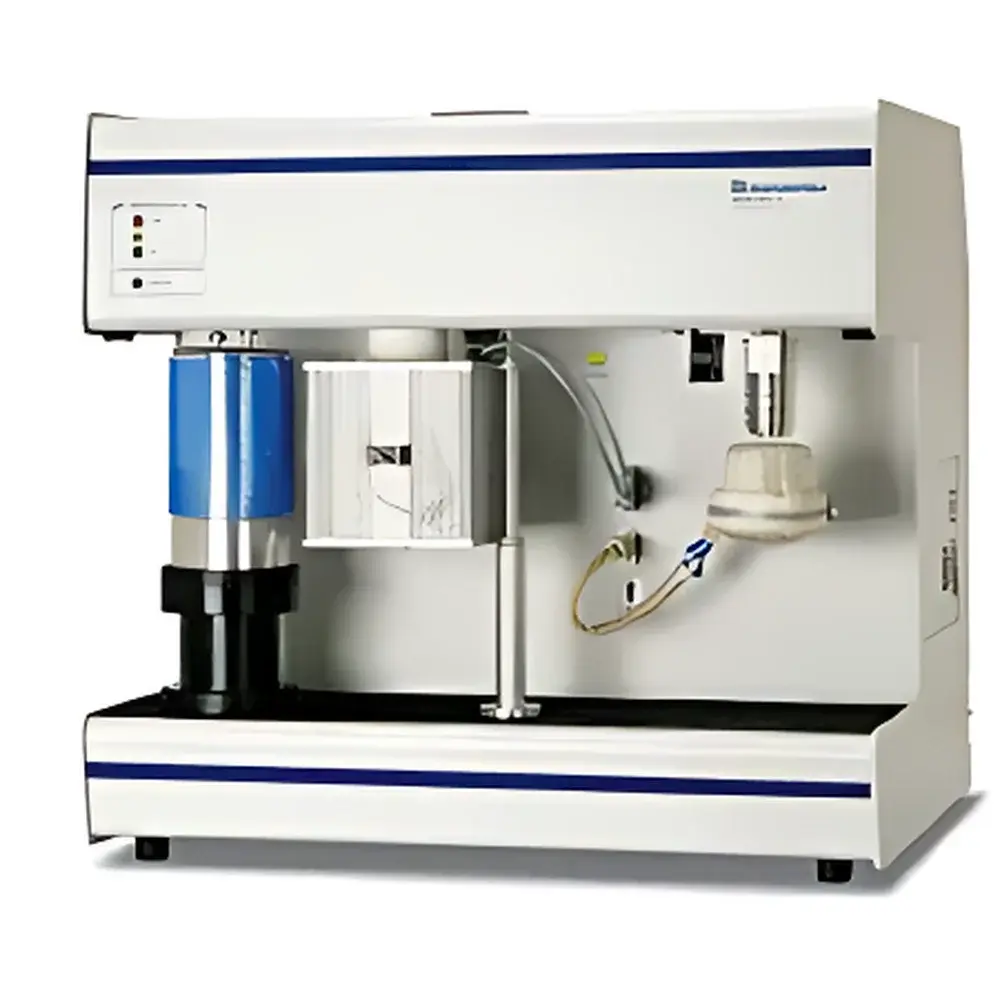
Micromeritics AutoChem II 2920 Automated Temperature-Programmed Chemisorption Analyzer
| Brand | Micromeritics |
|---|---|
| Origin | USA |
| Model | AutoChem II 2920 |
| Temperature Range | –110 °C to 1100 °C |
| Detection Method | High-Stability TCD (Thermal Conductivity Detector) |
| Gas Inlets | 12 |
| Automated Valves | 4 × 6-port valves |
| Mass Flow Controllers | 4 (sample prep, dual carrier/reference, analysis) |
| Sample Tube | FlowThru™ quartz, rated to 1100 °C |
| TCD Zone Temperature | 150–250 °C |
| Optional Accessories | Online MS/FTIR/GC interface, vapor generator, cryogenic bath (–110 °C) |
| Software | Windows-based AutoChem software with GRAMS/32 peak processing module |
| Analytical Modes | TPD, TPR, TPO, TPRx, pulse chemisorption, isothermal reaction, BET surface area |
Overview
The Micromeritics AutoChem II 2920 is an automated temperature-programmed chemisorption analyzer engineered for quantitative characterization of heterogeneous catalysts and functional materials. It operates on the principle of thermal desorption and reactive gas uptake monitored by high-sensitivity thermal conductivity detection (TCD), enabling precise measurement of surface-active sites, metal dispersion, active metal surface area, acid site density and strength distribution, and redox behavior. The system supports fully programmable temperature ramps from –110 °C to 1100 °C, allowing rigorous control over pre-treatment conditions (e.g., reduction, oxidation, calcination) and subsequent dynamic adsorption/desorption events. Its architecture integrates gas-phase reactivity with thermally resolved detection, making it a core instrument in catalysis R&D, catalyst manufacturing QC, and academic surface science laboratories.
Key Features
- Twelve independently controlled gas inlets enable complex multi-step gas switching protocols, including inert purges, reactive gas dosing (H₂, O₂, CO, NH₃, NO, etc.), and carrier gas blending.
- Four motorized six-port valves provide robust, repeatable flow path selection—critical for sequence integrity across TPD, TPR, TPO, pulse chemisorption, and isothermal kinetics experiments.
- Four precision mass flow controllers regulate sample preparation gas, dual carrier or reference streams, and analytical gas flow—ensuring stoichiometric accuracy and reproducible gas exposure.
- All critical components—including TCD detector, valve manifolds, and stainless-steel transfer lines—are housed within a thermostatically controlled zone (150–250 °C) to eliminate condensation, adsorption artifacts, and thermal gradients.
- The FlowThru™ quartz sample tube is designed for uniform heating up to 1100 °C and features rapid thermal response and facile post-run cleaning—minimizing cross-contamination between samples.
- Dual-wound, gold-plated Fe–Ni thermistor filaments deliver extended TCD lifetime and baseline stability under prolonged high-temperature operation.
- Integrated gas mixing manifold enables real-time generation of calibrated gas mixtures without external dilution systems.
Sample Compatibility & Compliance
The AutoChem II 2920 accommodates powdered, pelletized, or extruded solid catalysts (typically 0.1–1.0 g) in standard quartz microreactors. It supports ASTM D7215 (TPD of ammonia for acid site quantification), ISO 18388 (catalyst metal dispersion via H₂ chemisorption), and USP guidelines for catalyst surface area validation. Data acquisition and reporting comply with GLP and GMP requirements when configured with audit-trail-enabled software options; raw data files are timestamped, user-logged, and exportable in ASCII or CSV format for third-party statistical analysis or LIMS integration.
Software & Data Management
The Windows-based AutoChem software provides intuitive workflow configuration—from custom temperature ramp profiles and gas sequencing logic to real-time TCD signal visualization. Each experiment is saved as a structured project file containing method parameters, instrument logs, raw chromatograms, and processed results. The embedded GRAMS/32 module supports interactive peak identification, baseline correction, deconvolution of overlapping desorption peaks, integration, smoothing, and derivative analysis—essential for resolving multi-step desorption processes (e.g., weak vs. strong acid sites). All data are stored in a vendor-neutral format compatible with MATLAB, Python (Pandas), or commercial chemometrics platforms.
Applications
- Quantification of metal dispersion and active surface area in supported Pt, Pd, Ni, Co, and Ru catalysts via H₂ or CO pulse chemisorption.
- Acid site characterization of zeolites, aluminas, and sulfated oxides using NH₃-TPD or pyridine-TPD coupled with FTIR validation.
- Redox behavior assessment of transition metal oxides (e.g., CeO₂, V₂O₅) via H₂-TPR and O₂-TPO.
- Stability evaluation of catalysts under simulated regeneration cycles (oxidation–reduction cycling).
- BET surface area and pore volume determination using N₂ physisorption at 77 K (when equipped with optional low-temperature accessory).
- Reaction mechanism studies—including hydrogenation, dehydrogenation, cracking, isomerization, alkylation, and reforming—via in situ isothermal reaction monitoring.
FAQ
Can the AutoChem II 2920 be interfaced with online mass spectrometry or FTIR?
Yes—the dedicated effluent port supports direct coupling to commercial mass spectrometers (e.g., MicroTOF, Hiden QIC), Fourier-transform infrared spectrometers, or gas chromatographs for evolved gas analysis.
Is cryogenic capability standard or optional?
A –110 °C cryobath is an optional accessory, required for low-temperature TPD studies (e.g., CO adsorption on Cu/ZnO or weakly bound water on acidic supports).
How is calibration traceability maintained for gas flow and temperature?
Mass flow controllers are factory-calibrated against NIST-traceable standards; temperature sensors (Type K thermocouples) are verified per ASTM E230 during installation and recommended for annual verification.
Does the system support automated regeneration cycles?
Yes—user-defined multi-segment methods can include alternating oxidative and reductive steps with dwell times, ramp rates, and gas switches—all executed unattended.
What sample tube geometries are supported?
Standard 6-mm outer diameter quartz tubes are supplied; custom diameters and lengths (e.g., for packed-bed or monolith testing) are available upon request.
Related Products





