
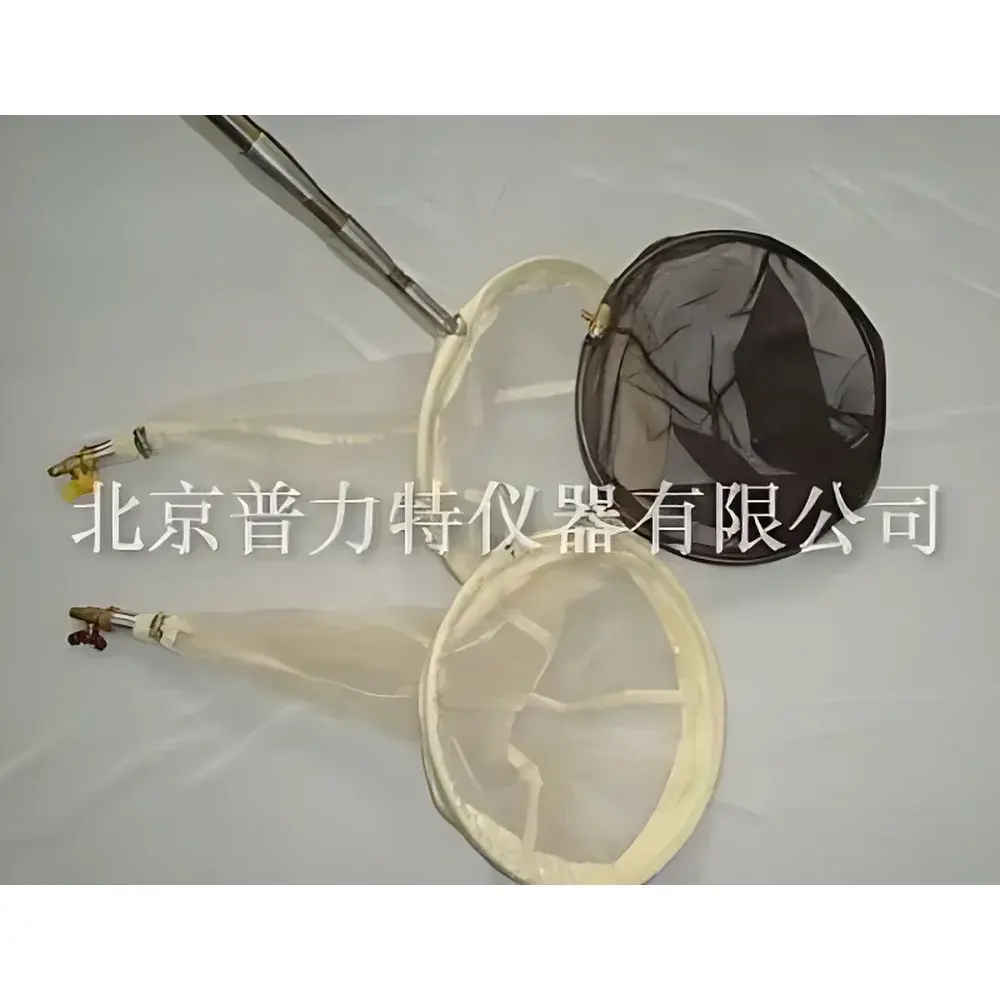
Handheld Plankton Net H-PTN by Beijing Pulite Instruments Co., Ltd.
| Origin | Beijing |
|---|---|
| Manufacturer Type | Distributor |
| Origin Category | Domestic (China) |
| Model | H-PTN |
| Price | Upon Request |
| Handle | Stainless steel telescopic, max length 2.5 m |
| Ring diameter | 30 cm, stainless steel |
| Net body | Nylon, 60 cm length |
| Bottom tube | Aluminum alloy with brass valve |
| Mesh aperture options | 0.064 mm, 0.112 mm, 1 mm |
Overview
The Handheld Plankton Net H-PTN is a field-deployable, manually operated water sampling instrument engineered for quantitative and qualitative collection of planktonic organisms from freshwater and marine environments. Designed in accordance with standard limnological and oceanographic sampling protocols, the H-PTN operates on the principle of passive filtration: as the net is towed vertically or horizontally through water—either from shore, pier, or small vessel—plankton are retained on the inner surface of the mesh while water passes freely. Its modular architecture enables rapid adaptation to target organism size classes, supporting taxonomic identification, biomass estimation, and ecological monitoring programs aligned with ISO 21977:2022 (Water quality — Guidance on plankton sampling) and EPA Method 1623.2 (for protozoan indicator organisms).
Key Features
- Modular mesh interchangeability: Three standardized conical net heads—0.064 mm (suitable for phytoplankton, small flagellates, and bacterial aggregates), 0.112 mm (optimized for microzooplankton including rotifers and nauplii), and 1.0 mm (designed for mesozooplankton such as cladocerans, copepodites, and early-stage crustacean larvae)—are secured via precision-machined stainless-steel threaded couplings for leak-free, repeatable installation.
- Ergonomic telescopic handle: A corrosion-resistant stainless-steel shaft extends from 1.2 m to 2.5 m, enabling adjustable sampling depth control without requiring wading or boat deployment in shallow littoral zones. The locking mechanism ensures rigidity during retrieval under load.
- Hydraulically stable frame geometry: The 30 cm diameter stainless-steel ring maintains consistent opening area across flow velocities up to 0.8 m/s, minimizing net collapse and ensuring representative volumetric filtration—critical for calculating plankton density per cubic meter (ind./m³).
- Contamination-minimized sample retention: The 60 cm nylon net body terminates in an aluminum alloy collecting tube fitted with a brass needle valve. This design prevents backflow during haul retrieval and allows sterile, sediment-free sample transfer into labeled cryovials or preservation vials without manual handling of the net interior.
- Durability and field serviceability: All structural components—including ring, handle, and bottom tube—are non-galvanic and saltwater-compatible. No adhesives or polymer welds are used; maintenance requires only periodic inspection of thread integrity and valve seating.
Sample Compatibility & Compliance
The H-PTN supports compliance with multiple environmental monitoring frameworks. Its mesh specifications align with the nominal pore sizes defined in ASTM D5116–21 (Standard Guide for Small-Scale Environmental Simulation) and WHO Guidelines for Safe Recreational Water Environments (2003). When deployed following standardized vertical haul protocols (e.g., from bottom to surface at ≤0.3 m/s), data generated are admissible in reports submitted to national water quality assessment programs, including China’s “Surface Water Environmental Quality Standards” (GB 3838–2002) and the EU Water Framework Directive (WFD) monitoring requirements for biological quality elements. Preservation compatibility includes formalin (4%), Lugol’s iodine, and RNAlater™ for subsequent molecular analysis.
Software & Data Management
As a manual, non-electronic sampling tool, the H-PTN does not incorporate embedded sensors or digital output. However, it integrates seamlessly into structured field data workflows. Each deployment should be documented using standardized metadata templates compliant with ISO 19115–1:2014 (Geographic information — Metadata), including GPS coordinates, depth interval, duration, ambient temperature, Secchi disk transparency, and mesh ID. Field logs may be digitized via mobile applications such as ODK Collect or ESRI Survey123, with optional linkage to laboratory information management systems (LIMS) for chain-of-custody tracking. For audit readiness under GLP or ISO/IEC 17025 environments, calibration records pertain solely to mesh certification—traceable to NIST-traceable sieve standards—and are maintained per manufacturer’s certificate of conformance.
Applications
- Baseline biodiversity surveys in reservoirs, lakes, rivers, and coastal embayments
- Monitoring seasonal succession of phyto- and zooplankton communities in response to nutrient loading or climate variability
- Early detection of harmful algal bloom (HAB) species such as Microcystis, Dinophysis, and Pseudo-nitzschia
- Evaluation of treatment efficacy in constructed wetlands and wastewater polishing ponds
- Training and education in aquatic ecology, environmental science, and fisheries biology curricula
- Supporting trophic state index (TSI) calculations and eutrophication assessment models
FAQ
Can the H-PTN be used in turbulent or high-flow river environments?
Yes—when deployed with controlled towing speed (<0.5 m/s) and stabilized by anchoring or two-person operation, the rigid ring and low-drag conical profile maintain effective filtration even at surface velocities up to 1.2 m/s. For highly turbid or debris-laden flows, pre-screening with a 2 mm guard mesh is recommended.
Is mesh certification provided with each net head?
Each H-PTN mesh head is supplied with a manufacturer-issued test certificate indicating nominal aperture, tolerance band (±5% per ISO 3310-1), and batch-specific sieve calibration traceability.
How should the net be cleaned and stored between uses?
Rinse thoroughly with deionized water after each use; air-dry inverted in shaded, low-humidity conditions. Store mesh heads separately in labeled, dust-proof containers. Avoid ethanol or acetone, which may degrade nylon tensile strength over time.
Does the brass valve meet potable water material safety standards?
The valve assembly complies with NSF/ANSI Standard 61 for incidental contact with drinking water sources, though the device itself is not intended for direct potable water abstraction.
Can the H-PTN be adapted for quantitative flow measurement?
Not natively—but when paired with a calibrated flowmeter (e.g., General Oceanics Model 2030) mounted upstream of the net mouth, volumetric throughput can be calculated for absolute abundance normalization (ind./m³).







