Flowatch Flow Velocity Meter (Swiss-Made Portable Anemometer & Hydrometer)
| Origin | Switzerland |
|---|---|
| Manufacturer Type | Authorized Distributor |
| Origin Category | Imported |
| Model | Flowatch |
| Pricing | Available Upon Request |
| Power Supply | 2 × 1.5 V AA batteries |
| Weight | 210 g |
| Cable | PUR-jacketed, robust flex |
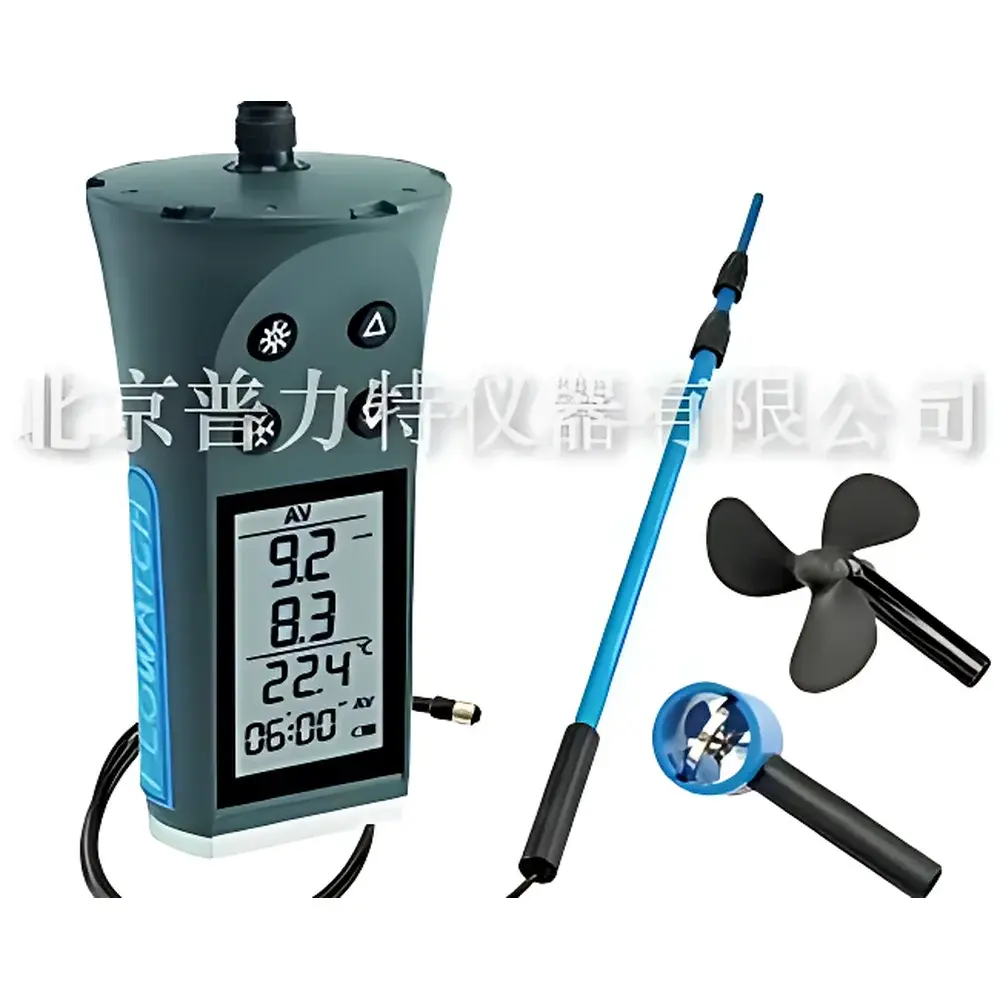
| Probe Rod | Telescopic, 2 m extended length |
| Display | Waterproof, backlit LCD |
| Measurement Interval | Configurable from 3 min to 24 h |
| Air Velocity Range | 0.3–51 km/h (0.2–32 mph) |
| Water Velocity Range | 0.1–14.2 m/s (0.3–51 km/h) |
| Air Velocity Resolution | 0.1 unit (selectable units: m/s, km/h, mph, knots, cm/s, fps) |
| Air Velocity Accuracy | ±2% of reading |
| Air Min. Sensitivity | <1 m/s (<3.6 km/h) |
| Air Off-Axis Error | ±30° / ±3% |
| Water Velocity Accuracy | ±2% of reading |
| Water Min. Sensitivity | <0.1 m/s (<0.3 km/h) |
| Water Off-Axis Error | ±20° / ±3% |
| Temperature Range | −30 °C to +50 °C (−22 °F to +122 °F) |
| Temperature Resolution | 0.1 °C / 0.1 °F |
| Temperature Accuracy | ±0.5 °C / ±1 °F |
| Operating Temp. | −50 °C to +100 °C (sensor housing) |
Overview
The Flowatch Flow Velocity Meter is a dual-medium, handheld velocity and temperature measurement instrument engineered for field-deployable precision in environmental monitoring, HVAC commissioning, hydrological surveying, and industrial process verification. Designed and calibrated in Switzerland, the device implements a dual-sensor architecture: a precision cup-type anemometer for gaseous media (air, exhaust streams, ventilation ducts) and a low-inertia propeller-based hydrometer optimized for open-channel and pipe-flow water applications. Its core measurement principle relies on rotational transduction—where fluid-induced angular velocity of the impeller is converted into digital velocity output via Hall-effect or optical pulse counting, with real-time compensation for temperature drift and axis misalignment. The instrument operates across extreme ambient conditions (−50 °C to +100 °C housing rating), enabling year-round deployment in alpine catchments, desert HVAC audits, or coastal marine environments.
Key Features
- Dual-mode operation: seamlessly switches between air and water velocity modes via dedicated hardware toggle—no software reconfiguration required.
- Multi-parameter real-time display: concurrently shows instantaneous velocity, maximum/minimum recorded velocity, arithmetic mean over user-defined interval, plus current, max, and min temperature—all on a single backlit, IP67-rated LCD screen.
- Configurable logging interval: programmable sampling frequency from 3 minutes to 24 hours, supporting long-term unattended monitoring without external data loggers.
- Telescoping probe rod (2 m extended): constructed from corrosion-resistant anodized aluminum, enabling safe, non-contact measurements in deep channels, high-velocity flumes, or ceiling-mounted ducts.
- PUR-jacketed cable (standard 1.5 m, extendable): provides superior abrasion resistance, UV stability, and flexibility down to −40 °C—critical for outdoor infrastructure inspections.
- Low-power architecture: two standard AA alkaline cells deliver >200 hours of continuous operation under typical field use; auto-sleep mode activates after 5 minutes of inactivity.
Sample Compatibility & Compliance
The Flowatch supports direct contact measurement in clean or mildly turbid aqueous media (e.g., rivers, irrigation canals, wastewater effluents, cooling towers) and in non-corrosive, particle-free gas streams (e.g., ambient air, compressed air lines, fume hood exhaust). It is not rated for submersion beyond 1 m depth or for use in explosive atmospheres (ATEX/IECEx). Calibration traceability follows ISO/IEC 17025 requirements through the Swiss manufacturer’s accredited metrology lab. While not certified for regulatory compliance per se, its ±2% velocity accuracy and documented calibration history support adherence to ASTM D3858 (Standard Test Method for Determining Average Velocity in Open Channels), ISO 7145 (Determination of flowrate of fluids in closed conduits), and EPA Method 2 (Velocity Traverse for Stack Gas Monitoring) when used within specified operating envelopes.
Software & Data Management
Data export is supported via optional USB-C interface (adapter sold separately), enabling direct transfer of time-stamped CSV files containing all measured parameters. The included desktop utility (Windows/macOS compatible) allows visualization of velocity vs. time profiles, statistical summary generation (mean, SD, CV%), and export to Excel or PDF report templates compliant with GLP documentation standards. Audit trail functionality records operator ID, calibration date, firmware version, and configuration changes—meeting foundational requirements of FDA 21 CFR Part 11 for electronic records in regulated laboratories conducting environmental QA/QC.
Applications
- Environmental science: streamflow assessment, wetland hydrology, sediment transport studies, and climate station wind profiling.
- Building services engineering: HVAC airflow balancing, duct leakage testing, and indoor air quality (IAQ) surveys per ASHRAE Standard 111.
- Water utilities: intake screening validation, pump station efficiency audits, and stormwater overflow characterization.
- Academic research: undergraduate fluid mechanics labs, field-based geoscience coursework, and citizen science water monitoring programs.
- Industrial hygiene: workplace ventilation verification, fume extraction system performance checks, and confined space entry pre-assessment.
FAQ
Can the Flowatch measure velocity in viscous or sediment-laden water?
It is designed for clear to moderately turbid water. High suspended solids (>500 mg/L) or oils may cause impeller fouling; routine cleaning with fresh water and soft brush is recommended.
Is temperature compensation applied automatically during velocity measurement?
Yes—temperature readings are acquired simultaneously with each velocity sample and used internally to correct for fluid density and sensor thermal drift, improving cross-media repeatability.
Does the device meet NIST-traceable calibration standards?
Calibration certificates issued by the Swiss manufacturer include NIST-traceable reference standards per ISO/IEC 17025, with full uncertainty budgets provided for both velocity and temperature channels.
What is the minimum measurable water velocity, and under what conditions is it achievable?
The stated minimum of 0.1 m/s assumes laminar, fully developed flow in a straight, smooth-walled channel with no surface turbulence or wave action—verified per ISO 7145 Annex B test protocols.
Can the Flowatch be used for gas flow in pressurized pipelines?
No—it is intended for atmospheric or near-atmospheric pressure applications only. For pressurized gas systems, a differential pressure or thermal mass flowmeter is required.