
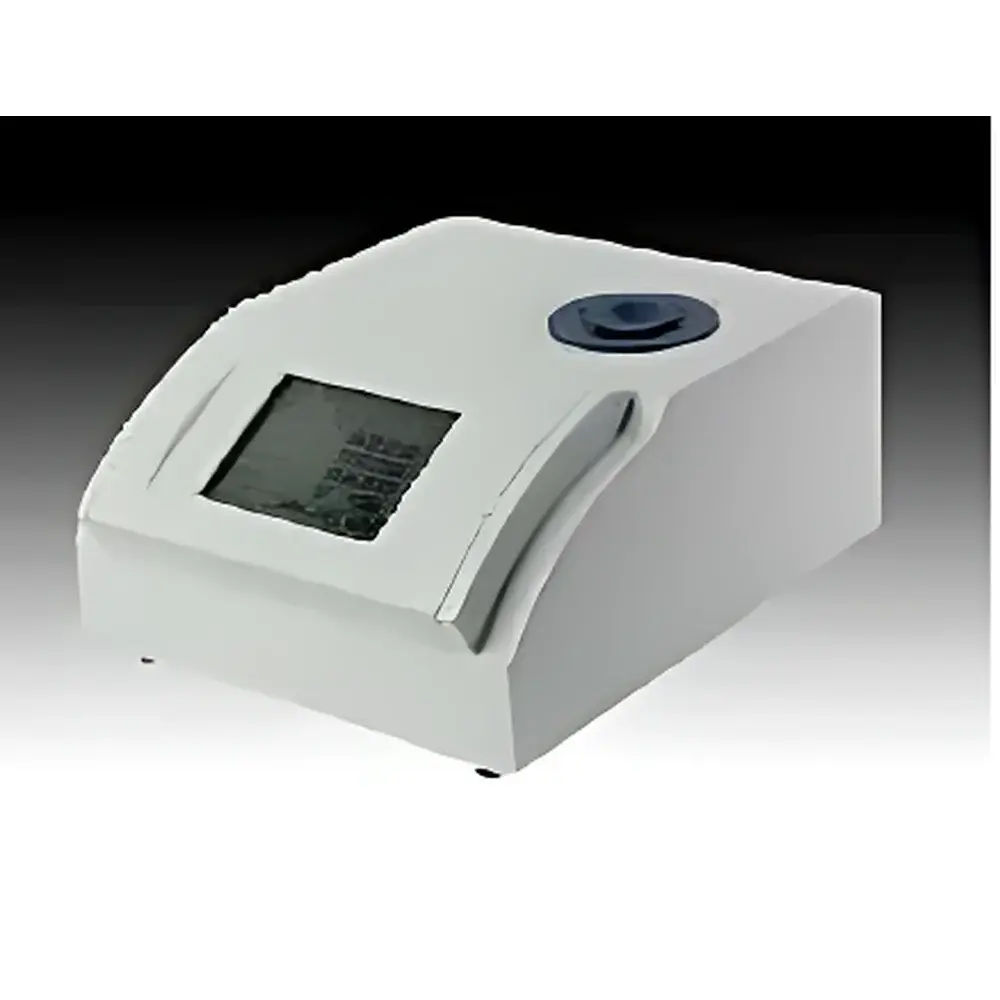
YDWG WRS-1C Digital Automatic Melting Point Apparatus
| Brand | YDWG |
|---|---|
| Origin | Shanghai, China |
| Model | WRS-1C |
| Temperature Range | Ambient to 400 °C |
| Heating Rate | 0.1–20.0 °C/min (continuously adjustable) |
| Temperature Repeatability | ±0.3 °C |
| Temperature Accuracy | ±0.4 °C ≤200 °C |
| Temperature Resolution | 0.1 °C |
| Capillary Dimensions | OD 1.4 mm, ID 1.0 mm, Length 90 mm |
| Sample Capacity | 1 capillary per run |
| Display | 5.7-inch graphical LCD with touch interface |
| Control System | Digital PID + PWM temperature regulation using Pt100 sensor |
| Data Storage | 1000 measurement records |
| Communication Interfaces | RS232 and USB |
| Power Supply | 220 V ±10%, 50 Hz |
| Dimensions (W×D×H) | 360 × 290 × 170 mm |
| Net Weight | 9 kg |
Overview
The YDWG WRS-1C Digital Automatic Melting Point Apparatus is a precision thermal analysis instrument engineered for reliable, operator-independent determination of melting point ranges in solid organic compounds, pharmaceuticals, polymers, and reference standards. It operates on the principle of optical detection of phase transition—specifically, the onset and completion of solid-to-liquid transformation—as observed through a high-contrast capillary tube under controlled linear heating. The system employs a calibrated Pt100 platinum resistance thermometer as the primary temperature sensing element, coupled with digital PID feedback control and pulse-width modulation (PWM) heating regulation to ensure stable, reproducible thermal ramping across its full operating range (ambient to 400 °C). Designed in accordance with pharmacopoeial requirements—including USP , EP 2.2.17, and ChP IV—this apparatus uses standard 1.4 mm OD × 1.0 mm ID × 90 mm glass capillaries, enabling direct comparability with regulatory test protocols.
Key Features
- Precision optical detection system with real-time photodiode-based monitoring of sample opacity changes during melting
- Graphical 5.7-inch LCD touchscreen interface supporting intuitive parameter configuration, live curve visualization, and on-device result review
- Digitally implemented PID algorithm with adaptive tuning for consistent ramp fidelity across the full 0.1–20.0 °C/min range (±10% linearity tolerance per ISO 8677)
- Multi-point temperature calibration capability, traceable to NIST-certified reference materials
- Embedded non-volatile memory storing up to 1000 complete measurement records—including date/time stamp, heating rate, start/end temperatures, and user ID
- Dual communication interfaces (RS232 and USB) compliant with standard virtual COM port drivers for seamless integration into LIMS or QA documentation workflows
- Robust mechanical design featuring thermally isolated optical path, low-drift heating block, and passive cooling assist for rapid cycle turnaround
Sample Compatibility & Compliance
The WRS-1C accommodates single-sample analysis per cycle using pharmacopeia-compliant capillaries (1.4 mm OD, 1.0 mm ID, 90 mm length), with optimal sample fill height of 3–5 mm. It supports crystalline and semi-crystalline solids including APIs, excipients, fine chemicals, and polymer intermediates. All operational parameters—including heating rate selection, data logging intervals, and alarm thresholds—are configurable to align with internal SOPs and external regulatory expectations. The instrument meets essential safety and electromagnetic compatibility requirements per IEC 61010-1 and EN 61326-1. While not certified for GMP environments out-of-the-box, its audit-ready data export, timestamped records, and calibration traceability support validation under FDA 21 CFR Part 11 when deployed with appropriate procedural controls and electronic signature policies.
Software & Data Management
Data acquisition and reporting are supported via bidirectional serial/USB connectivity. Raw temperature vs. time profiles, detected onset/offset points, and metadata (operator, date, method ID) are exportable in CSV format for post-processing in Excel, MATLAB, or validated analytical software. Optional PC software provides method templating, batch report generation, and trend analysis across historical datasets. All stored measurements include immutable timestamps and retain full context—including actual heating rate deviation logs—for GLP-compliant record retention. No proprietary runtime or cloud dependency is required; local storage and transfer operate independently of third-party platforms.
Applications
- Pharmaceutical quality control: Identity verification and purity assessment of active pharmaceutical ingredients per USP/EP monographs
- Chemical synthesis validation: Confirmation of product crystallinity and batch-to-batch consistency in R&D laboratories
- Academic research: Thermal behavior characterization of novel organic frameworks and metal-organic compounds
- Regulatory submissions: Generation of melting point data for ICH Q5C stability studies and dossier preparation
- Educational use: Hands-on instruction in thermal analysis principles, phase transition theory, and pharmacopeial compliance
FAQ
What capillary specifications are required for compliant operation?
Standard pharmacopeial capillaries with 1.4 mm outer diameter, 1.0 mm inner diameter, and 90 mm length must be used. Sample fill height should be 3–5 mm for optimal optical detection sensitivity.
Is the instrument suitable for GMP-regulated environments?
Yes—when paired with documented calibration procedures, electronic signature implementation, and audit trail configuration, the WRS-1C supports 21 CFR Part 11 compliance for electronic records and signatures.
How is temperature accuracy verified during routine use?
The unit supports multi-point calibration using certified reference standards (e.g., indium, tin, zinc) traceable to NIST SRMs. Calibration data is stored internally and linked to each measurement session.
Can multiple samples be analyzed sequentially without manual intervention?
No—the WRS-1C is a single-capillary system requiring manual sample loading between runs. However, automated data capture and rapid cooldown reduce overall cycle time to under 5 minutes per measurement.
What file formats are supported for data export?
Measurements export natively as UTF-8 encoded CSV files containing time-stamped temperature readings, detected melt events, and method parameters—fully compatible with statistical process control (SPC) and LIMS ingestion pipelines.



