
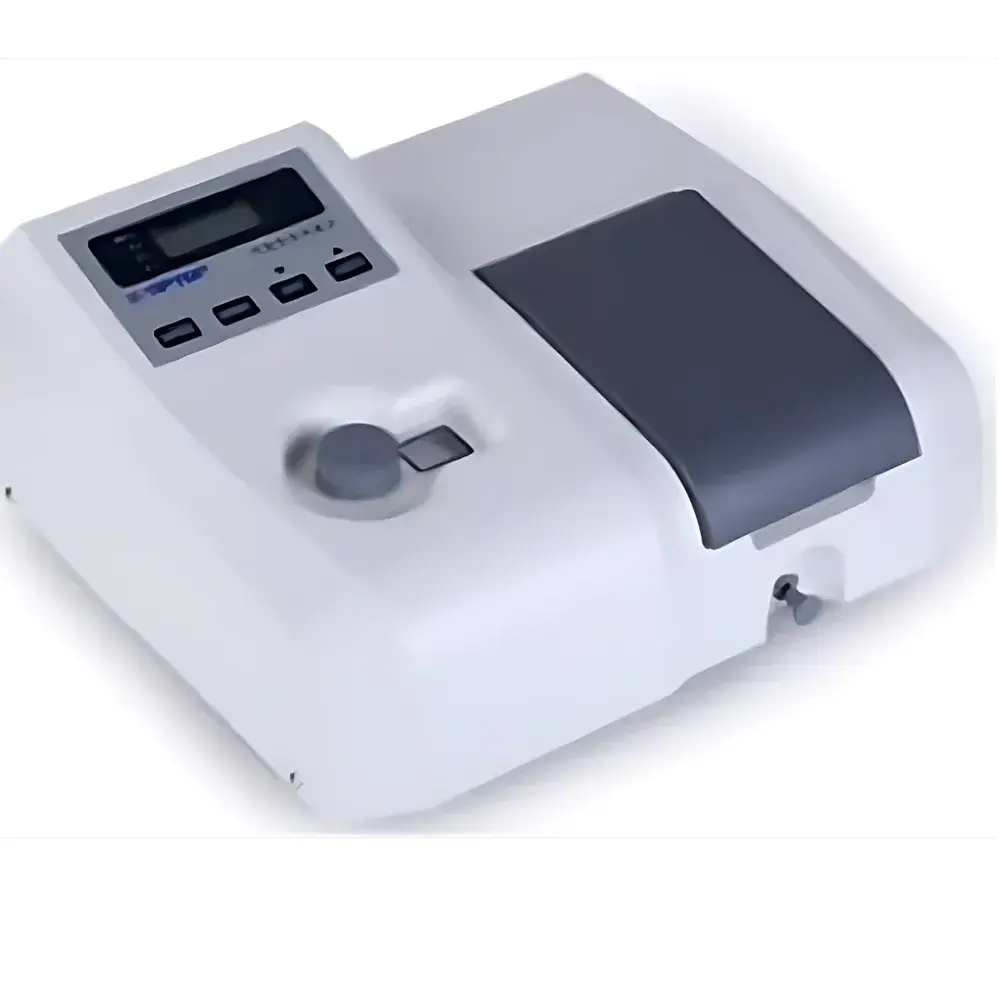
SOPOTOP 721 & 722 Visible Spectrophotometers
| Brand | SOPOTOP |
|---|---|
| Origin | Shanghai, China |
| Model | 721 (330–1000 nm), 722 (325–1000 nm) |
| Optical System | Single-beam |
| Detector | Silicon photodiode |
| Wavelength Range | 330–1000 nm (721), 325–1000 nm (722) |
| Spectral Bandwidth | 5 nm (721), 4 nm (722) |
| Wavelength Accuracy | ±2 nm |
| Wavelength Repeatability | ≤1.0 nm |
| Stray Light | ≤0.5%T at 360 nm |
| Photometric Accuracy | ±0.5%T |
| Photometric Repeatability | ≤0.2%T |
| Display | Backlit LCD |
| Zero/100%T Auto-adjustment | Yes |
| Concentration Mode | Direct readout with user-defined factor |
| Power Supply | 220 V ±10%, 50 Hz |
| Dimensions | 470 × 350 × 200 mm |
| Weight | 8 kg |
Overview
The SOPOTOP 721 and 722 Visible Spectrophotometers are single-beam, manually operated analytical instruments engineered for reliable quantitative absorbance and transmittance measurements across the visible spectrum. Based on classical Beer–Lambert law principles, these spectrophotometers utilize a self-collimating monochromator equipped with a 1200-line/mm holographic grating to isolate discrete wavelengths. Light from a 20 W/12 V tungsten-halogen source passes through the sample compartment and is detected by a silicon photodiode — a robust, temperature-stable sensor well-suited for routine laboratory applications requiring moderate spectral resolution and high photometric reproducibility. Designed for accessibility without compromise in core optical performance, the 721 and 722 models serve as foundational tools in teaching laboratories, quality control environments, and field-deployable analytical workflows where regulatory-grade validation is not mandated but consistent, traceable results are essential.
Key Features
- Backlit LCD display for clear visibility under varied ambient lighting conditions
- Integrated auto-zero (0%T) and auto-100%T calibration functions to minimize operator-induced drift between blank and sample measurements
- Direct concentration readout mode with programmable concentration factor — enabling rapid calculation of analyte concentration without manual data transformation
- Dual-model configuration: 721 covers 330–1000 nm; 722 extends low-end sensitivity to 325 nm with narrower 4 nm spectral bandwidth for improved resolution in critical regions such as the violet edge of the visible range
- Mechanically stable optical bench and rigid aluminum housing ensure long-term alignment retention and resistance to mechanical shock during transport or daily handling
- No external software dependency — all operations executed via front-panel controls, reducing IT infrastructure requirements and cybersecurity exposure
Sample Compatibility & Compliance
The SOPOTOP 721/722 accommodates standard 10 mm pathlength cuvettes (glass or plastic), supporting both liquid and semi-transparent solid samples compatible with visible-range absorption. While not certified for GLP/GMP-regulated production environments, the instrument meets fundamental metrological requirements outlined in ISO 6223 (spectrophotometer performance verification) and ASTM E275 (standard practices for describing and measuring performance of ultraviolet, visible, and near-infrared spectrophotometers). Its ±2 nm wavelength accuracy and ≤0.2%T photometric repeatability align with educational and industrial QC specifications for non-critical assays — including dye concentration monitoring, enzyme kinetics screening (e.g., NADH/NADPH at 340 nm), and basic water quality testing (e.g., nitrate/nitrite via colorimetric reagents). No compliance documentation is provided for FDA 21 CFR Part 11 or EU Annex 11; however, raw absorbance/transmittance values are directly recordable in lab notebooks or LIMS-compatible spreadsheets.
Software & Data Management
These instruments operate independently of proprietary software — data acquisition and processing occur entirely via manual entry and analog-style readouts. The backlit LCD displays transmittance (%T), absorbance (Abs), and concentration (C) simultaneously when enabled. While no USB or RS-232 interface is included, users may document measurements using external digital loggers or integrate readings into validated electronic lab notebooks (ELN) via manual transcription. For institutions requiring audit trails, SOPOTOP recommends pairing the device with a standardized measurement protocol that includes timestamped operator ID, calibration date, cuvette lot number, and environmental conditions (e.g., ambient temperature and humidity), satisfying basic ALCOA+ data integrity expectations for non-GxP contexts.
Applications
- Educational laboratories: Teaching fundamental spectroscopic concepts, calibration curve construction, and Beer’s law validation
- Food & beverage QA: Color intensity assessment (e.g., anthocyanin in juices), preservative quantification (e.g., sulfites), and turbidity screening
- Environmental testing: Phosphate, iron, and copper determination using APHA-approved colorimetric methods
- Pharmaceutical R&D support: Excipient compatibility studies and dissolution profile monitoring at fixed wavelengths
- Agricultural labs: Chlorophyll extraction analysis, soil extract nutrient screening (e.g., phosphorus via molybdenum blue method)
- Industrial process control: Dye bath concentration checks in textile manufacturing and pigment dispersion uniformity verification
FAQ
What is the primary difference between the 721 and 722 models?
The 722 model features a wider wavelength range (325–1000 nm vs. 330–1000 nm) and a narrower spectral bandwidth (4 nm vs. 5 nm), offering enhanced resolution near the UV–visible boundary.
Can this instrument be used for UV-range measurements below 325 nm?
No — neither model supports wavelengths below their specified lower limits due to optical cutoff characteristics of the tungsten-halogen source and grating efficiency profile.
Is wavelength calibration traceable to NIST standards?
Factory calibration uses internal reference filters; users may perform periodic verification using certified holmium oxide or didymium glass filters compliant with ISO 6223 Annex B.
Does the instrument support kinetic or scanning modes?
No — both models are fixed-wavelength, single-point measurement devices; spectral scanning requires external automation or alternative instrumentation.
What maintenance is required to sustain photometric accuracy?
Annual cleaning of the monochromator slit and cuvette holder, biannual verification of 0%T and 100%T stability, and replacement of the tungsten-halogen lamp every 1,000 operating hours or per visible output degradation.




