
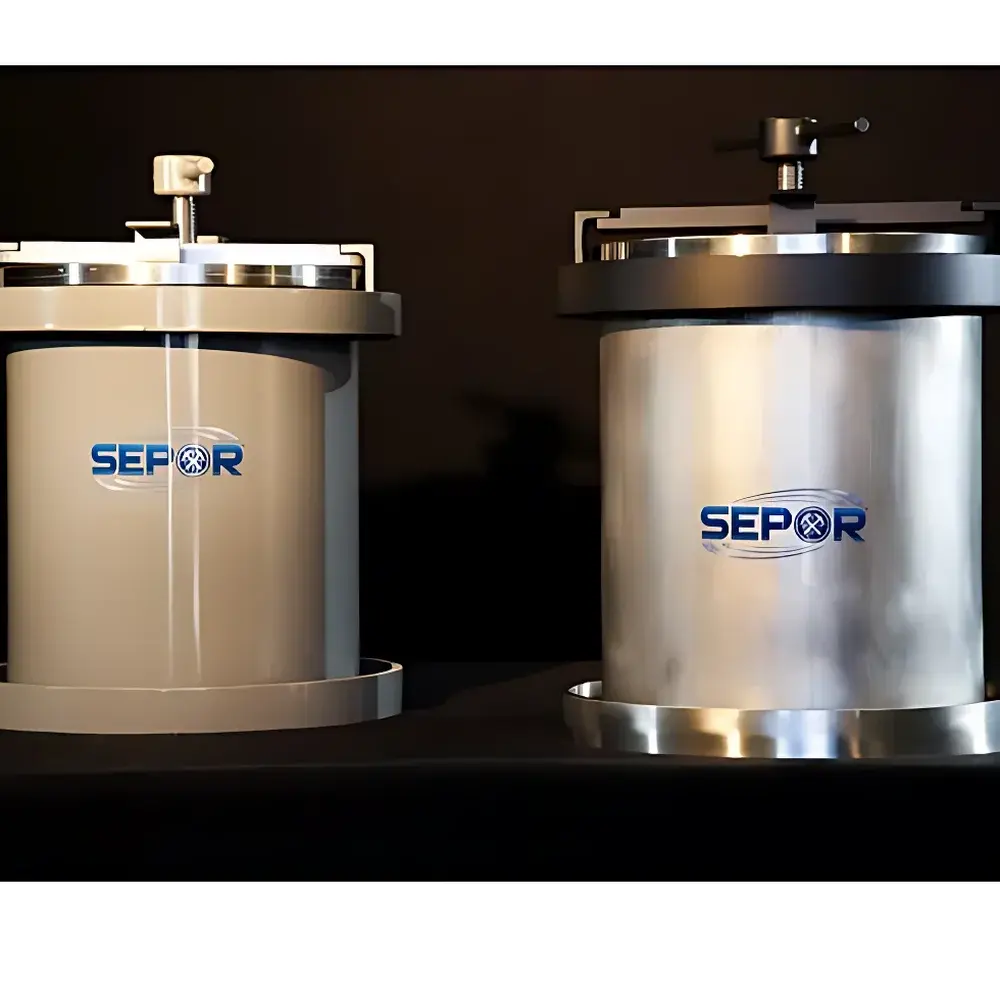
Sepor 010E-007/008/013/01 Batch Ball or Rod Mill Container
| Origin | USA |
|---|---|
| Manufacturer Type | Authorized Distributor |
| Origin Category | Imported |
| Model | 010E-007 / 008 / 013 / 01 |
| Pricing | Upon Request |
Overview
The Sepor 010E-Series Batch Ball or Rod Mill Containers are precision-engineered laboratory-scale grinding vessels designed for controlled size reduction of mineral ores, geological samples, and brittle industrial materials. These containers operate on the principle of tumbling attrition—where rotational motion imparts kinetic energy to grinding media (steel balls or rods), inducing impact, shear, and compressive forces that fracture feed particles. Unlike continuous mills, batch configurations enable strict control over residence time, charge ratio, and process repeatability—critical for metallurgical assay development, comminution energy studies, and comparative grindability testing (e.g., Bond Work Index determination per ASTM E325 and ISO 8684). Constructed for durability under cyclic mechanical stress, each vessel integrates a rigid cylindrical shell with precisely machined rolling surfaces and sealing interfaces to maintain containment integrity during high-intensity operation.
Key Features
- Robust construction in either low-carbon steel (010E-007/008/015/016) or 304 stainless steel (010E-013/014/098/099), optimized for corrosion resistance and wear longevity in wet or dry environments.
- Standard internal dimensions: 8-inch (203 mm) diameter × 10.5-inch (267 mm) length, yielding a total volumetric capacity of 8 L (2.1 US gal) and an effective working volume of 1.4–2.0 L (35–50% fill level).
- Integrated four-lift-bar design within the grinding cylinder ensures consistent media cascading and uniform energy distribution across the charge.
- Machined rolled ring and threaded detachable yoke facilitate rapid assembly/disassembly; chloroprene rubber gasket (010E-010 spare included) provides leak-tight sealing under dynamic load conditions.
- Compatible with Sepor’s dual-diameter drive roller systems—5-inch (recommended) or 2-inch diameter rollers—both equipped with variable-speed AC drives to achieve precise rotational control.
- Validated operational speed ranges: 56–70 RPM for ball milling (60–75% of critical speed); 47–79 RPM for rod milling (50–90% of critical speed), ensuring optimal media trajectory without centrifuging.
Sample Compatibility & Compliance
These containers accept feed material with maximum particle sizes of ≤3.2 mm (–1/8″) for ball milling and ≤12.7 mm (–1/2″) for rod milling—aligning with standard preparation protocols for ASTM D3403 (grindability of coal) and ISO 10837 (ore hardness classification). The 20–40% volumetric loading (1.4–2.0 L solids + media) supports reproducible mass balance calculations required in GLP-compliant assay workflows. All stainless-steel variants meet FDA-compliant surface finish standards (Ra ≤ 0.8 µm) for applications involving pharmaceutical intermediates or food-grade minerals. Units comply with CE machinery directive 2006/42/EC when operated with certified Sepor drive systems.
Software & Data Management
While the 010E-Series containers themselves are mechanical components without embedded electronics, they are fully interoperable with Sepor’s digital drive controllers featuring RS-485 communication, real-time RPM logging, and programmable ramp profiles. When integrated into validated laboratory systems, operational parameters—including run duration, speed setpoints, and start/stop timestamps—can be captured in audit-trail-enabled LIMS platforms compliant with 21 CFR Part 11 requirements. Optional data acquisition modules support synchronization with torque sensors and temperature probes for energy input correlation studies.
Applications
- Metallurgical testwork: Bond ball mill work index (BBWI) and rod mill work index (RWI) determinations per ASTM E2517 and SAGDesign protocols.
- Mineral liberation analysis: Controlled grinding prior to SEM-EDS or QEMSCAN sample preparation.
- Geochemical reference material homogenization: Achieving sub-10 µm D90 particle distributions for ICP-MS digestion consistency.
- Ceramic and catalyst precursor milling: Dry grinding of alumina, zirconia, or zeolite powders under inert atmosphere glovebox integration.
- Recycling R&D: Size reduction of spent lithium-ion battery cathode materials for hydrometallurgical leaching optimization.
FAQ
What is the recommended media charge weight for these containers?
A minimum of 20 lb (9.1 kg) of grinding media (balls or rods) is required, with solids occupying 25–40% of total vessel volume.
Can these containers be used for wet grinding with aggressive solvents?
Yes—stainless-steel variants (010E-013/014/098/099) are chemically resistant to aqueous acids, alcohols, and acetone; low-carbon steel units require corrosion-inhibiting additives in acidic slurries.
Is the chloroprene gasket suitable for elevated temperature operation?
Chloroprene retains sealing integrity up to 80°C (176°F); for >100°C applications, fluorocarbon (FKM) gasket kits are available as field upgrades.
How is critical speed calculated for these vessels?
Critical speed (RPM) = 42.3 / √D, where D is internal diameter in meters (0.203 m → ~93.5 RPM); operational range is derived from this theoretical value.
Are spare parts such as lift bars or yokes available separately?
Yes—Sepor part numbers for replacement lift bars (010E-LB), yokes (010E-YK), and machined lids (010E-LID) are documented in the official service manual v3.2.






