
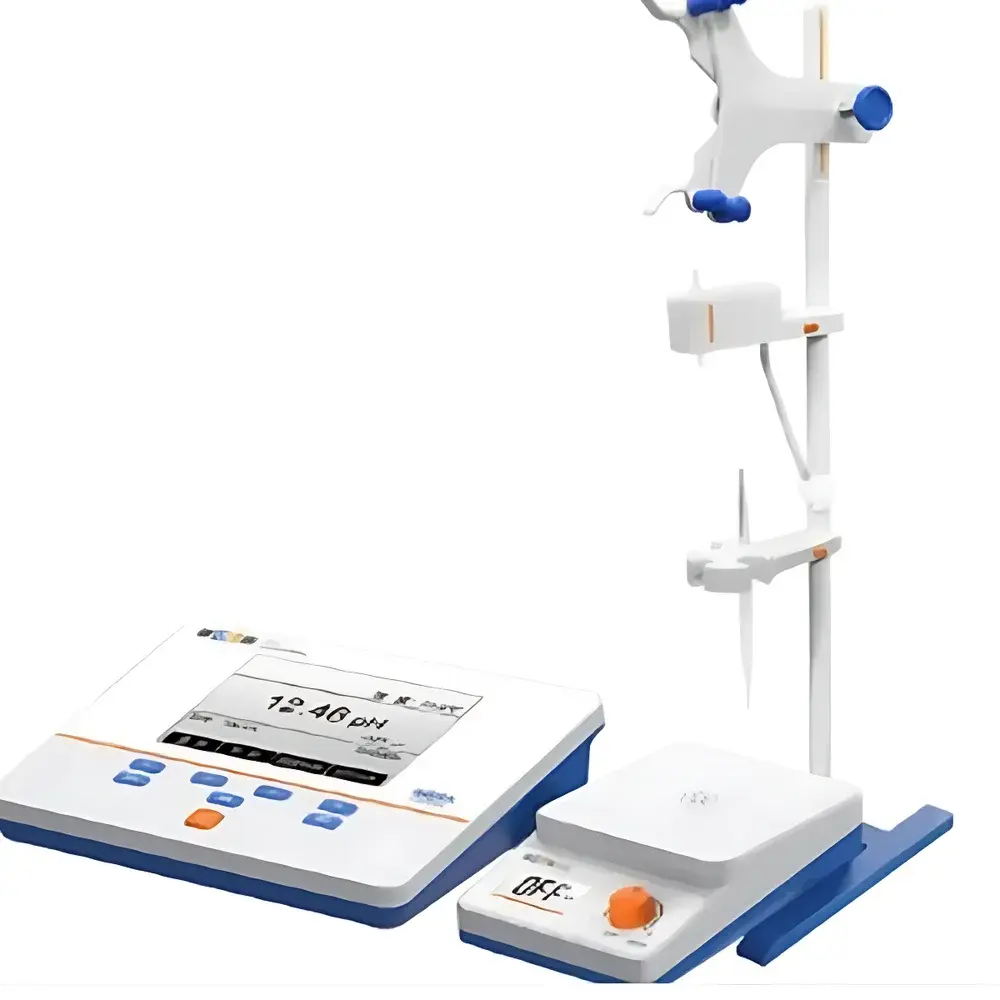
Leici ZD-2 Automatic Potentiometric Titrator
| Brand | Leici |
|---|---|
| Origin | Shanghai, China |
| Model | ZD-2 |
| Instrument Type | General-purpose Potentiometric Titrator |
| pH Range | 0.00–14.00 |
| mV Range | −1400 to +1400 mV |
| Temperature Range | 0–100 °C |
| pH Resolution | 0.01 pH |
| mV Resolution | 1 mV |
| pH Accuracy | ±0.03 pH ±1 digit |
| mV Accuracy | ±0.35% of full scale |
| Stability | ±0.01 pH / 3 h |
| Input Impedance | ≥3 × 10¹¹ Ω |
| Power Supply | AC 220 V ±10%, 50 Hz ±1 Hz |
| Dimensions (W×D×H) | 300 × 235 × 100 mm |
| Weight | 3 kg |
Overview
The Leici ZD-2 Automatic Potentiometric Titrator is a benchtop electrochemical instrument engineered for precision and reproducibility in volumetric titration based on potentiometric endpoint detection. It operates on the fundamental principle of monitoring potential change (mV) across a high-impedance indicator electrode—typically a glass pH electrode or redox-sensitive sensor—as titrant is incrementally delivered into the analyte solution. The inflection point in the resulting E–V curve (potential vs. titrant volume) defines the stoichiometric endpoint, enabling quantitative determination of acid–base, redox, precipitation, and complexometric reactions. Designed for routine laboratory environments—including QC labs, academic teaching facilities, and industrial process control settings—the ZD-2 implements classical potentiometric titration methodology with robust analog signal conditioning, low-drift circuitry, and stable reference electrode interface architecture. Its 0.5-class metrological rating per GB/T 9724–2007 (equivalent to ISO 8655-5 compliance for titration instruments) ensures traceable performance suitable for method validation under GLP conditions.
Key Features
- Triple-mode titration operation: manual stepwise addition, automatic endpoint-driven titration, and constant-pH (potentiostatic) titration for controlled pH maintenance during reaction kinetics studies
- Electromagnetically actuated solenoid valve for precise, pulse-width-modulated reagent delivery—minimizing dead volume and carryover between runs
- Dedicated endpoint delay circuitry to suppress false triggering caused by slow electrode response or solution equilibration lag
- High-input-impedance (>3 × 10¹¹ Ω) measurement circuitry optimized for compatibility with standard combination pH electrodes and ion-selective sensors
- Integrated real-time display of pH, mV, and temperature values with simultaneous dual-parameter logging capability
- Compact form factor (300 × 235 × 100 mm) and lightweight design (3 kg) for space-constrained workbenches and portable deployment in field laboratories
Sample Compatibility & Compliance
The ZD-2 supports aqueous and mildly polar non-aqueous matrices typical of pharmaceutical assay, water quality testing, food acidity analysis, and electroplating bath monitoring. It interfaces directly with Leici JB-1A magnetic stirrers (included), ensuring homogeneous mixing without introducing ground-loop interference. All electrical components conform to IEC 61010-1:2010 safety standards for laboratory equipment. While the instrument does not embed digital audit trails or electronic signature functionality, its analog output and manual record-keeping workflow align with basic GMP Annex 11 and USP guidance for non-computerized analytical systems. Calibration verification follows ASTM E2064–22 procedures for pH meter validation, and endpoint reproducibility meets ISO 7870-2:2013 requirements for control chart-based process consistency assessment.
Software & Data Management
The ZD-2 is a standalone hardware platform with no embedded microprocessor or digital data storage. Measurement values are displayed in real time on an integrated LED screen and recorded manually or via external analog chart recorder (0–10 mV output optional). For laboratories requiring digital archiving, the instrument may be coupled with third-party DAQ systems using its analog mV/pH output terminals. Though lacking native CSV export or LIMS integration, its deterministic endpoint logic and stable analog signal path support straightforward method transfer to validated software-controlled titrators during scalability phases. Users performing regulated testing are advised to implement paper-based SOPs documenting calibration frequency (daily pH buffer checks recommended), electrode maintenance logs, and endpoint confirmation criteria (e.g., second-derivative peak detection threshold ≥5 mV/mL).
Applications
- Determination of total acidity in fruit juices and vinegar per AOAC 973.05
- Chloride quantification in drinking water via argentometric titration (ISO 9297)
- Free fatty acid content in edible oils (AOCS Cd 3d-63)
- Calcium hardness in boiler feedwater (ASTM D1126)
- Endpoint verification in Karl Fischer moisture titration setups (when used as auxiliary potentiometric controller)
- Teaching core concepts of electrochemical equilibrium and titration curve analysis in undergraduate chemistry curricula
FAQ
What electrode types are compatible with the ZD-2?
The instrument accepts standard BNC-input pH electrodes, redox electrodes (Pt or Ag/AgCl), and ion-selective electrodes with high-impedance output—provided their output voltage remains within the −1400 to +1400 mV range.
Does the ZD-2 support GLP-compliant data integrity?
No. As an analog-only instrument without electronic records, audit trail, or user access controls, it requires supplementary procedural controls (e.g., bound logbooks, dual-signature calibration entries) to satisfy GLP documentation requirements.
Can the ZD-2 perform back-titration or multi-step titrations?
Yes—via manual mode and programmable endpoint thresholds; however, automated sequence logic (e.g., pause → add reagent → resume) is not supported without external timer or relay integration.
Is temperature compensation automatic?
No. Temperature is measured and displayed (0–100 °C), but pH readings are not automatically compensated; users must apply Nernst equation corrections or use ATC-equipped electrodes externally.
What maintenance is required for long-term accuracy?
Monthly verification against certified pH buffers (4.01, 7.00, 10.01), biweekly cleaning of the solenoid valve with dilute ethanol, and annual calibration of the mV channel using certified voltage standards per ISO/IEC 17025 guidelines.






