
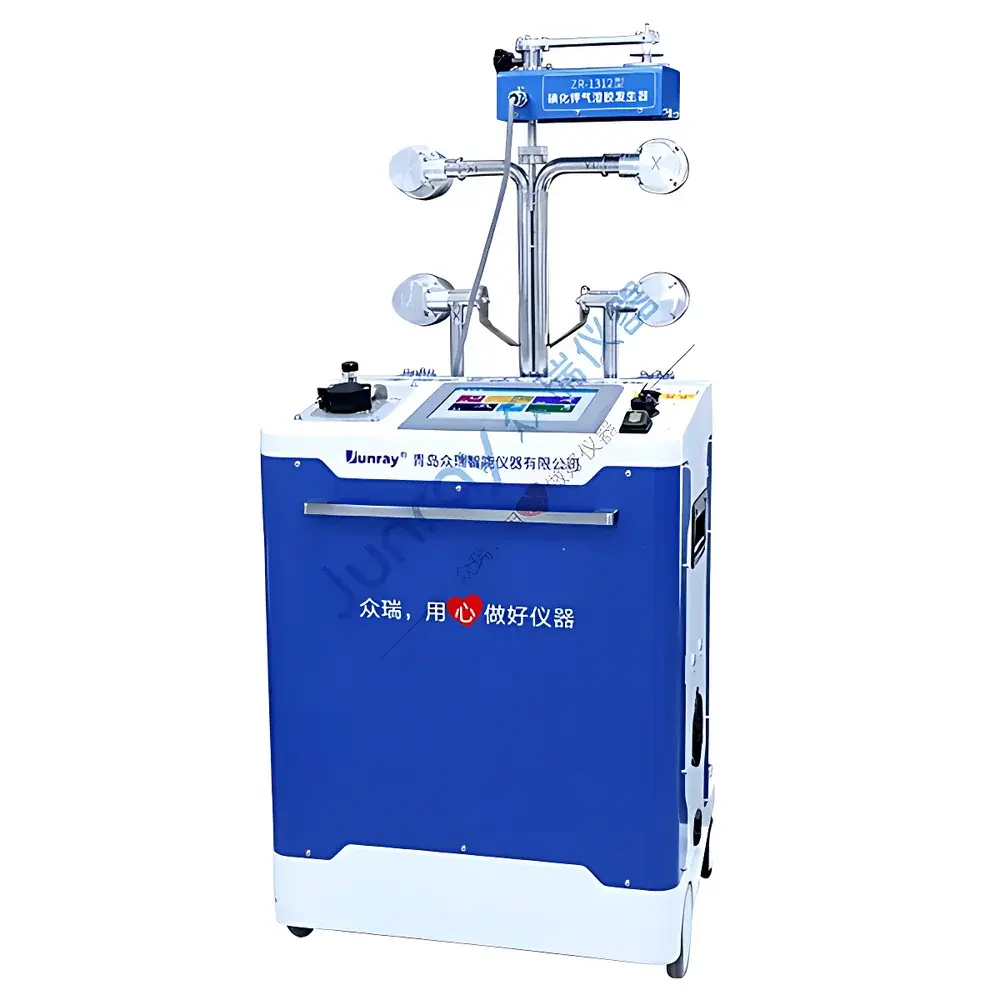
Junray ZR-1013 Biological Safety Cabinet (BSC) Performance Tester
| Brand | Junray |
|---|---|
| Origin | Shandong, China |
| Manufacturer Type | Direct Manufacturer |
| Product Category | Domestic |
| Model | ZR-1013 |
| Instrument Class | Class II Biological Safety Cabinet |
| Dimensions (L×W×H) | 450 × 380 × 600 mm |
| Internal Chamber Dimensions | Ø62 mm × 1000 mm (cylindrical sampling duct) |
| Filter Challenge Efficiency | 98% (KI aerosol, ≥0.3 µm) |
Overview
The Junray ZR-1013 Biological Safety Cabinet (BSC) Performance Tester is a dedicated, metrologically traceable instrument engineered for quantitative verification of containment integrity and airflow performance in Class II biological safety cabinets. It implements the potassium iodide (KI) aerosol challenge method—recognized as a primary reference test under YY 0569–2011, JJF 1815–2020, and DB52/T 1254–2017—to assess three critical protection parameters: personnel protection (inward airflow containment), product protection (downflow uniformity and velocity), and cross-contamination control (air curtain integrity and recirculation efficiency). Unlike optical or particle-counting alternatives, the KI method provides direct, physicochemical evidence of aerosol penetration through cabinet sashes and seams, making it indispensable for GLP-compliant facility validation, routine maintenance audits, and regulatory readiness assessments in clinical laboratories, biosafety level 2 (BSL-2) facilities, pharmaceutical QC labs, and academic research cores.
Key Features
- Integrated KI aerosol generator with patented high-speed rotating disc design—mechanically stabilized to prevent disc ejection during operation; equipped with real-time rotational speed feedback and automatic audible/visual activation indicators for operator safety.
- Four independent, high-stability sampling modules with precision electronic mass flow control (±2% full-scale accuracy), eliminating manual pressure adjustment and ensuring reproducible volumetric draw across all test configurations.
- Dedicated KI-specific aerosol capture probe with >95% collection efficiency at 0.3–3.0 µm particle range; optimized geometry minimizes turbulence-induced deposition loss in the sampling duct (Ø62 mm × 1000 mm).
- 8-inch HD capacitive touchscreen interface with bilingual (English/Chinese) firmware—supports intuitive navigation between Personnel Protection, Product Protection, and Cross-Contamination Test modes, each executable via single-button initiation or modular stepwise execution.
- Onboard rechargeable lithium-ion battery enabling full functionality—including data logging, USB export, and Bluetooth thermal printing—for field-deployable testing without AC dependency.
- Modular height-adjustable sampling支架 with integrated fluidic routing—no external tubing required—ensuring rapid setup and consistent probe positioning relative to sash opening, work surface, and front grille.
Sample Compatibility & Compliance
The ZR-1013 is validated exclusively for Class II BSCs (Types A1, A2, B1, and B2) per YY 0569–2011 structural and performance requirements. Its KI aerosol challenge protocol satisfies the mandatory acceptance criteria defined in JJF 1815–2020 for calibration laboratories performing accredited BSC verification. The system meets essential electrical safety (GB 4793.1) and electromagnetic compatibility (GB/T 18268.1) standards applicable to laboratory instrumentation in China. While not CE-marked or FDA 510(k)-cleared, its measurement methodology aligns with internationally accepted principles referenced in ISO 14644-3 (cleanroom testing) and NSF/ANSI 49 (BSC certification)—making it suitable for internal quality assurance, pre-certification functional checks, and technical documentation support in regulated environments operating under GLP or GMP-aligned SOPs.
Software & Data Management
Firmware supports timestamped test record generation with embedded metadata: test type, cabinet model/ID, operator ID, ambient temperature/humidity (via optional external sensor input), aerosol generation duration, total sampled volume per channel, and calculated penetration percentages. Data export is supported via USB 2.0 (CSV format) and Bluetooth 4.2 (to certified thermal printers). Audit trail functionality includes user login history, parameter modification logs, and firmware version stamping—enabling basic compliance with FDA 21 CFR Part 11 expectations for electronic records when deployed within controlled IT environments. No cloud connectivity or remote access features are implemented, preserving data sovereignty and network isolation requirements typical of BSL-2 infrastructure.
Applications
- Routine annual or semi-annual BSC performance verification in hospital microbiology and virology labs.
- Pre- and post-maintenance validation following filter replacement, fan servicing, or sash alignment.
- Commissioning support for new BSC installations prior to operational qualification (OQ).
- Training and competency assessment for biosafety officers and lab technicians on KI-based containment evaluation.
- Technical documentation generation for CNAS (China National Accreditation Service) or CMA (China Metrology Accreditation) audit submissions.
- Comparative studies of airflow dynamics across different BSC models or installation configurations (e.g., room ventilation interference).
FAQ
What aerosol agent does the ZR-1013 use, and why is KI preferred for BSC validation?
The instrument uses potassium iodide (KI) aerosol generated via centrifugal atomization. KI is specified in YY 0569 and JJF 1815 because its hygroscopic particles grow to ~0.3–1.0 µm under ambient humidity—matching the most penetrating particle size (MPPS) for HEPA filters—and provide quantifiable colorimetric detection after impaction on sampling filters.
Can the ZR-1013 be used for Class III BSCs or laminar flow hoods?
No. It is designed and calibrated only for Class II cabinets per YY 0569. Class III systems require sealed glovebox testing protocols, while laminar flow hoods lack recirculation pathways and are assessed using different standards (e.g., ISO 14644-1).
Is external calibration of the aerosol generator required?
Yes. The KI generator must be periodically recalibrated against gravimetric or photometric reference methods per JJF 1815–2020 Section 6.3. Junray provides NIST-traceable calibration certificates upon request.
Does the device meet international regulatory requirements such as ISO 14644 or NSF/ANSI 49?
It implements test procedures consistent with the physical principles underlying those standards but is not independently certified to them. Its output supports compliance evidence generation when interpreted within a broader QA framework.
How long does a full three-mode test sequence take?
Typical cycle time is 45–65 minutes, depending on cabinet size and ambient conditions—significantly faster than manual KI methods requiring separate generator setups and offline analysis.



