
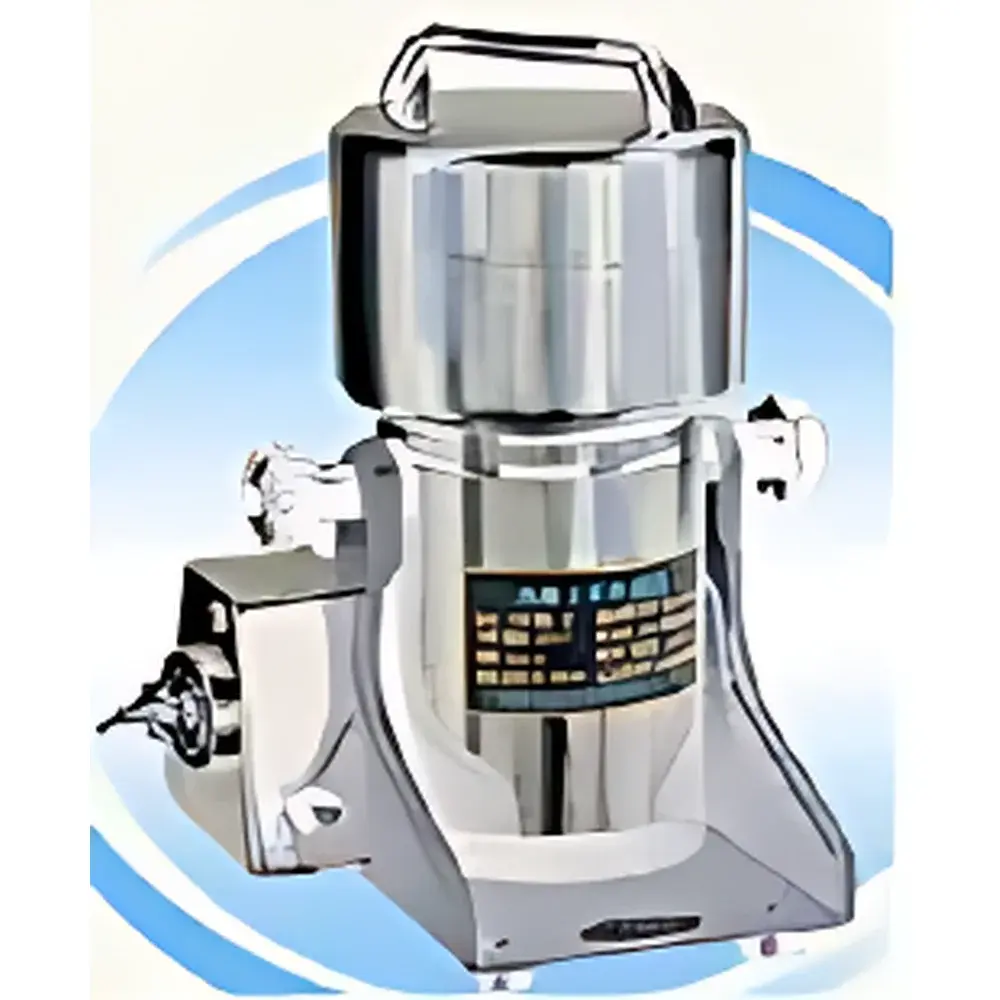
KeHeng FW135 & FW177 Herbal Powder Mill
| Brand | KeHeng |
|---|---|
| Origin | Shanghai, China |
| Manufacturer Type | Authorized Distributor |
| Country of Manufacture | China |
| Model | FW135, FW177 |
| Instrument Type | Benchtop Cryogenic-Compatible Crusher |
| Sample Suitability | Hard, Fibrous, and Dried Botanical Materials |
| Maximum Batch Capacity | 200 g per Cycle |
| Feed Particle Size | Not Specified (Pre-crushing Recommended for >5 mm Particles) |
Overview
The KeHeng FW135 and FW177 Herbal Powder Mills are benchtop laboratory crushers engineered for consistent, low-heat size reduction of dried herbal materials, roots, barks, seeds, and other fibrous botanical samples. Designed with a dual-blade rotor system and optimized chamber geometry, these mills operate on the principle of high-speed impact grinding combined with shear forces—enabling efficient comminution without significant thermal degradation of thermolabile phytochemicals. Unlike general-purpose grinders, the FW135 and FW177 incorporate reinforced stainless-steel grinding chambers and hardened alloy cutting blades to withstand the abrasive nature of lignified plant tissues. Their compact footprint and sealed design support routine use in GMP-aligned herbal QC labs, phytochemistry research workflows, and traditional medicine standardization protocols.
Key Features
- Benchtop footprint (FW135: 320 × 280 × 410 mm; FW177: 360 × 310 × 450 mm) suitable for standard fume hood or laminar flow cabinet integration
- Stainless-steel grinding chamber and rotor assembly compliant with ISO 8573-1 Class 4 for particulate cleanliness
- Interlocked safety cover with automatic power cutoff—meets EN 61000-6-2/6-4 electromagnetic compatibility requirements
- Adjustable retention time via variable speed control (FW135: 0–25,000 rpm; FW177: 0–28,000 rpm), enabling optimization for particle size distribution (PSD) targeting
- Cryogenic compatibility: Optional liquid nitrogen port (FW177 only) supports embrittlement of resilient samples such as resinous herbs or dried rhizomes
- Tool-free disassembly for rapid cleaning—validated for residue removal per USP chromatographic sample prep guidelines
Sample Compatibility & Compliance
The FW135 and FW177 are validated for hard, low-moisture botanical matrices including Angelica sinensis root, Glycyrrhiza uralensis bark, Salvia miltiorrhiza dried root, and Scutellaria baicalensis aerial parts. They are not intended for wet, oily, or highly elastic samples (e.g., fresh leaves, gums, or resins without pre-drying). Both models comply with GB/T 2828.1–2012 (Chinese national standard for sampling procedures) and support traceability under GLP Annex 11 and FDA 21 CFR Part 11 when paired with audit-trail-enabled lab information management systems (LIMS). Routine calibration verification is performed using NIST-traceable stainless-steel reference particles (100–500 µm).
Software & Data Management
While the FW135 and FW177 operate via analog speed dial and mechanical timer (FW135: 0–99 s; FW177: 0–180 s), they integrate seamlessly into digital lab ecosystems through optional RS-232 or USB-to-serial interfaces. When connected to third-party LIMS or electronic lab notebooks (ELN), operational parameters—including speed setpoint, runtime, and batch ID—are logged with timestamp and user authentication. Firmware updates (v2.1+) support CSV export of run logs for audit readiness. All firmware versions undergo IEC 62304 Class B software lifecycle validation.
Applications
- Preparation of homogeneous powder samples for HPLC, UPLC, and GC-MS analysis of active constituents (e.g., ginsenosides, flavonoids, alkaloids)
- Standardized milling prior to Soxhlet or accelerated solvent extraction (ASE) in pharmacognosy studies
- Particle size homogenization for dissolution testing per USP and Chinese Pharmacopoeia Volume IV (2020 Edition)
- Routine QC grinding of raw herbal materials before microscopy, ash value determination, or heavy metal digestion (per CP )
- Supporting ISO/IEC 17025-accredited testing laboratories in method validation for herbal monograph compliance
FAQ
Can the FW135/FW177 be used for non-herbal materials such as minerals or polymers?
No. These mills are specifically designed and validated for dried botanicals. Use with inorganic or synthetic materials may cause excessive blade wear, chamber abrasion, or inconsistent PSD and voids warranty coverage.
Is cryogenic operation supported on both models?
Only the FW177 includes a dedicated LN₂ inlet port and thermally insulated chamber. The FW135 lacks cryo-integration and should not be operated below ambient temperature.
What maintenance intervals are recommended?
Blade sharpening every 200 operational hours; full chamber inspection and fastener torque verification every 500 hours; annual calibration of speed sensor and timer against certified reference instruments.
Does the unit meet CE marking requirements?
Yes—both models carry CE marking per Machinery Directive 2006/42/EC and Electromagnetic Compatibility Directive 2014/30/EU, with technical documentation available upon request from authorized distributors.
How is particle size distribution verified post-milling?
Users are advised to perform sieve analysis (ISO 3310-1, 63–500 µm mesh series) or laser diffraction (Malvern Mastersizer-compatible) on representative subsamples; KeHeng provides SOP templates aligned with ISO 13320 for reporting PSD metrics (D10, D50, D90).



