
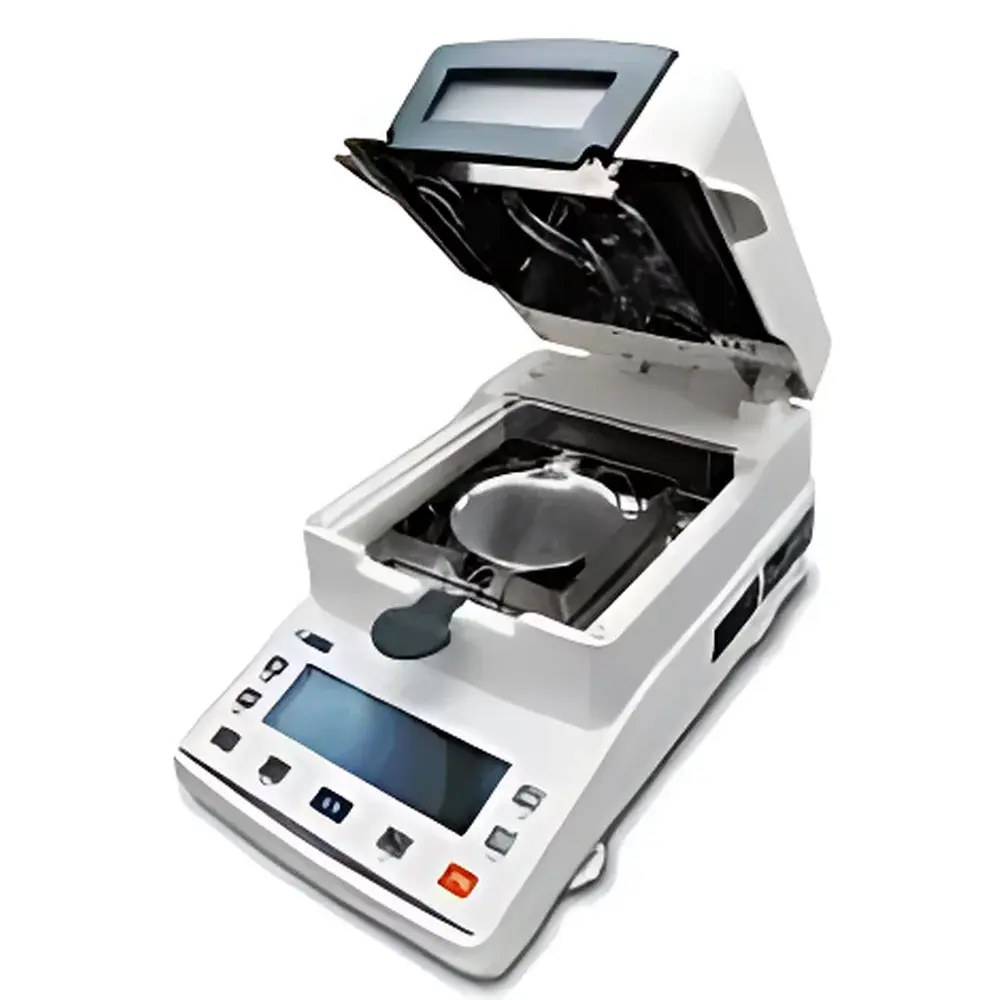
ZiQi WDH-5S Halogen Moisture Analyzer
| Brand | ZiQi |
|---|---|
| Origin | Shanghai, China |
| Manufacturer | ZiQi Laboratory Equipment Co., Ltd. |
| Model | WDH-5S |
| Max Capacity / Readability | 110 g / 5 mg |
| Heating Source | Halogen Lamp |
| Temperature Range | 40–199 °C (adjustable in 1 °C increments) |
| Moisture Content Range | 0.00–100.00 % |
| Moisture Readability | 0.10 % |
| Dry Residue Range | 100.00–0.00 % |
| Dry Residue Readability | 0.1 % |
| ATRO Mode Range | 0–999 % |
| Data Storage | 15 methods |
| Display | Backlit LCD showing moisture %, dry residue %, elapsed time, and set temperature |
| Interface | RS232 serial port |
| Pan Diameter | Φ90 mm |
| Operating Environment | 5–35 °C |
| Sensor Type | PT-100 platinum resistance thermometer |
| Housing Material | Precision-cast aluminum alloy |
Overview
The ZiQi WDH-5S Halogen Moisture Analyzer is a precision thermal gravimetric instrument engineered for rapid, reliable determination of moisture content in solid and semi-solid samples via halogen lamp-assisted drying. Unlike conventional oven-drying methods standardized in ASTM D4442, ISO 4611, or USP <921>, the WDH-5S employs controlled infrared radiation from a focused halogen heating element to induce uniform, volumetric sample desiccation—minimizing thermal degradation risks while accelerating evaporation kinetics. Its core measurement principle follows the loss-on-drying (LOD) protocol: real-time mass loss is continuously monitored by a high-stability electromagnetic force compensation sensor (PT-100 calibrated), and moisture content is calculated as a percentage of initial mass. Designed for laboratories requiring routine compliance with GLP and internal QC protocols, the WDH-5S delivers traceable, repeatable results without reliance on external ovens or subjective endpoint judgment.
Key Features
- Halogen lamp heating system with optimized spectral output (peak ~1.2 µm) enabling rapid, deep-penetrating energy transfer—reducing average drying time to under 5 minutes for most food, polymer, and pharmaceutical samples.
- Precision-cast aluminum housing provides mechanical rigidity, thermal inertia buffering, and electromagnetic shielding—critical for minimizing drift during extended measurements.
- Adjustable temperature control (40–199 °C, 1 °C resolution) coupled with programmable time profiles supports method development per material-specific drying kinetics.
- Backlit LCD interface displays moisture %, dry residue %, elapsed time, current temperature, and real-time mass curve—enabling visual verification of drying plateau formation.
- 15 user-storable drying methods—including ramp-hold, stepwise, and auto-terminate modes—eliminate repetitive setup and ensure inter-operator consistency.
- RS232 serial interface compliant with standard laboratory data capture workflows; supports direct export to LIMS, Excel, or validated third-party software for 21 CFR Part 11-compliant audit trails.
- Electromagnetic force restoration sensor with 110 g capacity and 5 mg readability ensures robust performance across heterogeneous particulates, powders, granules, and thin-film specimens.
Sample Compatibility & Compliance
The WDH-5S accommodates diverse sample morphologies—including granular feedstocks (e.g., corn meal, soybean meal), hygroscopic polymers (PET, nylon), herbal matrices (tea leaves, dried botanicals), and formulated products (tablet granules, powdered milk). Its Φ90 mm stainless steel pan allows uniform sample distribution and optimal infrared exposure. The instrument meets functional requirements aligned with ISO 1183-1 (plastics), AOAC 952.07 (food moisture), and EP 2.2.32 (pharmaceutical excipients). While not certified to IEC 61000-4 EMC standards out-of-box, its cast-aluminum chassis and shielded sensor circuitry support stable operation in shared analytical lab environments. Routine calibration verification using certified reference materials (e.g., sodium tartrate dihydrate) satisfies internal QA and external audit readiness.
Software & Data Management
Data acquisition and reporting are fully supported via RS232 communication using ZiQi’s optional PC application or generic terminal emulators (e.g., Tera Term). All measurements include timestamp, operator ID (manually entered), method name, final moisture value, dry residue, and mass decay profile. Exported CSV files contain raw second-by-second mass readings—essential for kinetic modeling or deviation investigation. When integrated into validated laboratory systems, the WDH-5S can be configured to generate electronic signatures, audit logs, and change-controlled method archives—fulfilling documentation expectations under FDA 21 CFR Part 11 and EU Annex 11 where local validation protocols are applied.
Applications
- Quality control of incoming raw materials (e.g., starch, flour, cellulose derivatives) in food and feed manufacturing.
- Batch release testing of active pharmaceutical ingredients (APIs) and excipients per pharmacopeial monographs.
- Moisture mapping in polymer processing to prevent hydrolysis during extrusion or injection molding.
- Research-grade dehydration studies in agricultural science—evaluating post-harvest drying efficiency of grains and legumes.
- Regulatory submissions supporting shelf-life modeling, where moisture stability is a critical quality attribute.
FAQ
Is the WDH-5S compliant with ISO/IEC 17025 requirements for accredited testing labs?
The instrument itself is not accredited, but its metrological performance—when operated within specified environmental conditions and verified using traceable standards—supports ISO/IEC 17025 method validation when embedded in an accredited lab’s documented procedures.
Can the WDH-5S measure bound water or only free moisture?
It quantifies total volatile loss interpreted as moisture under defined thermal conditions; distinction between free and bound water requires complementary techniques (e.g., DSC or Karl Fischer titration) due to overlapping evaporation enthalpies.
What maintenance is required for long-term accuracy?
Daily pan cleaning, weekly sensor zero calibration, and quarterly verification with certified moisture standards (e.g., 15.66 % Na₂C₄H₄O₆·2H₂O) are recommended; halogen lamp replacement every 2,000–3,000 hours maintains consistent irradiance.
Does it support GLP-compliant electronic records?
Yes—when paired with validated software and appropriate access controls, audit trail generation, and electronic signature functionality, it meets core GLP data integrity criteria.
How does halogen heating compare to traditional IR or microwave methods?
Halogen lamps offer superior spectral match to water absorption bands (vs. broad-spectrum ceramic IR) and avoid non-uniform field effects common in microwave cavities—yielding higher repeatability for heterogeneous samples.
Related Products







