
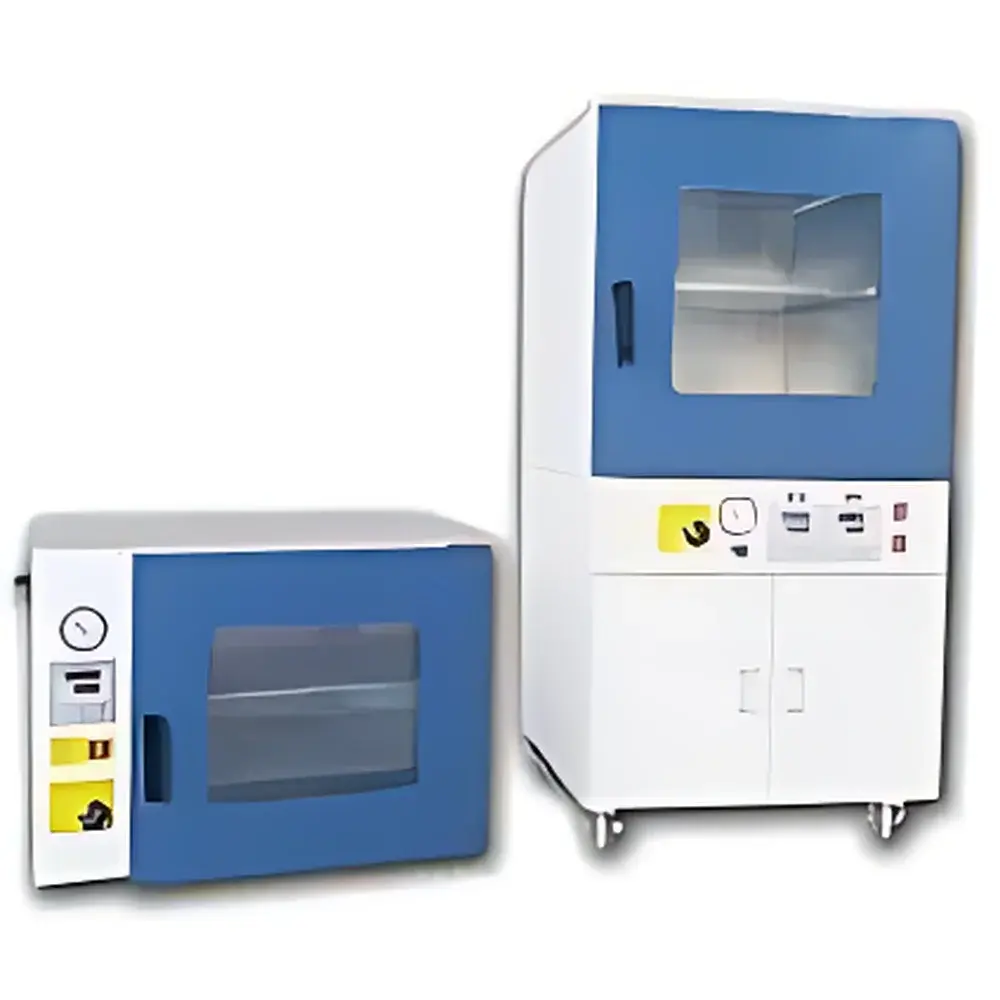
ZiQi DZF-6050 Benchtop Vacuum Drying Oven
| Brand | ZiQi |
|---|---|
| Origin | Shanghai, China |
| Manufacturer | Yes |
| Country of Origin | China |
| Model | DZF-6050 |
| Instrument Type | Vacuum Oven |
| Temperature Range | RT+10 to 250 °C |
| Temperature Fluctuation | ±1 °C |
| External Dimensions | 830 × 640 × 540 mm |
| Internal Chamber Dimensions | 415 × 370 × 345 mm |
| Temperature Resolution | 0.1 °C |
| Operating Ambient Temperature | +5 to 40 °C |
| Chamber Material | Stainless Steel (SUS304) |
| Heating Method | Forced Air Circulation |
| Temperature Uniformity | ±1 °C |
| Ultimate Vacuum Level | ≤133 Pa |
Overview
The ZiQi DZF-6050 Benchtop Vacuum Drying Oven is an engineered solution for controlled, oxygen-free thermal processing of heat-sensitive, oxidation-prone, or chemically unstable samples. Utilizing vacuum-assisted desiccation—where reduced ambient pressure lowers the boiling point of solvents and moisture—the system enables gentle, uniform drying below atmospheric temperature thresholds. This principle is critical in preserving structural integrity and chemical fidelity during post-synthesis purification, lyophilization pre-treatment, residual solvent removal from pharmaceutical intermediates, or moisture analysis of hygroscopic reference standards. Designed for compliance-driven laboratory environments, the DZF-6050 operates within a validated thermal envelope (RT+10 °C to 250 °C) with high reproducibility and minimal thermal overshoot, making it suitable for applications requiring adherence to ASTM E2018 (Standard Guide for Validation of Thermal Processing Equipment) and ISO 17025-compliant calibration protocols.
Key Features
- Stainless steel (SUS304) interior chamber with seamless welds and electropolished finish, ensuring corrosion resistance, cleanability, and compatibility with aggressive solvents and cleaning agents.
- Double-layer tempered glass observation door with integrated silicone gasket—field-adjustable compression mechanism maintains vacuum integrity down to ≤133 Pa without periodic seal replacement.
- Microprocessor-based PID temperature controller with dual digital display (setpoint/actual), auto-tuning capability, and programmable ramp-soak profiles for multi-stage drying sequences.
- Proportional heating power modulation prevents thermal shock at low setpoints (e.g., 30–60 °C), eliminating condensation risks and enabling stable operation near ambient conditions.
- Benchtop footprint (830 × 640 × 540 mm) optimized for space-constrained QC labs; includes integrated vacuum port (KF16 flange) compatible with standard two-stage rotary vane pumps (not included).
Sample Compatibility & Compliance
The DZF-6050 accommodates a broad range of sample formats—including glass Petri dishes, aluminum weighing pans, ceramic crucibles, and sealed ampoules—within its 415 × 370 × 345 mm chamber volume. Its inert, low-oxygen environment mitigates degradation pathways common in APIs, enzymes, nucleic acids, and metal-organic frameworks. The unit supports GLP/GMP workflows through traceable temperature logging (via optional RS485 interface), audit-ready calibration records, and configurable alarm thresholds for vacuum loss or overtemperature events. While not certified to UL/CSA or CE for medical device sterilization, it meets general laboratory safety requirements per IEC 61010-1 and is routinely deployed in R&D settings aligned with USP , ISO 14644-1 (cleanroom-adjacent use), and EPA Method 3540C (Soxhlet extraction support).
Software & Data Management
The embedded controller provides local data capture of real-time temperature, vacuum level, and elapsed time. Optional PC connectivity via RS485 enables integration with LIMS or ELN platforms using Modbus RTU protocol. Third-party software (e.g., LabVIEW or custom Python scripts) can poll setpoint/actual values at 1 Hz intervals for trend analysis, deviation reporting, and 21 CFR Part 11-compliant electronic signatures when paired with validated authentication modules. All calibration parameters—including sensor offset, PID coefficients, and vacuum transducer zero-point—are password-protected and exportable as CSV for internal QA review.
Applications
- Drying of thermolabile biological materials (e.g., antibodies, plasmid DNA, cell lysates) prior to freeze-drying or long-term storage.
- Removal of residual solvents (acetone, dichloromethane, ethyl acetate) from synthesized organic compounds without decomposition.
- Moisture content determination per AOAC 950.46 and ISO 5518 for food-grade starches, dairy powders, and botanical extracts.
- Pre-conditioning of humidity-sensitive sensors, MEMS devices, and optical coatings under controlled thermal-vacuum cycling.
- Accelerated aging studies of polymer films and battery electrode slurries where oxidative crosslinking must be suppressed.
FAQ
What vacuum pump is recommended for optimal performance with the DZF-6050?
A two-stage rotary vane pump with ultimate vacuum ≤5 Pa and pumping speed ≥2 m³/h is advised; common models include Welch 2052 or Edwards RV8. Pump selection must account for solvent vapor load to avoid oil contamination.
Can the DZF-6050 be used for sterilization?
No. It is not designed for microbial kill validation (e.g., F0 calculations) nor certified for sterile processing per ISO 11135 or ISO 11137. It supports depyrogenation of glassware only when combined with validated dry-heat cycles above 250 °C for ≥30 min.
Is temperature uniformity verified across the entire chamber volume?
Yes. Per internal qualification SOP, nine-point mapping (per ICH Q5C Annex) confirms ±1 °C uniformity at 105 °C and 150 °C using NIST-traceable PT100 probes placed at defined geometric locations.
Does the unit support external data logging without PC connection?
Not natively. Real-time logging requires RS485 interface and host software. However, the controller stores up to 100 event timestamps (door open/close, alarm triggers) with time/date stamps for basic traceability.
What maintenance intervals are recommended for sustained vacuum integrity?
Silicone door gasket inspection every 6 months; vacuum gauge zero calibration quarterly; chamber interior cleaning after each use with ethanol or isopropanol; annual verification of heater element resistance and thermal fuse continuity.



