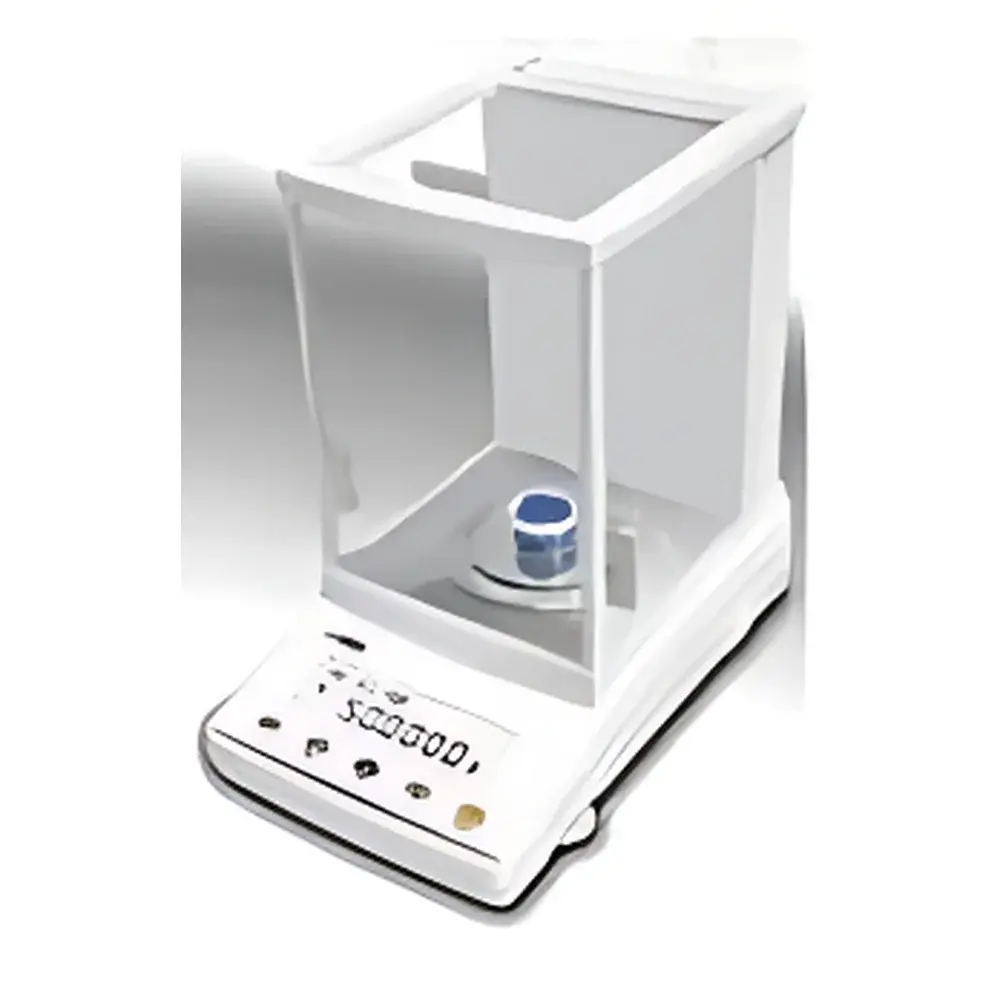
ZiQi FA2204I Advanced Analytical Balance with Internal Automatic Calibration
| Brand | ZiQi |
|---|---|
| Origin | Shanghai, China |
| Manufacturer | ZiQi Instrument Co., Ltd. |
| Model | FA2204I |
| Max Capacity | 220 g |
| Readability | 0.1 mg (0.0001 g) |
| Accuracy Class | Class I (per OIML R76) |
| Repeatability | ±0.0002 g |
| Linearity Error | ±0.0003 g |
| Stabilization Time | ≤4 s |
| Pan Diameter | Ø80 mm |
| Dimensions (L×W×H) | 340 × 215 × 350 mm |
| Net Weight | 6.5 kg |
| Power Supply | AC adapter (included) |
| Calibration | Fully automatic internal calibration (user-programmable schedule) |
| Interface | RS-232 serial port |
| Compliance | Meets ISO 9001 manufacturing standards |
Overview
The ZiQi FA2204I is a Class I analytical balance engineered for precision mass measurement in regulated laboratory environments. It employs electromagnetic force compensation (EMFC) technology — the industry-standard principle for high-resolution analytical balances — wherein the sample’s weight is counterbalanced by a precisely controlled electromagnetic current, enabling direct, drift-free measurement of mass without mechanical wear. With a maximum capacity of 220 g and readability of 0.1 mg (100 µg), the FA2204I delivers consistent performance across its full weighing range, supporting applications requiring trace-level quantification, such as pharmaceutical formulation, reference standard preparation, and quality control testing per USP and EP 2.1.1. Its robust die-cast aluminum housing provides electromagnetic interference (EMI) shielding and mechanical stability, minimizing environmental impact on measurement integrity.
Key Features
- Automatic internal calibration system with programmable scheduling — eliminates manual calibration dependency and ensures traceable, time-stamped verification prior to critical measurements.
- Electromagnetic force compensation sensor architecture — guarantees long-term stability, minimal hysteresis, and superior repeatability (±0.0002 g) under routine use conditions.
- Rapid stabilization (<4 seconds) and optimized weighing algorithm — reduces throughput time without compromising accuracy, especially beneficial in high-volume QC labs.
- Full-range tare, zero, cumulative weighing, overload/underload indication, and fault diagnostics — enhances operational safety and data reliability during extended shifts.
- Integrated RS-232 interface — enables seamless bidirectional communication with LIMS, ERP systems, or dedicated printers for audit-compliant record generation.
- Multi-function operation modes — including piece counting, unit conversion (g, oz, ct, etc.), and below-balance weighing via optional hook assembly — extends utility beyond standard gravimetric analysis.
Sample Compatibility & Compliance
The FA2204I accommodates a wide variety of solid and powdered samples on its Ø80 mm stainless steel weighing pan, compatible with standard weighing boats, crucibles, and volumetric flasks. Its sealed EMFC mechanism resists dust ingress and moisture-induced drift, making it suitable for ambient lab environments without requiring laminar flow enclosures. The instrument complies with OIML R76-1 (2017) for Class I accuracy, and its design supports adherence to ISO/IEC 17025:2017 requirements for calibration laboratories. When integrated into validated workflows, the FA2204I meets essential elements of FDA 21 CFR Part 11 for electronic records — particularly when paired with compliant software that enforces user authentication, audit trails, and electronic signatures for calibration logs and weighing reports.
Software & Data Management
While the FA2204I operates autonomously via its built-in LCD interface, its RS-232 port facilitates standardized ASCII protocol communication. Third-party laboratory software (e.g., LabX, BalanceLink, or custom Python/Node.js scripts) can capture real-time weight values, timestamped calibration events, and status flags (e.g., “CAL OK”, “OVERLOAD”). Data export supports CSV and TXT formats, enabling traceable integration into ELN systems. Internal memory retains last-calibration date and user-defined interval settings — critical for internal audit readiness and periodic review per ISO 9001 clause 7.1.5.
Applications
- Pharmaceutical: Active pharmaceutical ingredient (API) dispensing, excipient ratio verification, and dissolution sample preparation per USP .
- Chemical R&D: Stoichiometric reagent weighing, catalyst loading, and gravimetric titrant standardization.
- Materials Science: Density determination of powders, ash content analysis, and thermal gravimetric sample preparation.
- Food & Agriculture: Nutrient fortification verification, pesticide residue standard dilution, and feed additive dosing.
- Academic Research: Teaching fundamental metrology principles, uncertainty budgeting exercises, and inter-laboratory comparison studies.
FAQ
What does “Class I” accuracy mean for this balance?
Class I, per OIML R76, defines the highest metrological class for non-automatic weighing instruments — requiring maximum permissible error (MPE) of ±0.5e (where e = 0.1 mg) up to 100 g, and ±1.0e thereafter. This classification validates suitability for legal-for-trade and regulatory-grade measurements.
Can the internal calibration be triggered manually, or only on schedule?
Both: the FA2204I supports on-demand calibration via front-panel keypress, as well as time-based auto-execution (e.g., every 2 hours, at startup, or daily). All calibrations use the same internal reference mass and are logged with timestamps.
Is the RS-232 interface opto-isolated?
Yes — the interface includes galvanic isolation to prevent ground-loop interference and ensure signal integrity when connected to PCs or industrial printers in electrically noisy environments.
Does the balance support external calibration with certified weights?
No — the FA2204I is designed exclusively for internal calibration. External calibration is neither required nor supported per manufacturer specifications, as the internal reference mass is factory-traceable to NIM (National Institute of Metrology, China) standards.
How is compliance with GLP/GMP maintained during daily use?
By enforcing scheduled internal calibration, retaining calibration history, using password-protected configuration menus, and exporting raw data with metadata (operator ID, timestamp, balance ID), users fulfill core ALCOA+ (Attributable, Legible, Contemporaneous, Original, Accurate, Complete, Consistent, Enduring, Available) data integrity criteria.