
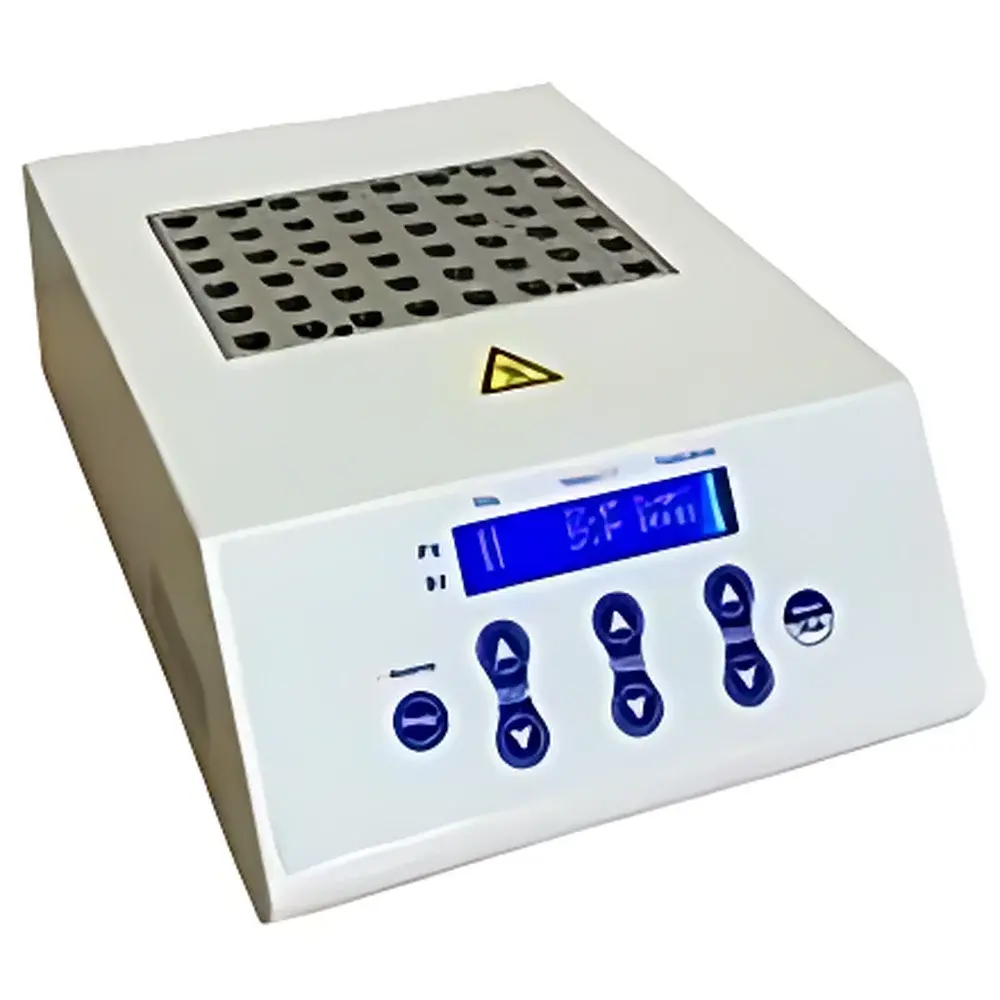
ZiQi MD150-2 Dual-Block High-Temperature Dry Block Heater
| Brand | ZiQi |
|---|---|
| Origin | Shanghai, China |
| Manufacturer Type | OEM/ODM Manufacturer |
| Model | MD150-2 Dual-Block |
| Temperature Range | Ambient +5°C to 150°C |
| Temperature Accuracy | ±0.5°C |
| Temperature Uniformity | ≤±0.5°C at 100°C |
| Display Resolution | 0.1°C |
| Heating Time | ≤30 min (40°C → 150°C) |
| Dimensions (W×D×H) | 260 × 220 × 95 mm |
| Net Weight | 5 kg |
| Max Power | 400 W |
| Timer Range | 1–99 h 59 min |
| Programmable Profiles | 5 user-defined temperature-time programs |
| Cooling Mechanism | Integrated side-mounted thermal management fan with internal high-temp sensor activation |
| Block Compatibility | 17 interchangeable aluminum blocks for tubes ranging from 0.2 mL PCR strips to 40 mm diameter vessels |
Overview
The ZiQi MD150-2 Dual-Block High-Temperature Dry Block Heater is a precision-engineered thermal platform designed for reproducible, contact-based sample heating in research, quality control, and routine laboratory workflows. Unlike water baths—whose limitations include evaporation, contamination risk, and restricted temperature ceilings—the MD150-2 employs solid-state conduction via machined aluminum heating blocks, enabling stable operation up to 150°C with minimal thermal inertia and no fluid maintenance. Its dual independent block architecture allows simultaneous yet distinct thermal protocols across two sample sets—ideal for comparative assays, time-series incubations, or parallel reaction optimization. The instrument operates on Peltier-free resistive heating combined with PID-controlled feedback loops and real-time internal thermal monitoring, ensuring compliance with fundamental requirements of ISO/IEC 17025 for equipment calibration traceability and thermal stability validation.
Key Features
- Dual independent heating blocks with individual digital setpoint control and real-time temperature display
- LCD interface with intuitive navigation, 0.1°C resolution, and multi-language support (English default)
- Five programmable temperature/time profiles supporting ramp-hold-cool sequences for complex thermal protocols
- Integrated overtemperature protection circuitry with automatic shutdown and audible alarm
- Self-diagnostic system with error code reporting and automatic calibration offset adjustment capability
- Passive thermal shielding and active forced-air cooling: an internal high-temperature sensor triggers the side-mounted fan when internal chassis temperature exceeds safe thresholds, maintaining electronic reliability during extended 150°C operation
- Energy-efficient design: 400 W maximum power draw with rapid thermal response and low standby consumption
- Compact footprint (260 × 220 × 95 mm) optimized for benchtop integration in regulated environments including cleanrooms and GLP-compliant laboratories
Sample Compatibility & Compliance
The MD150-2 accepts 17 standardized interchangeable aluminum blocks—including formats for 0.2 mL PCR tubes, 1.5 mL and 2.0 mL microcentrifuge tubes, 13–40 mm diameter culture tubes, and deep-well plates—enabling seamless adaptation across molecular biology, clinical diagnostics, pharmaceutical stability testing, and environmental sample preparation. All blocks are CNC-machined from aerospace-grade aluminum alloy (6061-T6), anodized for corrosion resistance and ease of decontamination (autoclavable up to 121°C for non-electronic components). The device meets IEC 61010-1:2010 safety standards for laboratory electrical equipment and supports documentation required under FDA 21 CFR Part 11 for audit trails when used with validated SOPs. Temperature uniformity data (≤±0.5°C at 100°C; ≤±1.0°C at 150°C) aligns with ASTM E2209-18 guidelines for dry block heater performance verification.
Software & Data Management
While the MD150-2 operates as a standalone instrument, its embedded firmware supports full parameter logging via optional RS-232 or USB-to-serial interface (cable sold separately). Logged data—including setpoint, actual block temperature, elapsed time, and fault events—can be exported to CSV for integration into LIMS or ELN systems. Firmware versioning, calibration history storage, and user-accessible offset correction facilitate internal QA audits and regulatory submissions. The timer function (1 min to 99 h 59 min) includes auto-shutdown and audible completion alerts—critical for unattended overnight reactions in ISO 15189-accredited clinical labs.
Applications
- Enzyme inactivation and heat shock protocols in molecular cloning workflows
- Thermal denaturation studies for protein stability assessment (e.g., DSF, DSC pre-screening)
- Accelerated stability testing per ICH Q1A(R2) guidelines for pharmaceutical intermediates
- Sample thawing and homogenization prior to HPLC or GC analysis
- Pre-incubation of reagents in immunoassay development (ELISA, lateral flow)
- Controlled drying of thin-film samples in materials science characterization
- Calibration verification of thermocouples and RTDs using NIST-traceable reference blocks
FAQ
What is the maximum continuous operating temperature?
The MD150-2 is rated for uninterrupted operation at 150°C, provided ambient conditions remain below 30°C and ventilation clearance ≥5 cm is maintained on all sides.
Can both blocks run at different temperatures simultaneously?
Yes—each block has independent PID control, allowing concurrent operation at two distinct setpoints within the ambient+5°C to 150°C range.
Are replacement blocks certified for traceable calibration?
ZiQi provides NIST-traceable calibration certificates (optional add-on) for individual blocks, documenting uniformity and accuracy at three points (40°C, 100°C, 150°C) per ISO/IEC 17025.
Does the unit support GLP-compliant audit trails?
When connected to external data acquisition software, all temperature logs, user actions, and system events can be timestamped and digitally signed—meeting core requirements of GLP Annex 11 and 21 CFR Part 11 for electronic records.
How often does the internal temperature sensor require recalibration?
Under normal use, annual verification against a calibrated reference thermometer is recommended; the built-in offset adjustment function allows field correction without disassembly.



