
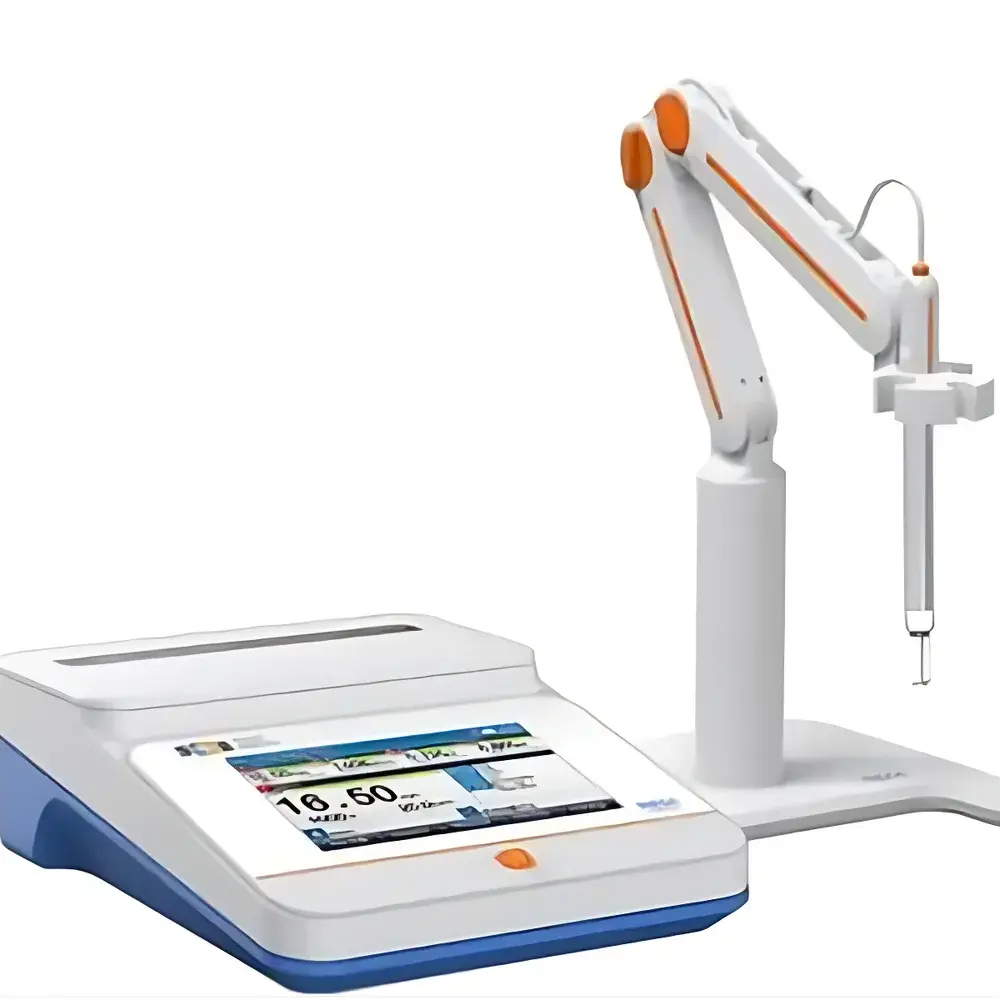
Leici PXSJ-270F Ion Meter
| Brand | Leici |
|---|---|
| Origin | Shanghai, China |
| Model | PXSJ-270F |
| Instrument Class | 0.01 |
| mV Range | (−2000.0 to +2000.0) mV |
| mV Resolution | 0.1 mV |
| mV Accuracy | ±0.1% or ±0.3 mV |
| pH Range | (−2.00 to 20.00) pH |
| pH Resolution | 0.01 pH |
| pH Accuracy | ±0.01 pH |
| pX Range | (−2.00 to 20.00) pX |
| pX Resolution | 0.01 pX |
| pX Accuracy | ±0.01 pX |
| Ion Concentration Range | 0–19990 (units: mol/L, mmol/L, g/L, mg/L, µg/L) |
| Concentration Resolution | 4 significant digits |
| Concentration Accuracy | ±0.5% |
| Temperature Range | −5.0 to 110.0 °C / 23.0 to 230.0 °F |
| Temp Resolution | 0.1 °C / 0.1 °F |
| Temp Accuracy | ±0.2 °C |
| Input Power | AC 100–240 V, DC 9 V output |
| Dimensions | 242 × 195 × 68 mm |
| Weight | 0.9 kg |
| IP Rating | IP54 |
| Data Storage | 500 datasets |
| Interfaces | RS-232, USB |
| Compliance | GLP-compliant data logging with audit trail support |
Overview
The Leici PXSJ-270F Ion Meter is a high-precision potentiometric analyzer engineered for quantitative determination of monovalent and multivalent ions in aqueous solutions via selective ion electrode (ISE) measurement. Based on the Nernst equation, the instrument measures the potential difference between a sample-specific ion-selective electrode and a stable reference electrode under controlled temperature conditions, converting the resulting electromotive force (EMF) into concentration values across multiple standardized units. Designed for routine quality control, environmental monitoring, pharmaceutical water testing, and academic research laboratories, the PXSJ-270F delivers trace-level sensitivity and metrological reliability aligned with ISO/IEC 17025 calibration practices. Its dual-mode architecture supports both direct pX (negative logarithm of activity) and absolute concentration readouts, enabling seamless transition between regulatory reporting formats—particularly relevant for compliance with USP , ASTM D1129, and ISO 10523 standards governing ion analysis in purified water and process streams.
Key Features
- High-resolution dual-display LCD with selectable resolution modes: 0.01 pX / 0.1 mV (high-precision mode) or 0.1 pX / 1 mV (rapid screening mode)
- Intelligent endpoint detection algorithm with configurable reading modes: auto-read, timed-read, interval-read, and manual-read
- Comprehensive temperature compensation: automatic (via integrated Pt1000 sensor) or manual input; dual-unit support (°C/°F)
- Multi-point calibration capability: 1–5 point pH calibration with auto-recognition of GB, DIN, and NIST standard buffer sets; user-defined buffer management
- Built-in ion templates for Na⁺, K⁺, NH₄⁺, Cl⁻, F⁻, and customizable ion profiles supporting user-defined selectivity coefficients
- Flexible concentration unit switching: mol/L, mmol/L, g/L, mg/L, µg/L, and pX — all accessible without recalibration
- Robust hardware design meeting IP54 ingress protection rating for dust and splash resistance in shared lab environments
- Firmware-upgradable architecture enabling future protocol expansion, new ion models, and enhanced GLP functionality
Sample Compatibility & Compliance
The PXSJ-270F is validated for use with commercially available liquid-membrane and solid-state ISEs, including but not limited to fluoride-selective electrodes (LaF₃ crystal), chloride-selective electrodes (AgCl/Ag₂S), and ammonium-selective electrodes (nonactin-based). It accommodates standard double-junction reference electrodes and temperature-compensated combination probes. All measurements adhere to Good Laboratory Practice (GLP) requirements: each stored dataset includes timestamp, electrode ID, calibration history, ambient temperature, operator ID (if configured), and measurement mode metadata. Audit-trail-ready data export supports FDA 21 CFR Part 11 readiness when paired with compliant PC software and user access controls.
Software & Data Management
Data acquisition and archival are supported via native RS-232 serial interface (compatible with industry-standard dot-matrix and thermal printers) and high-speed USB 2.0 connection. Leici’s proprietary communication software enables bidirectional data transfer, batch export to CSV/Excel, calibration report generation, and secure backup to network drives. Stored records (up to 500 entries) retain full contextual parameters and support selective deletion, filtering by date range or ion type, and GLP-compliant printout formatting—including headers with instrument ID, calibration certificate number, and analyst signature field. No cloud dependency or subscription model is required; local data sovereignty is maintained at all times.
Applications
- Environmental labs: Fluoride and chloride quantification in drinking water per EPA Method 300.0 and ISO 10304-1
- Pharmaceutical QC: Monitoring sodium and potassium levels in parenteral solutions and purified water (PW/WFI) per USP
- Food & beverage: Ammonium ion detection in fermentation broths and dairy processing effluents
- Academic research: Teaching Nernstian behavior, ion activity coefficient modeling, and multi-ion interference studies
- Electroplating & surface treatment: Real-time monitoring of bath composition stability for process control
FAQ
Does the PXSJ-270F support differential pulse voltammetry or other electroanalytical techniques?
No. The PXSJ-270F is a dedicated potentiometric ion meter and does not perform voltammetric, amperometric, or coulometric measurements.
Can third-party ion-selective electrodes be used with this instrument?
Yes—provided they conform to standard BNC or QD connectors and operate within the input impedance and voltage range specifications (≥10¹² Ω, ±2000 mV). Calibration validation is recommended prior to deployment.
Is firmware update performed locally or via internet connection?
Firmware updates are conducted offline using a USB flash drive and Leici’s certified update utility; no internet connectivity or remote access is required.
What is the recommended calibration frequency for GLP-compliant operation?
Daily calibration is advised for critical applications; at minimum, calibration verification must precede each analytical batch and after electrode replacement or extended idle periods (>8 hours).
How is traceability ensured for audit purposes?
Each measurement record contains embedded calibration certificate references, electrode serial numbers, environmental conditions, and operator identifiers—fully exportable in timestamped, tamper-evident files compliant with ISO/IEC 17025 clause 7.7.
Related Products





