
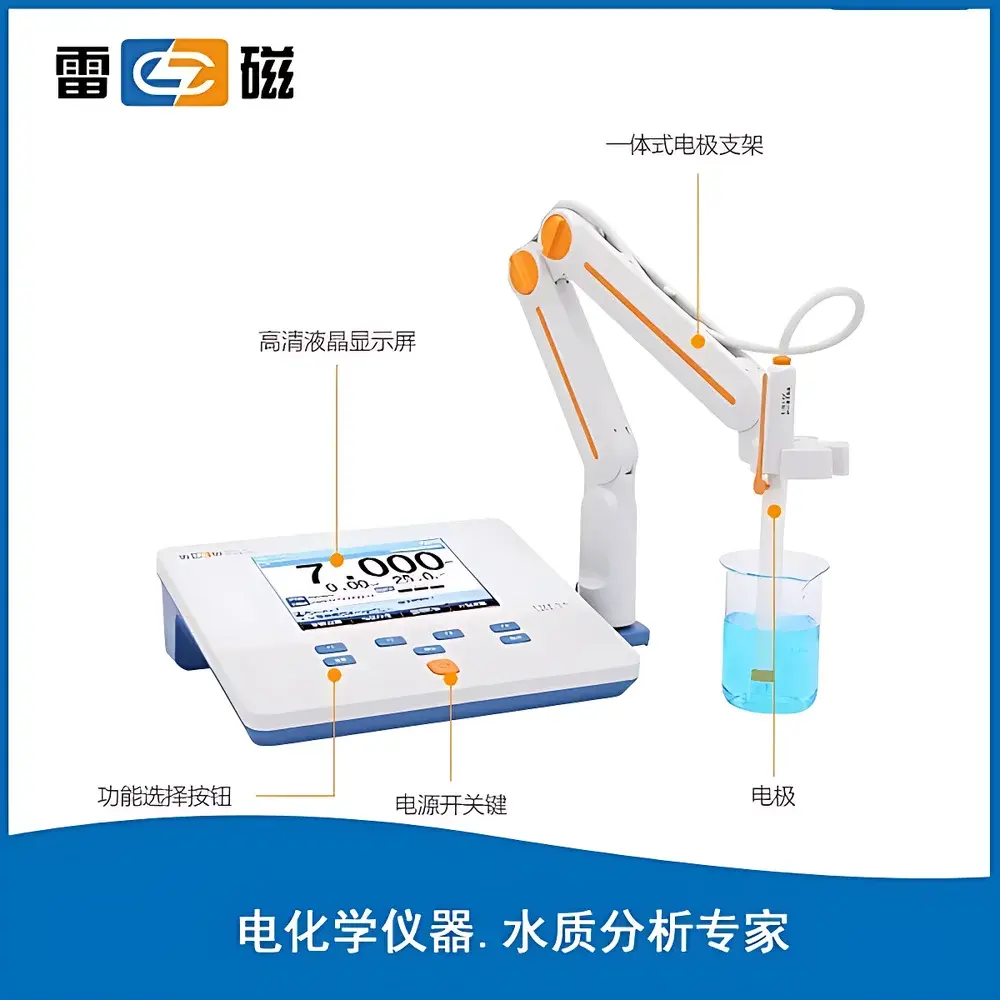
Leici PHSJ-4F Benchtop pH Meter
| Brand | Leici |
|---|---|
| Origin | Shanghai, China |
| Instrument Type | Benchtop |
| Measurement Parameters | pH, mV (ORP), Temperature |
| pH Range | -2.000 to 20.000 pH |
| Resolution | 0.001 pH |
| Accuracy | ±0.002 pH |
| Temperature Range | -10.0 to 135.0 °C |
| Temperature Resolution | 0.1 °C |
| mV Range | -2000.00 to 2000.00 mV |
| mV Resolution | 0.1 mV |
| Calibration Options | Up to 5-point pH calibration |
| Buffer Standards Supported | GB, DIN, NIST, USA, MERK |
| Data Storage Capacity | 500 measurement sets |
| Connectivity | RS-232 (printer), USB (PC communication) |
| Compliance | GLP-compliant data logging with user ID / sample ID assignment |
| Power Supply | DC 9 V adapter (AC 100–240 V input) |
| Dimensions | 242 × 195 × 68 mm |
| Weight | 0.9 kg |
Overview
The Leici PHSJ-4F Benchtop pH Meter is a high-precision electrochemical analyzer engineered for laboratory-grade pH, mV (ORP), and temperature measurements in research, quality control, and regulatory environments. Operating on the fundamental principle of potentiometric measurement—where the potential difference between a pH-sensitive glass electrode and a reference electrode is converted into a logarithmic pH value—the PHSJ-4F delivers metrological traceability and analytical rigor across an extended pH range from –2.000 to +20.000. This broad operational envelope enables reliable characterization of strongly acidic, neutral, and highly alkaline solutions—including caustic soda, concentrated buffer systems, and low-ionic-strength samples—without manual range switching or recalibration drift. Its 0.001-pH resolution and ±0.002-pH accuracy at 25 °C meet the requirements of ISO 7027, ASTM D1293, and USP , supporting method validation in pharmaceutical, environmental, and industrial hygiene applications.
Key Features
- High-resolution 0.001-pH display with dual-parameter simultaneous readout (pH/mV/temperature)
- Five-point pH calibration capability with automatic buffer recognition for GB, DIN, NIST, USA, and MERK standard solutions
- Three configurable measurement modes: continuous, equilibrium-based, and time-triggered (interval or fixed-duration)
- Equilibrium detection algorithm with visual and audible stabilization prompts to minimize operator subjectivity
- GLP-compliant data management: user ID, sample ID, timestamp, calibration history, and electrode diagnostics logged with each result
- Dual connectivity architecture: RS-232 interface for direct thermal printer output and USB port for bidirectional PC communication via Leici’s certified data acquisition software
- Integrated temperature compensation with manual or automatic mode (–10.0 to 135.0 °C), supporting Pt1000 or thermistor-based probes
- Robust front-panel navigation with tactile keys and context-sensitive soft-keys for intuitive operation under gloves or lab coat conditions
Sample Compatibility & Compliance
The PHSJ-4F is validated for use with standard combination pH electrodes (e.g., Leici E-201-C series) and temperature sensors meeting IEC 60751 Class B tolerance. It accommodates aqueous, semi-aqueous, and low-conductivity matrices—including ultrapure water, boiler feedwater, and pharmaceutical rinse solutions—when paired with low-resistance reference junctions and flow-through cells. All measurement data include embedded metadata required for audit readiness under FDA 21 CFR Part 11 (when used with compliant software and access controls), ISO/IEC 17025, and GLP frameworks. Calibration records retain full traceability: date/time, buffer IDs, slope (%), offset (mV), and asymmetry potential—enabling retrospective assessment of electrode performance degradation per ASTM E2064 guidelines.
Software & Data Management
Leici’s proprietary PC communication suite provides secure, encrypted transfer of measurement datasets, calibration logs, and instrument configuration files. The software supports CSV and XML export formats compatible with LIMS integration (e.g., LabWare, STARLIMS) and statistical process control (SPC) platforms. Audit trail functionality records all user-initiated actions—including parameter changes, calibration events, and data deletions—with immutable timestamps and operator authentication. Data integrity safeguards include write-protection for archived records, digital signature options, and optional password-protected administrative access levels aligned with GMP Annex 11 and EU GMP Chapter 4 requirements.
Applications
- Pharmaceutical manufacturing: final product pH verification per USP monographs and batch release testing
- Environmental monitoring: wastewater effluent compliance (EPA Method 150.1), soil extract analysis (ASTM D4972)
- Food & beverage QA: titratable acidity correlation, fermentation endpoint detection, shelf-life stability studies
- Chemical R&D: catalyst slurry pH profiling, surfactant micelle transition monitoring, electroplating bath control
- Academic research: enzyme kinetics in non-standard pH regimes, corrosion inhibitor evaluation in alkaline media
- Power generation: high-purity steam condensate and feedwater pH surveillance per ASME PTC 19.11
FAQ
What pH buffer standards does the PHSJ-4F recognize automatically?
The instrument identifies five internationally referenced buffer families: Chinese National Standard (GB), German DIN 19266, NIST SRM 186, US Standard (4.005, 7.000, 10.012 at 25 °C), and MERCK Titrisol® certified solutions.
Can the PHSJ-4F measure pH in non-aqueous solvents?
While primarily designed for aqueous systems, it supports pH measurement in mixed solvents (e.g., ethanol–water) when used with solvent-compatible electrodes and appropriate calibration buffers; however, absolute pH values are not thermodynamically defined outside aqueous media.
Is the USB interface compatible with modern Windows/macOS operating systems?
Yes—the included driver package supports Windows 10/11 (64-bit) and macOS 12+; no virtual COM port emulation is required.
How is electrode health monitored during routine use?
The instrument calculates and displays real-time electrode slope (% theoretical) and zero-point offset after each calibration; deviations beyond ±5% slope or >±30 mV offset trigger advisory alerts per ISO 17025 clause 6.4.10.
Does the device support 21 CFR Part 11 compliance out-of-the-box?
Hardware-level features (audit trail, electronic signatures, role-based access) are built-in; full Part 11 compliance requires deployment with validated Leici software, documented SOPs, and periodic system verification per FDA guidance.
Related Products




