
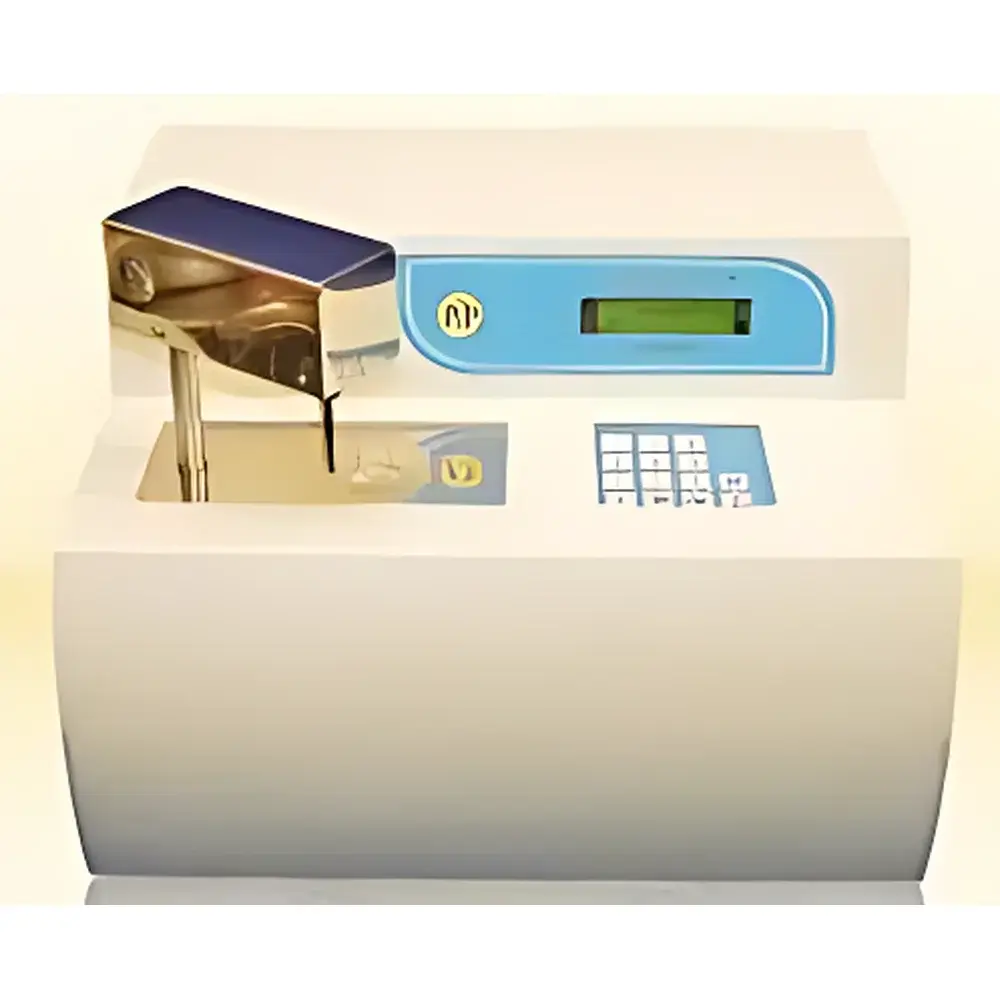
PP QC-TECH Milk Cryoscope
| Brand | PP |
|---|---|
| Origin | USA |
| Model | QC-TECH |
| Automation | Fully Automatic |
| Analysis Time | < 2 min |
| Freezing Point Range | 0 to –1000 m°C or m°H |
| Repeatability | ±0.002 m°H (or m°C) |
| Linearity | < ±0.5% |
| Resolution | 0.001 m°H (or m°C) |
| Bath Temperature | –6.0°C ±0.5°C |
| Calibration | Two-point (422 & 621 m°H / 408 & 600 m°C) |
| Power Consumption | 120 W |
| Input Voltage | 95–250 VAC, 50/60 Hz |
| Fuse | 3 A |
| Operating Environment | 15–40°C, 30–80% RH |
| Sample Volume | 2.5 mL |
| Sample Throughput | Single-sample per run |
Overview
The PP QC-TECH Milk Cryoscope is a fully automated, laboratory-grade freezing point depression analyzer engineered for precise quantification of added water in raw and processed bovine milk. It operates on the thermodynamic principle of colligative property measurement: the presence of dissolved solutes—including lactose, salts, and proteins—lowers the freezing point of milk relative to pure water. When exogenous water is introduced, the solute concentration decreases proportionally, resulting in a measurable shift toward a higher (less negative) freezing point. This deviation—expressed in millidegrees Celsius (m°C) or millidegrees Hortvet (m°H)—is directly correlated to the volume fraction of added water. The instrument complies with internationally harmonized reference methods specified in ISO 5764:2009, IDF 108:2009, and AOAC Official Method 972.16, ensuring metrological traceability and regulatory acceptability across global dairy supply chains.
Key Features
- Fully automated thermal cycle with integrated Peltier cooling and high-stability temperature bath (–6.0°C ±0.5°C), eliminating reliance on external refrigerants or ice baths.
- Digital signal processing architecture optimized for detection of the true freezing plateau—identified via real-time slope analysis of the cooling curve—not just inflection points.
- Two-point calibration using certified reference standards (408/600 m°C or 422/621 m°H), supporting both SI-aligned and legacy Hortvet units without conversion error.
- Robust mechanical design with sealed optical sensor housing and vibration-dampened sample chamber, minimizing drift during transport or operation in non-laboratory environments (e.g., milk collection centers).
- Intuitive touchscreen interface with multilingual support (English, Spanish, French, Arabic), contextual help prompts, and audit-ready event logging including operator ID, timestamp, and calibration history.
- Compliance-ready firmware with configurable user access levels, electronic signature capability, and optional 21 CFR Part 11–compliant data integrity modules for GMP-regulated facilities.
Sample Compatibility & Compliance
The QC-TECH accepts undiluted, homogenized raw milk, pasteurized whole milk, skim milk, and reconstituted powdered milk—provided samples are free of visible clots, excessive fat separation, or microbial spoilage that may interfere with nucleation kinetics. It does not require filtration or pre-treatment under standard operating conditions. All measurements adhere strictly to ISO 5764:2009 procedural requirements, including mandatory sample equilibration at 4–6°C prior to insertion, controlled cooling rate (≤0.15°C/min), and plateau validation criteria (duration ≥15 s, slope ≤0.002°C/s). Instrument validation documentation includes factory-verified linearity reports, repeatability studies per ISO 5725-2, and uncertainty budgets traceable to NIST SRM 1992a (Freezing Point Standard for Milk).
Software & Data Management
Built-in CryoLink™ software provides real-time visualization of the cooling curve, automatic plateau identification, and immediate calculation of added water percentage using the official IDF equation: % added water = [(FPref – FPsample) / 0.545] × 100, where FPref = –0.545°C (–545 m°C) for normal milk. Data export supports CSV, PDF report generation (with embedded digital signature), and direct integration into LIMS via ASTM E1384-compliant HL7 messaging or ODBC connectivity. Audit trails record all parameter changes, calibration events, and result modifications—including timestamps, user credentials, and reason-for-change fields—meeting GLP and EU Annex 11 requirements for electronic records.
Applications
- Dairy farm gate testing: Rapid verification of milk integrity before tanker loading; detection of condensation-induced dilution in bulk tanks or improper milking-line rinsing.
- Transport & collection hubs: On-site screening of incoming loads to enforce contractual water-content clauses; correlation with somatic cell count and conductivity data for holistic quality assessment.
- Processing plants: In-process monitoring at reception, pre-standardization, and post-pasteurization stages to ensure compositional consistency and prevent economic adulteration.
- Regulatory laboratories: Reference method compliance for national food safety authorities conducting routine surveillance or forensic investigations under Codex Alimentarius Standard 206-1999.
- R&D and academia: Development of predictive models linking freezing point depression to mineral profile (Ca²⁺, K⁺, Cl⁻), lactose polymorphism, or thermal history effects in ultra-heat-treated (UHT) products.
FAQ
What is the theoretical basis for detecting added water using freezing point depression?
Freezing point depression is a colligative property dependent solely on the molal concentration of solutes. Milk’s natural freezing point (–0.545°C ±0.010°C) reflects its characteristic electrolyte and lactose content. Dilution with pure water reduces total solute molality, raising the observed freezing point linearly—enabling quantitative back-calculation of adulterant volume.
How does the QC-TECH differentiate between naturally low-freezing-point milk and water-adulterated samples?
It does not rely on absolute freezing point alone. The instrument cross-validates results against conductivity and pH trends when integrated with optional auxiliary sensors—and flags outliers requiring manual review per ISO 5764 Annex B protocols.
Is routine maintenance required beyond calibration?
Yes. Daily cleaning of the sample cell with deionized water and weekly verification of thermal bath stability using a calibrated NIST-traceable thermometer are mandated in the SOP manual to preserve long-term accuracy.
Can the QC-TECH be used for non-bovine milks (e.g., goat, buffalo)?
While the instrument measures freezing point accurately, the standard IDF equation assumes bovine composition. For alternative species, users must establish species-specific reference freezing points and recalculate using validated correction factors published in IDF Bulletin 475:2021.





