
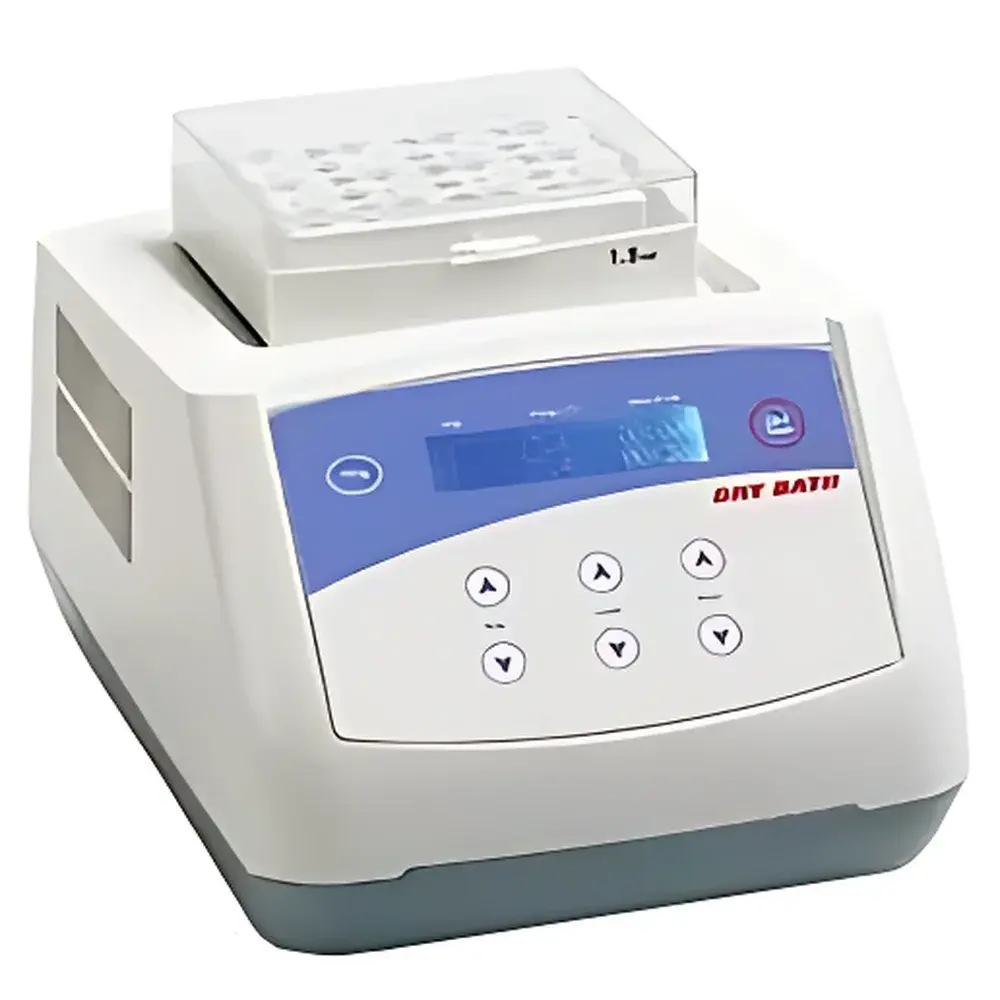
Yiheng TU-10 / TU-100 / TU-100C Peltier-Cooled Metal Block Thermostat
| Brand | Yiheng |
|---|---|
| Origin | Shanghai, China |
| Model | TU-10 |
| Temperature Range | RT+5°C to 100°C (TU-10/TU-100), –10°C to 100°C (TU-100C) |
| Temperature Accuracy | ±0.5°C |
| Display Resolution | 0.1°C |
| Heating Time | ≤25 min (20°C to 100°C) |
| Cooling Time | ≤25 min (20°C to 0°C, TU-100C only) |
| Uniformity | ±0.5°C |
| Power | 100 W (TU-10), 200 W (TU-100/TU-100C) |
| Timer Range | 0–99 h 59 min |
| Module Type | Interchangeable aluminum blocks (B-module standard for TU-10 |
Overview
The Yiheng TU-10, TU-100, and TU-100C are microprocessor-controlled metal block thermostats engineered for precise, contamination-free thermal management of small-volume samples in molecular biology, clinical diagnostics, and analytical laboratories. Unlike water baths—prone to evaporation, microbial growth, and cross-contamination—these devices utilize solid aluminum heating/cooling blocks with direct conductive heat transfer, ensuring rapid thermal response, superior temperature stability, and compliance with Good Laboratory Practice (GLP) requirements for traceable, reproducible sample conditioning. The TU-100C integrates a Peltier thermoelectric cooling module, enabling active sub-ambient operation down to –10°C without refrigerants or external chillers—a critical capability for enzyme storage, cold-sensitive assay setup, and controlled denaturation protocols. All models feature real-time digital display of setpoint, actual block temperature, and countdown timer, supporting unattended operation across extended incubation or reaction cycles.
Key Features
- Microprocessor-based PID temperature control with ±0.5°C accuracy and 0.1°C display resolution, calibrated per ISO/IEC 17025 traceable procedures.
- Interchangeable anodized aluminum modules (B-module for TU-10; E-module for TU-100/TU-100C) designed for rapid thermal equilibration and easy decontamination via autoclaving or chemical wipe-down.
- Peltier-driven active cooling (TU-100C only) achieves ≤25-minute cooling from 20°C to 0°C, eliminating reliance on ice baths or external refrigeration units.
- Integrated safety architecture: over-temperature cutoff, open-circuit detection, fan-failure monitoring, and audible alarm upon cycle completion or fault condition.
- Transparent polycarbonate lid minimizes ambient thermal interference while permitting visual sample verification without lid removal—reducing contamination risk and thermal drift.
- Programmable timer (0–99 h 59 min) with auto-shutdown and end-of-cycle buzzer, supporting overnight or multi-step thermal protocols without manual intervention.
Sample Compatibility & Compliance
These thermostats accommodate standard microtubes (0.2 mL, 0.5 mL, 1.5 mL, 2.0 mL), PCR strips, and deep-well plates via interchangeable modules—ensuring uniform thermal coupling across all positions (±0.5°C block uniformity). The sealed metal block design prevents liquid ingress and eliminates condensation-related artifacts during low-temperature operation (TU-100C). Units comply with IEC 61010-1:2010 for laboratory electrical safety and meet electromagnetic compatibility (EMC) requirements per EN 61326-1. While not FDA 21 CFR Part 11–certified out-of-the-box, audit-ready operation is supported through manual logbook entries, timestamped timer records, and calibration certificate documentation—facilitating GLP/GMP-aligned validation workflows in QC labs and contract research organizations.
Software & Data Management
The TU-series operates as a standalone instrument with no proprietary software dependency. Temperature setpoints, timer values, and real-time readings are managed exclusively via the front-panel keypad and dual-line LCD. For integration into validated environments, users may document operational parameters and calibration events in laboratory information management systems (LIMS) or electronic lab notebooks (ELN) using printed calibration certificates (provided with each unit) and internal event logs (e.g., alarm triggers, power-on cycles). Optional external data loggers (e.g., USB-connected thermocouple interfaces) can be used to capture time-stamped block temperature profiles for IQ/OQ/PQ documentation.
Applications
- DNA/RNA thermal cycling preparation: pre-heating master mixes, denaturation steps prior to PCR, and post-amplification hold at 4°C.
- Enzyme kinetics assays requiring stable sub-ambient temperatures (TU-100C): restriction digests, ligase reactions, and phosphatase treatments.
- Clinical specimen processing: serum coagulation timing (37°C), cold-chain maintenance for plasma aliquots (–10°C to 4°C), and antigen retrieval in histopathology.
- Chemical synthesis support: controlled heating of reagent vials, solvent drying, and catalyst activation at defined setpoints.
- Quality control testing: stability studies of reference standards, buffer equilibration, and viscosity sample conditioning prior to rheometry.
FAQ
What is the difference between the TU-10, TU-100, and TU-100C models?
The TU-10 is a compact heater-only unit (RT+5°C to 100°C) with B-module configuration; the TU-100 adds higher power (200 W) and E-module compatibility for larger tube formats; the TU-100C integrates Peltier cooling for bidirectional control (–10°C to 100°C) with identical E-module support.
Can the aluminum modules be autoclaved?
Yes—standard B and E modules are constructed from medical-grade anodized aluminum rated for repeated autoclaving at 121°C for 20 minutes, maintaining dimensional stability and thermal conductivity.
Is calibration traceable to national standards?
Each unit ships with a factory calibration certificate referencing NIST-traceable reference thermometers; users may perform in-house verification using a calibrated PT100 probe inserted into designated module wells.
Does the device support continuous operation for 24+ hours?
Yes—designed for unattended long-duration runs; thermal management includes intelligent fan modulation and thermal cut-off redundancy to prevent overheating under sustained load.
How is temperature uniformity verified across the block?
Uniformity is validated during manufacturing using a 9-point grid measurement (center + eight peripheral positions) per ASTM E2209–18 guidelines, with results documented in the unit’s conformance report.
Related Products



