
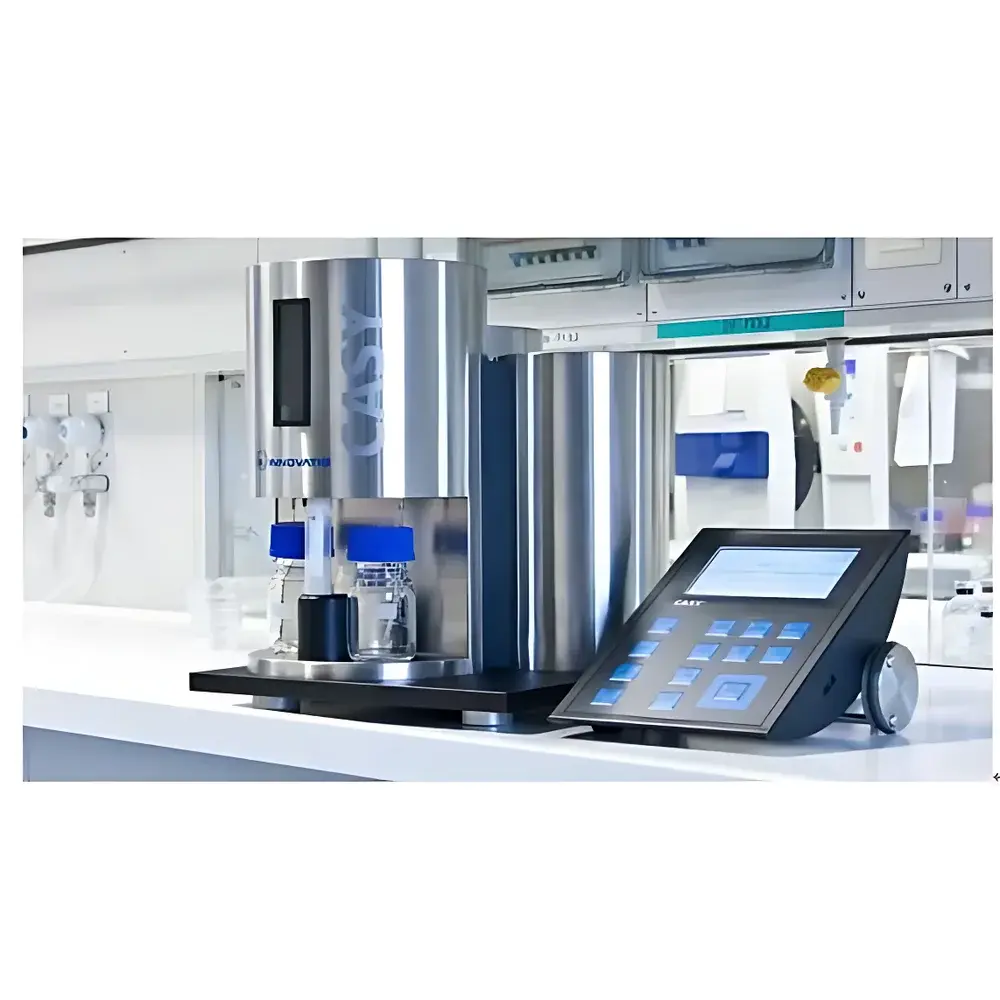
OLS CASY 3D Label-Free Cell Analyzer
| Brand | OLS |
|---|---|
| Origin | Germany |
| Manufacturer Type | Authorized Distributor |
| Origin Category | Imported |
| Model | CASY |
| Quotation | Available Upon Request |
| Measurement Time | 10 s |
| Cell Concentration Range | 1×10²–1×10⁷ cells/mL |
| Sample Volume | 10–100 µL |
| Sample Throughput | 512,000 channels |
| Detectable Cell Size Resolution | 1 in 512,000 |
| Measurement Principle | Electrical Sensing Zone (Coulter Principle), Compliant with ISO 13319 |
| Viability Assessment | Exclusion Current Elimination (ECE) Technology |
| Dynamic Diameter Ratio | >1:40 |
| Dynamic Volume Ratio | >1:70,000 |
| Channel Resolution | 512,000 size bins |
| Display Bins | 1,024 |
| Diameter Range | 0.7–120 µm |
Overview
The OLS CASY 3D Label-Free Cell Analyzer is an advanced impedance-based cell analysis platform engineered for high-precision, non-invasive quantification and characterization of viable and non-viable cells across diverse biological systems. Operating on the well-established Electrical Sensing Zone (ESZ) principle—commonly referred to as the Coulter principle—the system detects changes in electrical resistance as individual cells or particles pass through a precision-machined aperture under controlled hydrodynamic flow. Each event generates a voltage pulse proportional to the particle’s volume, enabling simultaneous enumeration, volumetric profiling, and viability discrimination without fluorescent dyes, antibodies, or enzymatic assays. Designed in accordance with ISO 13319 for particle size analysis by electrical sensing zone, the CASY platform delivers traceable, reproducible measurements essential for GLP-compliant research, bioprocess monitoring, and regulatory submissions.
Key Features
- Label-free, real-time impedance cytometry: Eliminates reliance on viability dyes (e.g., Trypan Blue, PI) and associated staining artifacts, phototoxicity, or incubation bias.
- High-frequency pulse acquisition: 1 MHz sampling rate ensures robust detection of transient events—including small debris (down to 0.7 µm), single cells, and large aggregates—within a single 10-second measurement cycle.
- Ultra-high resolution sizing: 512,000-channel measurement matrix enables sub-femtoliter volume resolution (1 in 512,000), supporting granular population deconvolution and subtle morphological shifts.
- Exclusion Current Elimination (ECE) technology: A proprietary method for distinguishing live from dead cells based on membrane integrity-dependent current exclusion profiles—not conductivity alone—enhancing accuracy in heterogeneous samples.
- Wide dynamic range: Measures particles from 0.7 µm to 120 µm in diameter, covering mammalian cells (primary, hybridoma, CHO, HEK293), yeast, bacteria, algae, pollen, spermatozoa, and parasitic protozoa in one platform.
- Regulatory-ready architecture: Full compliance with FDA 21 CFR Part 11 requirements, including electronic signatures, audit trails, role-based access control (3-tier user permissions), and secure database logging.
Sample Compatibility & Compliance
The CASY analyzer accepts untreated, unfiltered suspensions in standard physiological buffers (e.g., PBS, saline, culture medium) without centrifugation or dilution steps. Its compatibility extends to fragile primary isolates, cryopreserved cells, and shear-sensitive suspension cultures. All measurement protocols adhere to ISO 13319 for standardized calibration and inter-laboratory comparability. The system supports full audit trail generation per GLP and GMP frameworks, making it suitable for QC release testing in biomanufacturing environments and preclinical safety assessment workflows. Documentation packages include IQ/OQ/PQ validation templates aligned with EU Annex 11 and USP guidelines.
Software & Data Management
CASY Control Software (v5.x) provides intuitive workflow navigation, customizable gating, automated report generation, and integrated statistical modules (e.g., coefficient of variation, population skewness, aggregate index). Two concurrent license types are included: one for instrument control and one for offline data review and reanalysis on desktop workstations. Raw impedance pulse data, histogram exports (CSV, TXT), and fully annotated PDF reports are supported. A relational SQL-based database enables longitudinal study tracking, multi-user collaboration, and version-controlled protocol archiving. All data exports retain metadata stamps (operator ID, timestamp, instrument serial, calibration status) required for regulatory submission packages.
Applications
- Mammalian cell culture monitoring: Accurate seeding density control, growth kinetics modeling, and harvest timing optimization for upstream bioprocessing.
- Bacterial and yeast QC: Quantification of viable units, detection of filamentation or clumping, and biomass estimation in fermentation development.
- Toxicity and proliferation assays: Dose-response profiling of cytostatic/cytotoxic compounds via real-time viability decay curves and debris accumulation kinetics.
- Immunology research: Enumeration and size distribution analysis of T-cell subsets, dendritic cells, and PBMC preparations without activation-induced phenotypic drift.
- Stem cell and organoid characterization: Monitoring spheroid dissociation efficiency, single-cell yield, and debris-to-cell ratio post-mechanical/enzymatic treatment.
- Environmental and agricultural microbiology: Enumeration of phytoplankton, fungal spores, and parasitic cysts in water or soil extracts.
FAQ
Does the CASY system require daily calibration?
No—calibration is performed using NIST-traceable polystyrene microspheres only during initial installation and after major maintenance. Routine operation relies on internal reference checks validated per ISO 13319.
Can I analyze adherent cells without trypsinization?
Yes—provided cells are fully suspended in isotonic buffer prior to loading; however, enzymatic or mechanical dissociation must ensure monodispersity to avoid aggregation-related counting errors.
Is raw pulse data export supported for third-party analysis?
Yes—full binary pulse stream (.cas) files and ASCII-encoded event lists are exportable for MATLAB, Python (NumPy/Pandas), or R-based custom analytics pipelines.
What is the recommended maintenance schedule?
Aperture cleaning every 500 measurements; annual performance verification with certified standards; firmware updates issued quarterly via secure OLS portal.
How does CASY differentiate apoptotic from necrotic cells?
Via ECE-derived volume distribution shifts: early apoptosis manifests as progressive shrinkage (pyknosis) within the live gate, while late-stage necrosis yields increased sub-G1 debris peaks and loss of membrane-defined current exclusion.




