
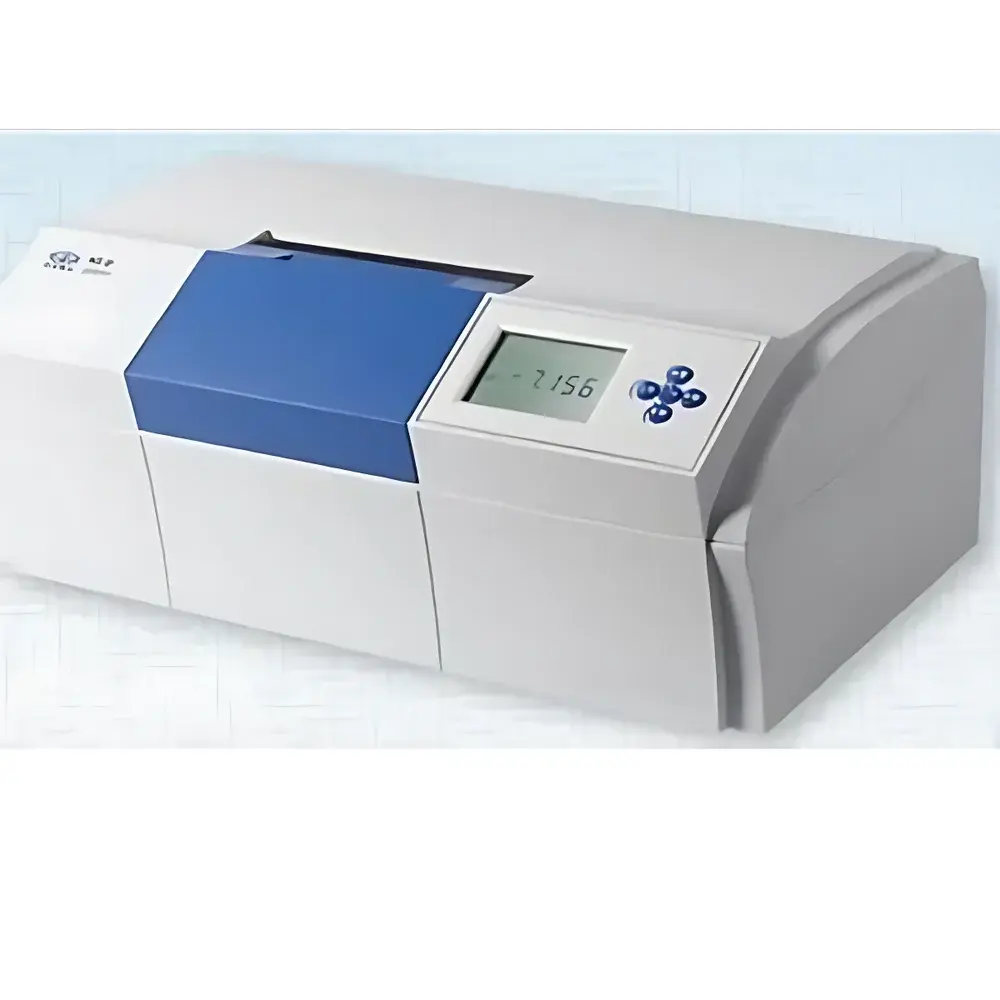
Shanghai Physical Optics WZZ-2B Digital Automatic Polarimeter
| Brand | YDWG (Yidian Wuguang) |
|---|---|
| Origin | Shanghai, China |
| Product Type | Automatic Polarimeter |
| Temperature Control | None |
| Display | Backlit LCD with Digital Readout |
| Light Source | Sodium D-line Lamp (589.3 nm) |
| Measurement Range | ±45° |
| Angular Resolution | 0.001° |
| Accuracy Class | 0.05 (per JJG 536–2015, equivalent to ISO 13807:2020 compliance for routine polarimetric accuracy) |
| Data Handling | Triple-measurement storage with automatic mean calculation |
| Compliance | Meets national metrological verification regulation JJG 536–2015 |
Overview
The Shanghai Physical Optics WZZ-2B Digital Automatic Polarimeter is a precision optical instrument engineered for the quantitative measurement of optical rotation—defined as the angular deflection of plane-polarized light as it passes through an optically active substance. Operating at the standardized sodium D-line wavelength (589.3 nm), the WZZ-2B employs a closed-loop photoelectric detection system coupled with an automatic servo-controlled polarization analyzer. This architecture eliminates manual null-point searching and ensures consistent, operator-independent measurement repeatability. Designed for routine quality control and educational applications in pharmaceutical, food, chemical, and academic laboratories, the instrument delivers traceable angular measurements across a full ±45° range with a resolution of 0.001° and certified accuracy conforming to Class 0.05 per China’s national metrological regulation JJG 536–2015—a performance tier aligned with the repeatability and linearity requirements specified in ISO 13807:2020 for general-purpose polarimeters.
Key Features
- High-stability sodium vapor lamp (589.3 nm) with integrated thermal stabilization, ensuring spectral purity and long-term intensity consistency
- Digital angular readout via backlit LCD display, optimized for ambient lab lighting and extended visual clarity
- Auto-zero and auto-calibration routines initiated at power-on and user command, minimizing warm-up drift effects
- Triple-measurement memory buffer: stores three consecutive readings and computes arithmetic mean, standard deviation, and pass/fail flagging against user-defined tolerance limits
- Robust mechanical design with precision-ground quartz half-shade field and calibrated zero-reference position
- No external temperature control or Peltier module—intended for use in thermally stable environments (20–25 °C, <60% RH) per JJG 536–2015 operational guidelines
Sample Compatibility & Compliance
The WZZ-2B accommodates standard 100 mm and 200 mm path-length sample tubes (inner diameter 19 mm), compatible with both aqueous and organic solvent-based solutions. It supports common optically active analytes including sucrose, glucose, fructose, camphor, menthol, and chiral pharmaceutical intermediates. While not equipped with active temperature regulation, its mechanical and optical stability enables reliable measurements under controlled room conditions. The instrument satisfies metrological traceability requirements for routine QC testing in non-GMP environments and aligns with verification protocols referenced in USP , EP 2.2.7, and Chinese Pharmacopoeia IV (2020 Ed.) for polarimetric assay of raw materials and finished products. Calibration is performed using certified quartz control plates traceable to NIM (National Institute of Metrology, China).
Software & Data Management
The WZZ-2B operates as a standalone instrument with embedded firmware—no PC connection or proprietary software required. All data handling occurs locally: measurements are stored in volatile RAM, displayed in real time, and retained until power cycle or manual reset. The triple-readout function provides immediate statistical feedback without external computation. For laboratories requiring audit trails or electronic records, manual transcription into LIMS or Excel is supported. Though lacking FDA 21 CFR Part 11-compliant electronic signatures or audit logging, the device’s deterministic behavior, fixed firmware, and absence of network interfaces render it suitable for environments governed by basic GLP documentation practices where handwritten logbooks or printed result summaries constitute the official record.
Applications
- Routine concentration determination of sucrose in food and beverage manufacturing (e.g., Brix estimation in syrups and fruit juices)
- Enantiomeric purity assessment of chiral compounds during synthetic route development
- Pharmaceutical raw material identity testing per pharmacopoeial monographs (e.g., identification of dextromethorphan, levodopa, or penicillin derivatives)
- Educational demonstration of optical activity, Fresnel’s theory of rotary polarization, and Biot’s law in undergraduate physics and chemistry labs
- Stability-indicating assays tracking racemization kinetics under accelerated storage conditions
FAQ
Does the WZZ-2B support temperature-controlled measurements?
No. The instrument lacks integrated thermostatic control and must be operated in a stable ambient environment (20–25 °C). For temperature-dependent studies, external water-jacketed cells and independent bath control are required.
Is calibration traceable to international standards?
Yes. Factory calibration uses NIM-traceable quartz control plates; users may verify performance annually using the same reference standards per JJG 536–2015.
Can measurement data be exported electronically?
No. The WZZ-2B does not feature USB, RS-232, or Bluetooth connectivity. Results must be recorded manually or via external camera/document capture.
What maintenance is required for the sodium lamp?
The sodium lamp has a rated service life of ≥2,000 hours. Replacement is recommended when luminance drops below 80% or spectral output shows visible broadening—typically verified during annual verification.
Is the WZZ-2B compliant with ISO/IEC 17025 requirements?
As a Class 0.05 polarimeter, it meets the metrological criteria for inclusion in accredited test methods when operated within defined environmental and procedural controls; however, full scope accreditation requires documented uncertainty budgets and interlaboratory validation per ISO/IEC 17025:2017 Clause 7.7.





