
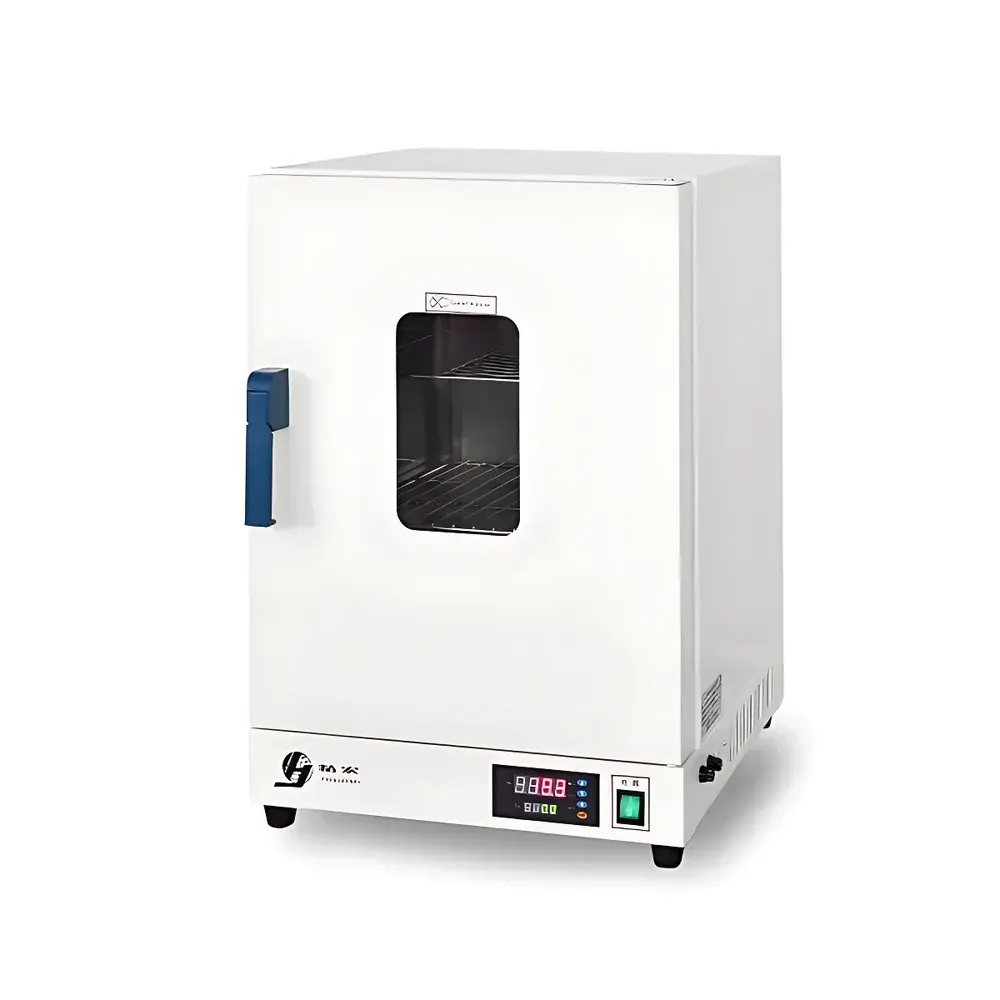
JingHong DHG-9140A & DHG-9140Y Forced-Air Drying Oven
| Brand | JingHong |
|---|---|
| Origin | Shanghai, China |
| Model | DHG-9140A, DHG-9140Y |
| Type | General-Purpose Forced-Air Oven |
| Temperature Range | Ambient +10 °C to 200 °C |
| Temperature Uniformity | ±1 °C |
| Temperature Resolution | 0.1 °C |
| Chamber Dimensions (W×D×H) | 450 mm × 550 mm × 550 mm |
| External Dimensions (W×D×H) | 655 mm × 760 mm × 905 mm |
| Operating Ambient Temperature | 5–40 °C |
| Interior Material | Stainless Steel (Grade 304) |
| Heating Method | Forced-Air Convection via Low-Noise Centrifugal Fan |
Overview
The JingHong DHG-9140A and DHG-9140Y are precision-engineered forced-air drying ovens designed for routine thermal processing in industrial quality control laboratories, academic research facilities, and pharmaceutical development environments. These ovens operate on the principle of convective heat transfer, utilizing a calibrated centrifugal blower and optimized internal air duct architecture to ensure uniform temperature distribution across the entire 0.136 m³ working chamber. Unlike natural convection ovens, the forced-air design accelerates moisture removal, shortens drying cycles, and improves repeatability—particularly critical for ASTM D2240 (Shore hardness), ISO 527 (tensile testing specimen conditioning), or USP polymer drying protocols. The dual-model configuration reflects minor variations in control interface or certification documentation (e.g., DHG-9140Y may include optional calibration certificate traceable to CNAS-accredited standards), while maintaining identical thermal performance and mechanical specifications.
Key Features
- Stainless steel (304 grade) interior chamber with seamless welded corners and polished finish—resistant to corrosion from solvents, acids, and repeated thermal cycling.
- Microprocessor-based PID temperature controller with dual digital display: one for setpoint, one for real-time chamber temperature—enabling immediate deviation detection during GLP-compliant operations.
- Adjustable airflow velocity via multi-position fan speed control—optimized for delicate samples (e.g., lyophilized proteins) or high-mass loads (e.g., ceramic crucibles).
- Over-temperature protection circuit with independent mechanical thermostat—meets IEC 61010-1 safety requirements for laboratory electrical equipment.
- Insulated double-wall construction with mineral wool insulation (≥50 mm thickness) minimizes external surface temperature rise and reduces energy consumption during extended 200 °C operation.
Sample Compatibility & Compliance
The DHG-9140 series accommodates standard laboratory ware including porcelain crucibles (up to Ø120 mm), glass Petri dishes, aluminum weighing pans, and stainless steel sample trays. Its chamber geometry supports stacked rack configurations (optional accessory) without compromising airflow integrity. The oven complies with GB/T 5170.2–2017 (Chinese national standard for temperature uniformity testing of drying ovens) and is routinely validated per IQ/OQ protocols in regulated environments. While not pre-certified to FDA 21 CFR Part 11, its analog/digital hybrid controller supports manual audit trails; users may integrate external data loggers compliant with Annex 11 for electronic record retention in GMP settings.
Software & Data Management
The DHG-9140A/Y features embedded firmware with programmable ramp-soak profiles (up to 8 segments), timer-based shutdown, and power-failure recovery mode. No proprietary software is required for basic operation; however, optional RS485 communication port enables connection to SCADA systems or LabVIEW-based monitoring platforms via Modbus RTU protocol. All temperature events—including setpoint changes, alarm triggers, and door-open intervals—are timestamped in non-volatile memory (retention ≥10 years at 25 °C). For regulatory submissions, raw data export requires external USB data logger (e.g., Omega OM-DAQPRO-5300) configured for continuous 1-second sampling.
Applications
- Drying of moisture-sensitive powders prior to Karl Fischer titration (ASTM E203).
- Conditioning of polymer films and composites per ISO 291 ambient preconditioning requirements.
- Baking of filter membranes for gravimetric particulate analysis (EPA Method 201A).
- Melting point verification of waxes and low-melting-point alloys using standardized metal blocks.
- Pre-sterilization drying of reusable glassware in microbiology labs (non-sterilizing function only; autoclaving requires separate validation).
- Accelerated aging studies under controlled thermal stress (e.g., IPC-TM-650 2.6.25 for PCB substrates).
FAQ
What is the maximum load capacity for uniform temperature performance?
For guaranteed ±1 °C uniformity across the full chamber volume, the recommended maximum load is 15 kg of inert material (e.g., stainless steel weights) distributed evenly on two standard 450 mm × 550 mm trays.
Does the oven support NIST-traceable calibration?
The unit ships with a factory calibration report (±0.5 °C at 100 °C); users must engage an accredited third-party lab (e.g., A2LA-certified) for NIST-traceable recalibration per ISO/IEC 17025.
Can the DHG-9140A be used for sterilization?
No. This model is not designed for microbial kill validation; it lacks HEPA filtration, steam generation, or validated hold times required for dry-heat sterilization (USP ).
Is door-opening compensation active during temperature control?
Yes—the PID algorithm includes adaptive recovery tuning that reduces overshoot by up to 40% after a 5-second door opening event, verified per GB/T 5170.2 test method.
What maintenance intervals are recommended for long-term stability?
Fan motor lubrication every 12 months; gasket inspection quarterly; annual verification of thermocouple drift using a reference thermometer (±0.3 °C tolerance).



