
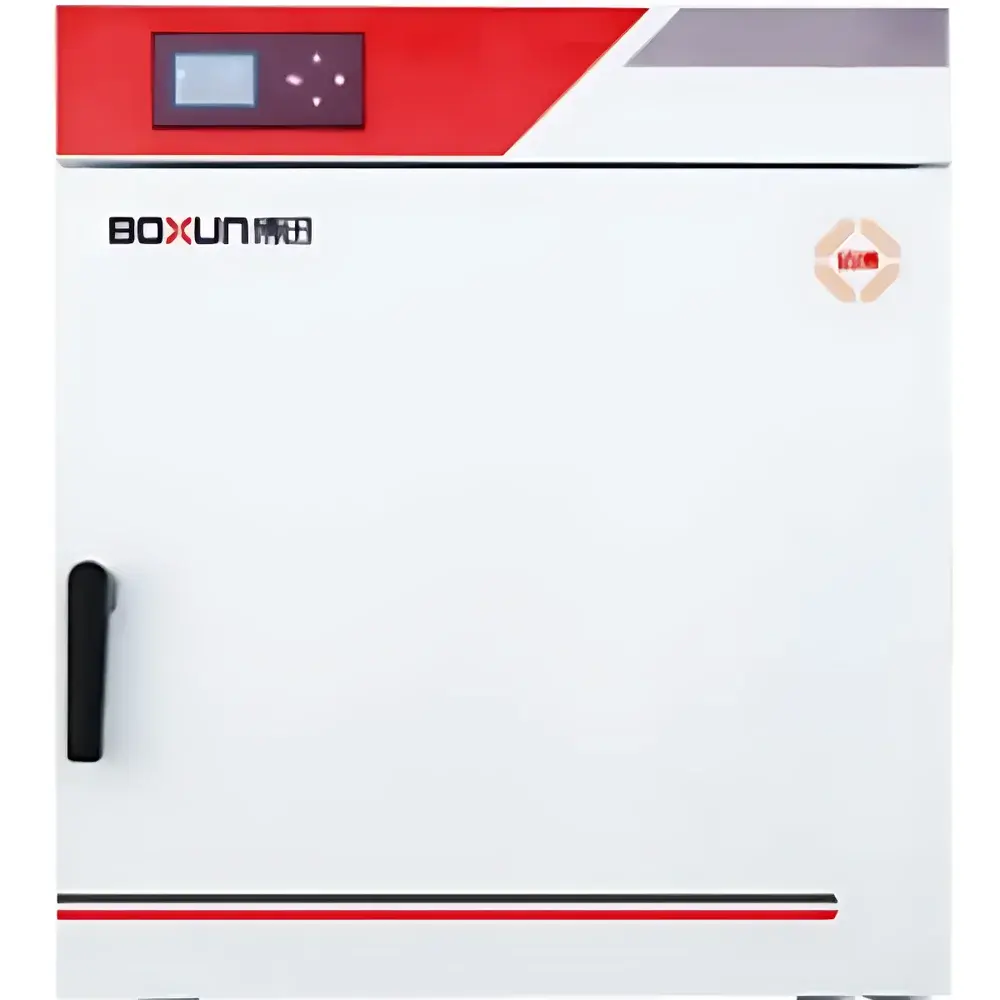
Boxun BGZ Series Forced-Air Drying Oven (Model BGZ-76)
| Key | Brand: Boxun |
|---|---|
| Origin | Shanghai, China |
| Model | BGZ-76 |
| Temperature Range | Ambient +5°C to 300°C |
| Temperature Uniformity | ±2% |
| Temperature Fluctuation | ±0.8°C at 105°C |
| Temperature Resolution | 0.1°C |
| Interior Dimensions (L×W×H) | 410×350×450 mm |
| Exterior Dimensions (L×W×H) | 555×566×722 mm |
| Heating Method | Forced-air convection with adjustable fan speed (6-speed) |
| Interior Material | Mirror-finish stainless steel |
| Insulation | High-efficiency mineral fiber |
| Power Supply | AC 220 V ±10%, 50 Hz ±2% |
| Input Power | 1550 W |
| Timer Range | 0–9999 min/h (switchable) |
| Programmable Control | 10 segments × 100 cycles |
| RS-485 Interface | Standard |
| Compliance | GB/T 30435–2013 |
Overview
The Boxun BGZ Series Forced-Air Drying Oven is a precision-engineered laboratory drying and heat treatment system designed for consistent thermal processing across research, quality control, and industrial validation environments. Based on forced convection heating principles, the BGZ series circulates preheated air uniformly throughout the chamber via a rear-mounted, multi-speed centrifugal blower and optimized airflow ducting—ensuring rapid temperature ramp-up (>5°C/min at 150°C), high spatial uniformity (±2%), and minimal thermal overshoot. Unlike natural-convection ovens, this design eliminates cold spots and supports applications requiring reproducible drying kinetics, moisture removal, sterilization of glassware, wax melting, and pre-conditioning of polymeric or particulate samples. The BGZ-76 model serves as the entry-point variant in a scalable platform spanning 64 L to 452 L internal volumes, all sharing identical control architecture, safety protocols, and regulatory alignment.
Key Features
- Robust dual-layer construction: Cold-rolled steel outer casing with electrostatic epoxy coating; mirror-polished 304 stainless steel interior chamber resistant to corrosion and repeated cleaning agents.
- Advanced PMMA II touchscreen interface with color LCD display, supporting real-time monitoring of setpoint, actual temperature, elapsed time, remaining time, and fan speed level.
- Programmable temperature profile capability: Up to 10 segments per cycle, 100 cycles total—enabling complex thermal ramps, holds, and step-down sequences for method development and process qualification.
- Pre-heated air inlet system: Air is heated externally and mixed before entering the working chamber, minimizing thermal lag and enhancing chamber-wide homogeneity during dynamic operation.
- 6-step adjustable fan speed control: Enables optimization of air velocity to suppress dust dispersion during drying of powders or granular materials while maintaining laminar flow integrity.
- Two-point mechanical door lock with dual-seal silicone gasket ensures >95% sealing efficiency and minimizes heat loss—critical for energy efficiency and stable long-duration runs.
- Chamber geometry optimized for serviceability: Rounded internal corners, tool-free removable shelves (2 standard, up to 5 optional), and smooth-welded seams facilitate ISO-compliant cleaning and residue inspection.
- Comprehensive safety architecture: Independent overtemperature cut-off (dual-limit thermostat), automatic power recovery after grid interruption, and audible/visual alarm for deviation >±5°C from setpoint.
Sample Compatibility & Compliance
The BGZ-76 accommodates a broad range of sample formats—including Petri dishes, weighing boats, crucibles, glass vials, aluminum pans, and ceramic trays—without compromising thermal stability. Its stainless steel chamber and absence of organic insulation binders make it suitable for low-outgassing applications under controlled environmental conditions. The oven complies with GB/T 30435–2013 (“Electric Hot Air Drying Ovens for Laboratory Use”), and its design principles align with foundational requirements of ISO/IEC 17025 for equipment qualification. While not certified to IEC 61010-1 or UL 61010B out-of-the-box, the unit’s electrical architecture, grounding continuity, and thermal cutoff redundancy support integration into GLP- and GMP-regulated workflows when accompanied by user-defined IQ/OQ documentation. It is routinely deployed in pharmaceutical stability studies (ICH Q1A), residual solvent analysis prep, catalyst activation, and ASTM D2240 Shore A hardness sample conditioning.
Software & Data Management
Data logging and remote supervision are enabled via the standard RS-485 serial interface (Modbus RTU protocol), permitting integration with SCADA systems, LIMS platforms, or custom Python-based acquisition scripts. The onboard controller retains full operational history—including start/stop timestamps, program ID, maximum deviation events, and fault codes—for minimum 30 days without external storage. Audit trail functionality meets basic traceability needs; however, for FDA 21 CFR Part 11 compliance (electronic signatures, role-based access, immutable logs), third-party middleware or validated data acquisition software is required. No proprietary cloud service or vendor-hosted firmware updates are implemented—firmware resides locally and remains user-controllable, supporting long-term validation lifecycle management.
Applications
- Drying of moisture-sensitive analytical standards prior to gravimetric assay
- Thermal stabilization of reference materials used in calibration laboratories
- Post-synthesis solvent evaporation for polymer synthesis intermediates
- Heat treatment of filter membranes prior to microbial challenge testing
- Conditioning of humidity sensors and hygrometer calibration standards
- Pre-baking of printed circuit board assemblies before conformal coating
- Accelerated aging of packaging materials per ASTM F1980
- Residue-on-ignition (ROI) determination in environmental soil testing (EPA Method 9081)
FAQ
Is the BGZ-76 validated for use in GMP environments?
Yes—when qualified per user-defined IQ/OQ protocols and operated within documented SOPs, the BGZ-76 meets baseline thermal performance criteria required for non-sterile manufacturing support activities, including component drying and equipment pre-heating.
Can the oven be calibrated internally without external tools?
The unit supports user-accessible offset calibration (±9.9°C range) using a certified reference thermometer at a single point (e.g., 105°C); full NIST-traceable calibration requires external dry-block or fluid-bath standards.
What is the maximum load weight the standard shelves can support?
Each shelf is rated for 15 kg distributed load; stacking multiple heavy samples requires verification of airflow obstruction and temperature uniformity per load configuration.
Does the RS-485 interface support Ethernet or USB conversion?
Yes—industrial-grade RS-485-to-Ethernet gateways (e.g., Moxa EDS-205A) or USB-to-RS-485 adapters (FTDI-based) are fully interoperable for lab network integration.
How often should the door seal be replaced for optimal performance?
Under continuous operation (8 h/day), inspect the silicone gasket every 6 months; replace if compression set exceeds 20% or visible cracking occurs—typical service life is 18–24 months.



