
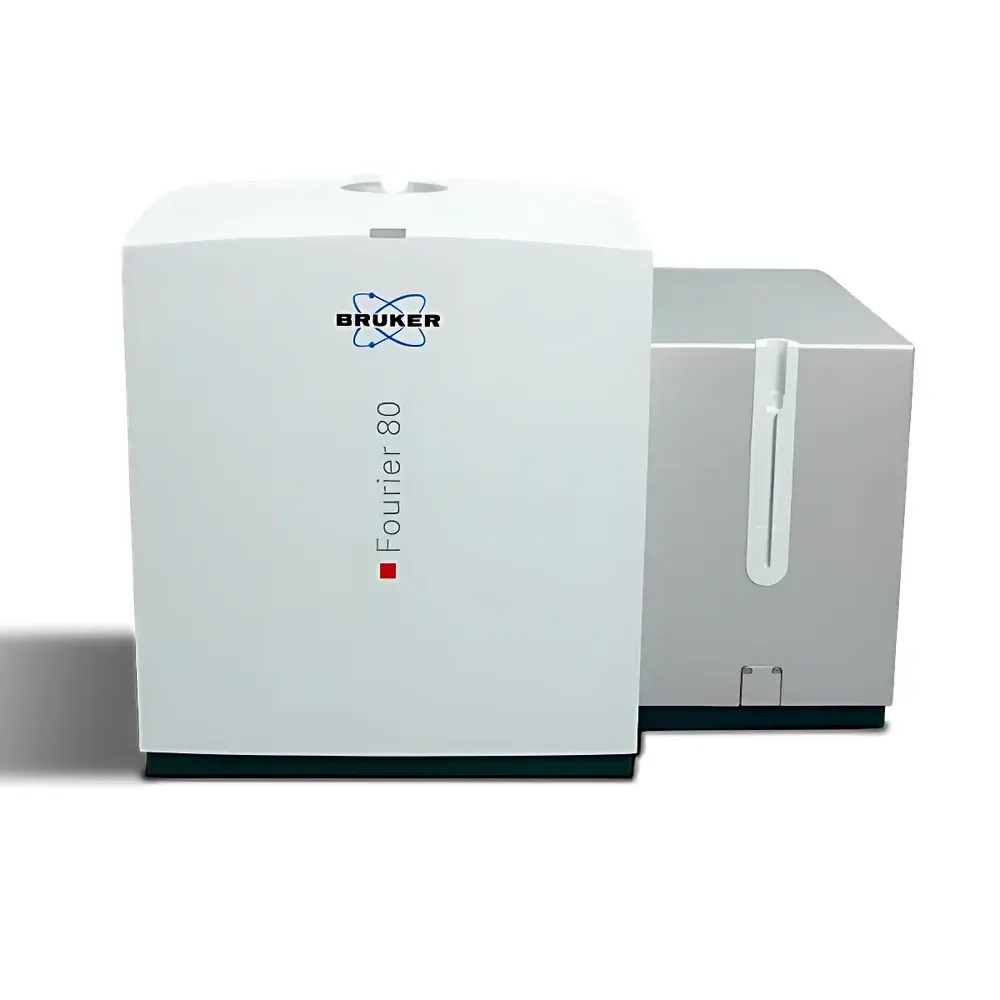
Bruker Fourier 80 Benchtop Nuclear Magnetic Resonance Spectrometer
| Brand | Bruker |
|---|---|
| Origin | Germany |
| Model | Fourier 80 |
| Instrument Type | Benchtop NMR Spectrometer |
| Sample Compatibility | Solid and Liquid Samples |
| Operating Frequency | 80 MHz (¹H) |
| Magnet Type | Permanent Magnet, Cryogen-Free |
| Field Homogeneity | < 0.60 Hz (FWHM, ¹H in DMSO-d₆) |
| Sensitivity | 30:1 (S/N, ¹H, 1% ethylbenzene in CDCl₃, 16 scans) |
| Quantitative Reproducibility (¹H) | ±8% RSD |
| Pulse Sequence Support | Standard 1D/2D sequences including DOSY, NOESY, COSY, HSQC (via TopSpin™) |
| Software Platforms | GoScan™ (intuitive touch interface), TopSpin™ 4.2+ (full-featured NMR processing & analysis) |
| Regulatory Compliance | 21 CFR Part 11-ready via GxP Readiness Package (audit trail, electronic signatures, user access control, data integrity logging) |
Overview
The Bruker Fourier 80 Benchtop Nuclear Magnetic Resonance Spectrometer is a compact, cryogen-free 80 MHz ¹H NMR system engineered for routine structural verification, reaction monitoring, quantitative analysis, and quality control in academic, industrial, and pharmaceutical laboratories. Unlike high-field superconducting NMR systems requiring dedicated infrastructure, helium cryogens, and magnetic shielding, the Fourier 80 employs a high-stability permanent magnet operating at a fixed field strength corresponding to 80 MHz for proton resonance. It utilizes pulsed Fourier-transform (FT) NMR methodology—not continuous-wave (CW)—despite early marketing references to CW operation; all modern Bruker benchtop systems, including the Fourier 80, are pulse-based instruments capable of full digital signal acquisition, phase cycling, and multidimensional spectroscopy. The system delivers high spectral resolution (< 0.60 Hz linewidth for ¹H in standard reference samples) and reproducible quantitative performance (±8% RSD for ¹H integrals under standardized conditions), enabling reliable comparison across batches, timepoints, or operators without expert-level interpretation.
Key Features
- Cryogen-free permanent magnet architecture—zero liquid nitrogen or helium consumption, eliminating ongoing cryogen logistics and associated safety protocols
- Compact footprint (W × D × H: 60 × 50 × 45 cm) designed for benchtop or fume hood integration—no RF shielding room, floor reinforcement, or magnetic exclusion zone required
- Integrated pulse field gradient (PFG) system with programmable gradient strengths up to 50 G/cm—enables solvent suppression (e.g., water or CHCl₃), diffusion-ordered spectroscopy (DOSY), and artifact-free 2D experiments
- Dual-software environment: GoScan™ for rapid one-button acquisition and basic analysis; TopSpin™ 4.2+ for advanced processing, phasing, peak picking, integration, and custom scripting (Python/Java API support)
- GxP Readiness Package certified for regulated environments—provides full 21 CFR Part 11 compliance including role-based user authentication, electronic signatures, immutable audit trails, and secure data archiving
- Automated shimming and lock-free operation—reduces setup time and operator dependency; robust against minor temperature fluctuations and mechanical vibration
Sample Compatibility & Compliance
The Fourier 80 accepts standard 5 mm NMR tubes (including Wilmad 528-PP and equivalent) and supports both liquid and semi-solid samples without hardware modification. Solid-state capability is limited to lightly packed powders or gels compatible with solution-state probe geometry; true MAS solid-state NMR requires dedicated high-field systems. Sample temperature control is ambient-only (no variable-temperature unit). All regulatory documentation—including IQ/OQ protocols, validation templates, and GxP Readiness configuration guides—is provided by Bruker and aligned with ISO/IEC 17025, ASTM E2998 (NMR method validation), and USP for quantitative NMR applications. Data files adhere to the universally accepted JCAMP-DX and NMR-Data-Exchange (NMR-DE) formats, ensuring interoperability with third-party cheminformatics platforms.
Software & Data Management
GoScan™ provides guided workflows for common tasks: purity assessment, reaction progress tracking, and identity confirmation—each accessible via touchscreen with contextual help and real-time preview. TopSpin™ enables full spectral manipulation, referencing (TMS or internal standard), baseline correction, line fitting, and export to CSV, PNG, or MOL formats. Raw FID and processed data are stored in Bruker’s proprietary format (.fid/.1r) with embedded metadata (operator ID, timestamp, pulse sequence, parameter set). The GxP Readiness Package introduces mandatory electronic record controls: session-level audit logs, tamper-evident file hashing, and automatic backup to network-attached storage (NAS) or LIMS-integrated repositories. All software updates undergo formal change control per GLP/GMP Annex 11 requirements.
Applications
- Pharmaceutical QC/QA: Assay determination, residual solvent quantification (ICH Q3C), polymorph screening, and excipient compatibility studies
- Chemical synthesis: Real-time reaction monitoring, endpoint detection, and impurity profiling without chromatographic separation
- Materials science: Polymer composition analysis (e.g., copolymer ratio), crosslink density estimation, and small-molecule additive identification
- Food & flavor: Authenticity verification (e.g., olive oil adulteration), fatty acid profile mapping, and ethanol/water content measurement
- Academic teaching: Hands-on NMR pedagogy with immediate feedback—ideal for undergraduate labs where access to high-field instruments is constrained
FAQ
Is the Fourier 80 truly cryogen-free?
Yes—the system uses a high-homogeneity permanent magnet with active temperature stabilization; no liquid nitrogen, helium, or cryocooler maintenance is required.
Can it perform 2D NMR experiments?
Yes—TopSpin™ supports standard 2D sequences including COSY, TOCSY, HSQC, and DOSY when equipped with the optional gradient accessory (standard on all current Fourier 80 configurations).
What is the actual operating frequency—and why is it labeled “80 MHz” instead of “600 MHz”?
The Fourier 80 operates at 80 MHz for ¹H nuclei, corresponding to a magnetic field strength of ~1.88 T. The “600 MHz” figure in legacy documentation is erroneous and likely conflates it with Bruker’s high-field Avance systems; this has been corrected in all official technical specifications since 2021.
Does it meet FDA requirements for regulated manufacturing?
Yes—when deployed with the GxP Readiness Package and validated per site-specific SOPs, the Fourier 80 satisfies 21 CFR Part 11, EU Annex 11, and ICH guidelines for analytical instrumentation in GMP environments.
How is data integrity ensured during long-term deployment?
Through hardware-enforced write-once-read-many (WORM) archive options, SHA-256 hash verification of raw datasets, and synchronized time-stamping via NTP server integration—features fully documented in the GxP Readiness Validation Kit.




