
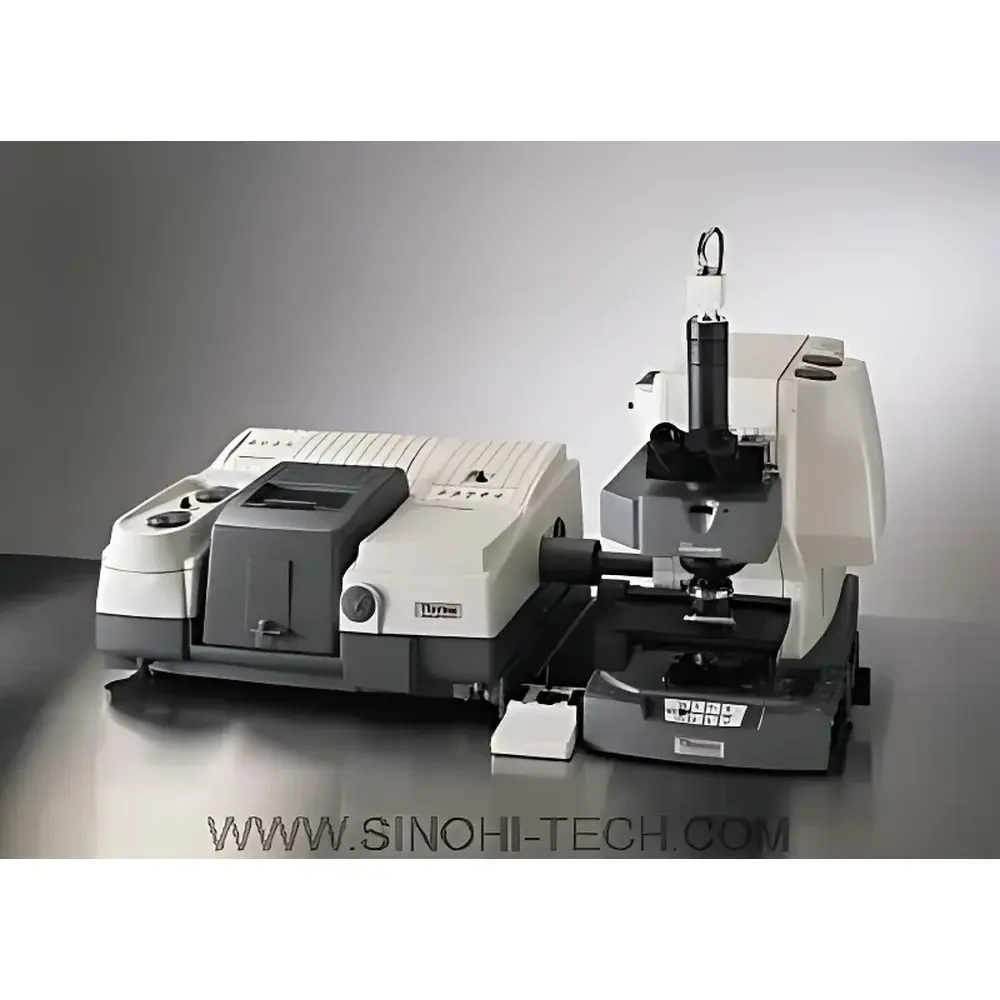
Continuum XL Infrared Chemical Imaging System
| Origin | USA |
|---|---|
| Manufacturer Type | Authorized Distributor |
| Origin Category | Imported |
| Model | Continuum XL |
| Pricing | Available Upon Request |
Overview
The Continuum XL Infrared Chemical Imaging System is a high-performance, research-grade FTIR microspectroscopy platform engineered for spatially resolved molecular characterization at the microscopic level. Based on Fourier Transform Infrared (FTIR) spectroscopy coupled with advanced optical microscopy, the system enables label-free, non-destructive chemical mapping of heterogeneous samples across mid- and near-infrared spectral ranges (typically 7500–600 cm⁻¹ or 1.3–16.7 µm). Its modular architecture supports seamless evolution from conventional single-point microanalysis to rapid, high-fidelity hyperspectral imaging—leveraging either dual-linear array detectors or focal plane array (FPA) technology. Designed for integration into regulated laboratory environments, the Continuum XL delivers sub-micron spatial resolution under optimal optical conditions and maintains strict alignment stability during extended acquisition sequences, making it suitable for quantitative spectral library matching, phase distribution analysis, and multivariate image decomposition.
Key Features
- Full backward compatibility with all patented optical and mechanical innovations of the Continuum μm series—including motorized beam path selection, automated aperture control, and precision Z-height compensation.
- Software-selectable single- or dual-aperture configuration: optimizes trade-offs between spatial resolution (down to ~3.5 µm diffraction-limited spot size in transmission) and signal-to-noise ratio (SNR) for diverse sample types and measurement modes.
- Multi-modal sampling support: fully integrated transmission, reflection, grazing-angle reflection, and Attenuated Total Reflection (ATR) geometries—each with dedicated optics calibration and alignment routines.
- Broad spectral flexibility: compatible with five interchangeable detector options—including liquid-nitrogen-cooled MCT, thermoelectrically cooled DTGS, and extended-range InSb—enabling tailored performance across NIR, MIR, and long-wave IR domains.
- Dual-linear array detector architecture: proprietary design enabling parallel acquisition of two adjacent spectral lines per scan, significantly accelerating imaging speed without compromising spectral fidelity or pixel registration accuracy.
- Configurable pixel formats: supports both 64 × 64 and 128 × 128 FPA imaging modes with on-chip binning options, balancing field-of-view coverage and spatial sampling density.
- Intelligent stage navigation: motorized XYZ sample stage with three programmable preview speeds (slow/medium/fast), real-time video overlay, and auto-focus-assisted region-of-interest (ROI) targeting for rapid micro-area localization.
- High-fidelity image capture: synchronized visible-light CCD imaging (1.4 MP, LED-illuminated) co-registered with IR spectral data, supporting precise morphological-spectral correlation and annotation.
- USB 2.0 high-throughput interface: ensures deterministic data streaming to host PC with minimal latency, compatible with Windows-based acquisition software and third-party spectral processing libraries.
Sample Compatibility & Compliance
The Continuum XL accommodates solid, thin-film, particulate, and semi-transparent biological specimens—including polymer blends, pharmaceutical tablets, forensic trace evidence, geological thin sections, and tissue cryosections. Sample mounting is facilitated via standard microscope slides, IR-transparent windows (KBr, CaF₂, BaF₂), or ATR crystal accessories. The system complies with ISO 17025 requirements for analytical instrument qualification and supports full GxP documentation workflows when paired with validated software modules. Data integrity safeguards include audit-trail-enabled acquisition logs, electronic signatures per FDA 21 CFR Part 11, and GLP-compliant metadata embedding (sample ID, operator, date/time, instrument parameters, spectral calibration status).
Software & Data Management
Operation is managed through OMNIC Paradigm software (v10.x or later), providing unified control of spectroscopic acquisition, stage motion, detector configuration, and real-time spectral visualization. The platform supports batch processing of hyperspectral cubes, hierarchical cluster analysis (HCA), principal component analysis (PCA), and classical least-squares (CLS) unmixing. All spectral data are stored in standardized JCAMP-DX format; image metadata conforms to the ASTM E2897-22 standard for infrared imaging data exchange. Raw and processed datasets export seamlessly to MATLAB, Python (via h5py or spectral Python libraries), and commercial chemometrics packages.
Applications
- Pharmaceutical development: active pharmaceutical ingredient (API) distribution mapping in tablet formulations, coating uniformity assessment, and counterfeit drug detection.
- Materials science: polymer phase segregation analysis, filler dispersion quantification in composites, and degradation product localization in aged plastics.
- Life sciences: lipid/protein distribution in frozen-hydrated tissue sections, cell-type identification in unstained histology, and biomolecular response profiling under controlled stimuli.
- Forensics: micro-trace identification (e.g., paint layers, fibers, explosives residues) with micron-scale spatial discrimination.
- Geosciences: mineralogical zoning in thin sections, fluid inclusion characterization, and organic matter distribution in shale samples.
FAQ
What spectral range does the Continuum XL support?
Standard configurations cover 7500–600 cm⁻¹ (1.3–16.7 µm); optional extensions enable coverage down to 50 cm⁻¹ or up to 12,000 cm⁻¹ depending on detector and beam splitter selection.
Is the system compliant with regulatory data integrity standards?
Yes—when operated with validated OMNIC Paradigm software and appropriate IT infrastructure, it meets FDA 21 CFR Part 11, EU Annex 11, and ISO/IEC 17025 requirements for electronic records and signatures.
Can the Continuum XL perform quantitative analysis?
Quantitative capabilities depend on calibration strategy and reference standards; the system supports external calibration curves, internal standard normalization, and multivariate regression models using built-in or third-party tools.
How is spatial resolution determined in IR imaging mode?
Resolution is governed by diffraction limits (~λ/2), optical magnification, and pixel sampling density; typical effective resolution ranges from 5.5 µm (20× objective, MCT detector) to 1.5 µm (36× ATR objective, FPA mode).
Does the system require liquid nitrogen cooling?
Only when using liquid-N₂-cooled MCT detectors; DTGS and thermoelectrically cooled alternatives operate at ambient or Peltier-stabilized temperatures.




