
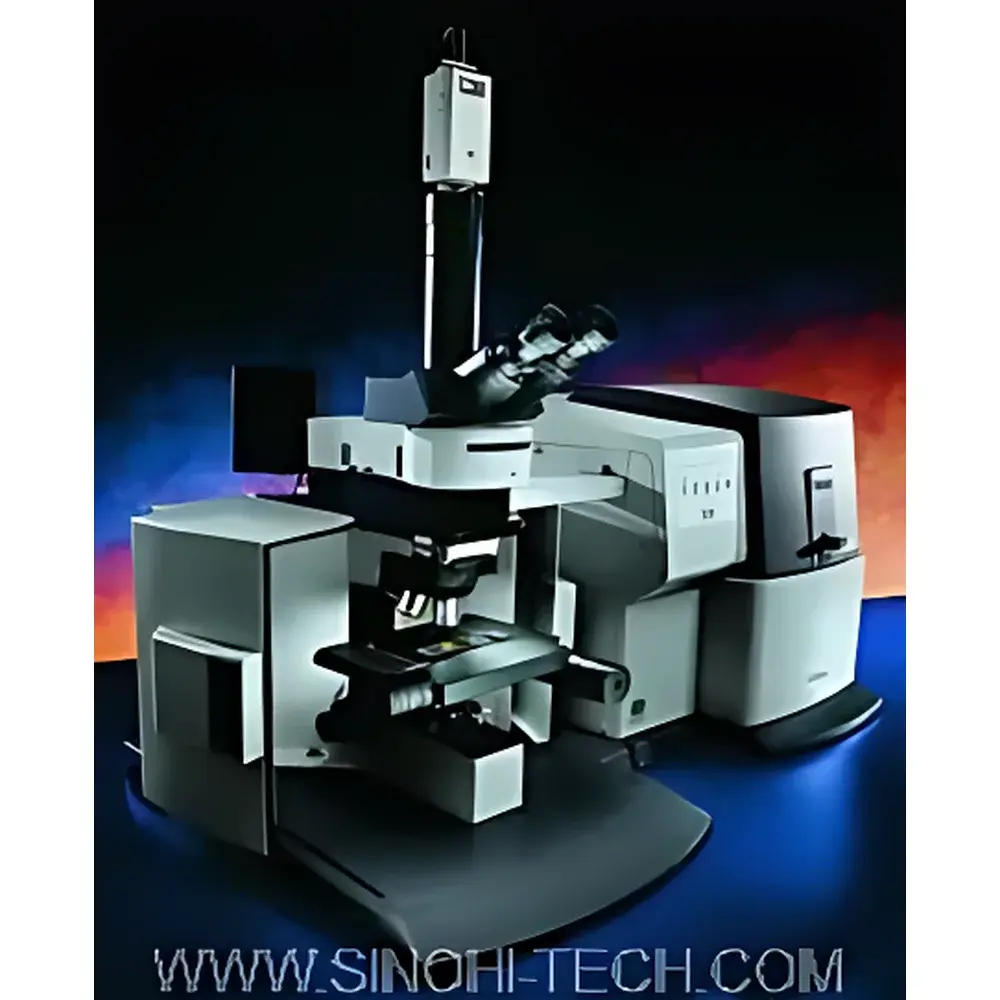
Thermo Scientific Almega XR FT-Raman Spectrometer
| Origin | USA |
|---|---|
| Manufacturer Type | Authorized Distributor |
| Origin Category | Imported |
| Model | Almega XR |
| Pricing | Available Upon Request |
Overview
The Thermo Scientific Almega XR FT-Raman Spectrometer is a high-performance, research-grade Fourier-transform Raman (FT-Raman) instrument engineered for precision molecular fingerprinting across diverse solid, liquid, and powder samples. Leveraging Thermo Fisher Scientific’s (formerly Nicolet) decades of expertise in FT-based vibrational spectroscopy, the Almega XR integrates dual optical architectures — a large-volume sample compartment and a fully integrated, motorized confocal Raman microscope — into a single platform. Its core measurement principle relies on near-infrared (NIR) laser excitation combined with interferometric detection to suppress fluorescence interference while delivering high signal-to-noise ratio spectra with excellent photometric accuracy. Designed for laboratories requiring regulatory-compliant spectral acquisition, method validation, and long-term instrument stability, the Almega XR supports both macro- and micro-scale analysis without hardware reconfiguration.
Key Features
- True confocal Raman microscopy with adjustable aperture — user-selectable slit or circular pinhole for depth-resolved spectral acquisition and axial optical sectioning;
- Large-capacity sample compartment accommodating standard petri dishes, vials, cuvettes, and custom fixtures up to 150 mm in diameter;
- Automated, software-controlled laser source switching among three NIR/visible wavelengths: 785 nm (standard), 633 nm, and 532 nm — each paired with dedicated high- and low-resolution diffraction gratings;
- Thermoelectrically cooled, wide-spectral-range CCD detector (400–1050 nm) with zero maintenance requirement and stable quantum efficiency across the full range;
- Class I laser safety certification per IEC 60825-1:2014 and FDA 21 CFR Part 1040.10 — no operator interlocks or external safety enclosures required during routine operation;
- Integrated XYZ motorized stage with sub-micron positioning repeatability for automated mapping and multi-point spectral acquisition.
Sample Compatibility & Compliance
The Almega XR accepts heterogeneous samples without preprocessing: crystalline pharmaceuticals, polymer blends, geological specimens, biological tissues (frozen or fixed), battery electrode materials, and catalytic surfaces. Its confocal geometry enables layer-by-layer interrogation of stratified structures such as coated tablets, multilayer films, and corrosion interfaces. The system complies with ISO/IEC 17025:2017 requirements for testing laboratories and supports audit-ready workflows aligned with FDA 21 CFR Part 11, EU Annex 11, and GLP/GMP documentation standards. All spectral metadata — including laser power, integration time, grating selection, aperture size, and stage coordinates — are embedded in proprietary .spa files and exportable in ASTM E131-compliant JCAMP-DX format.
Software & Data Management
Controlled by OMNIC™ Specta software (v10.x or later), the Almega XR provides intuitive method building, real-time spectral preview, and automated baseline correction using adaptive polynomial fitting. The software includes built-in spectral library search against >30,000 reference Raman spectra (including USP, EP, and NIST-certified compounds), peak deconvolution via constrained Gaussian-Lorentzian fitting, and quantitative PLS regression modeling. Data integrity safeguards include electronic signatures, audit trail logging (with timestamped user actions and parameter changes), and role-based access control. Raw data and processed results are stored in encrypted SQLite databases compliant with ALCOA+ principles (Attributable, Legible, Contemporaneous, Original, Accurate, Complete, Consistent, Enduring, Available).
Applications
- Pharmaceutical solid-state characterization: polymorph identification, hydrate/solvate screening, blend uniformity assessment;
- Materials science: carbon nanotube chirality mapping, graphene layer counting, stress/strain distribution in composites;
- Forensics: non-destructive analysis of inks, paints, explosives residues, and counterfeit drug formulations;
- Geosciences: mineral phase identification in thin sections and drill cores under ambient conditions;
- Academic research: time-resolved photochemical reaction monitoring, in situ electrochemical Raman studies, and temperature-dependent phonon mode tracking.
FAQ
Does the Almega XR support fluorescence suppression for highly fluorescent samples?
Yes — its 785 nm excitation source minimizes electronic resonance effects, and the FT architecture inherently rejects broadband fluorescence through interferometric filtering.
Can I perform Raman imaging without changing optics or alignment?
Yes — the integrated confocal microscope and motorized XYZ stage enable rapid point-and-shoot mapping with no manual realignment between spectral acquisition and spatial scanning.
Is the system compatible with third-party chemometric software?
Yes — spectral data exports in open formats (JCAMP-DX, CSV, ASCII) and supports direct API integration with MATLAB, Python (via SciPy/NumPy), and commercial tools like Unscrambler® and Pirouette®.
What maintenance is required for the CCD detector?
None — the thermoelectric cooling system is sealed and solid-state; no cryogens, vacuum pumps, or periodic recalibration are needed over the instrument’s operational lifetime.
How is laser power calibrated and verified?
Each laser module includes an internal power sensor with NIST-traceable calibration; OMNIC software logs real-time power values at acquisition and supports scheduled verification protocols per ISO 17025 Section 6.5.





