
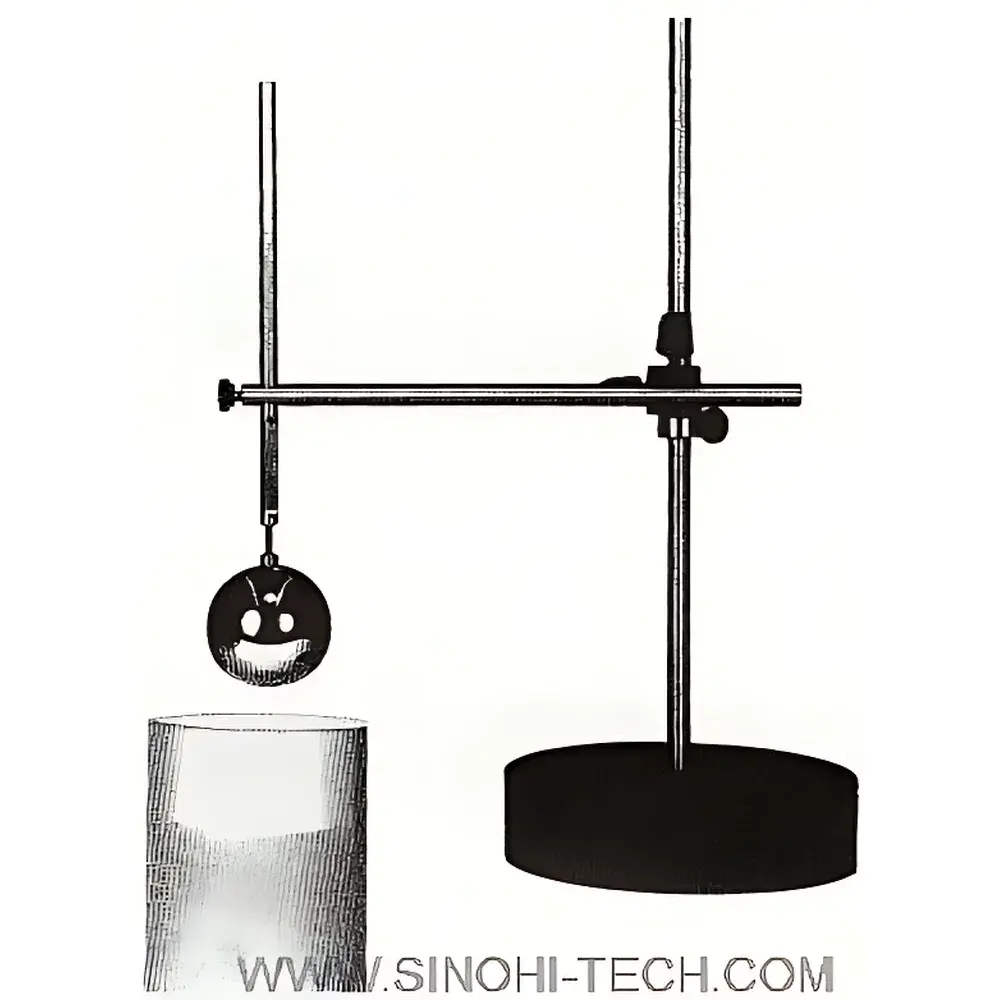
ILSIN #475 Density Sphere
| Origin | Germany |
|---|---|
| Manufacturer Type | Authorized Distributor |
| Origin Category | Imported |
| Model | #475 |
| Pricing | Upon Request |
Overview
The ILSIN #475 Density Sphere is a precision buoyancy-based density measurement instrument engineered for rapid, gravimetric determination of liquid density in industrial R&D and quality control laboratories. It operates on Archimedes’ principle: when the calibrated spherical body is fully immersed to a defined depth (at the neck reference mark of the support rod), the apparent mass loss—measured via high-resolution analytical balance—is directly proportional to the displaced volume and the density of the test liquid. Designed for non-sedimenting, low-viscosity liquids—including architectural paints, industrial coatings, solvents, inks, and cleaning formulations—the #475 sphere delivers traceable, temperature-controlled density values in g/mL at 20 °C, with final reporting resolution of 0.001 g/mL. Its methodology aligns with fundamental physical property testing standards under ISO 2811-1 (paints and varnishes — determination of density — part 1: pycnometer method) and ASTM D1475 (standard test method for density of liquid coatings, inks, and related products), serving as a robust alternative to pycnometers where sample throughput and operator repeatability are critical.
Key Features
- Calibrated spherical displacement body manufactured to DIN EN ISO/IEC 17025-accredited dimensional tolerances, available in two volumetric variants: 100 mL ±0.1% (Model #475/I and #475/II) or 10 mL ±0.1% (Model #475/III and #475/IV), both referenced at 20 °C
- Traceable calibration: Models #475/II and #475/IV include official certification issued by the German Physikalisch-Technische Bundesanstalt (PTB) or equivalent national metrology institute, documenting certified volume, air buoyancy correction factor, and uncertainty budget
- Modular mechanical design comprising a precision-ground stainless-steel sphere, a thermally stable glass-reinforced polymer support rod with engraved neck reference line, and optional rotating arm mount compatible with standard lab bench stands
- No internal electronics or fluid handling components—ensuring long-term stability, zero drift, and minimal maintenance across decades of use
- Compatible with Class I and II analytical balances (readability ≥0.001 g for #475/III; ≥0.01 g for #475/I), supporting GLP-compliant weight recording protocols
Sample Compatibility & Compliance
The #475 Density Sphere is validated for Newtonian and near-Newtonian liquids exhibiting negligible sedimentation over the measurement interval (typically <60 seconds). It is not suitable for highly thixotropic systems, suspensions with rapid phase separation (e.g., pigment-rich latexes without stabilizers), or volatile solvents requiring inert-atmosphere handling. For such cases, the complementary ILSIN #290 Specific Gravity Cup is recommended. All models comply with EU Measuring Instruments Directive (MID) Annex MI-001 for material measures, and calibration documentation satisfies traceability requirements under ISO/IEC 17025, FDA 21 CFR Part 11 (when integrated with compliant balance software), and GMP Annex 15 analytical instrument qualification frameworks.
Software & Data Management
As a passive mechanical standard, the #475 Density Sphere requires no embedded firmware or proprietary software. Density calculation follows the standardized equation:
ρt = (W2 − W1) / V + ρair,
where W1 = tare mass of beaker + liquid (g), W2 = apparent mass during immersion (g), V = certified sphere volume at immersion depth (mL), and ρair = 0.0012 g/mL (standard air density at 20 °C, 101.325 kPa). Laboratories may implement this formula within validated spreadsheet templates or LIMS-integrated balance software (e.g., Mettler Toledo LabX, Sartorius Cubis® II) to ensure audit-ready calculation logs, electronic signatures, and full data traceability per ALCOA+ principles.
Applications
- Batch release testing of solvent-borne and water-borne coatings per ISO 3233 and ASTM D2697
- Density verification of raw materials (resins, plasticizers, monomers) prior to formulation
- In-process monitoring of dilution consistency in paint manufacturing lines
- Reference density measurements for calibrating digital densimeters (e.g., Anton Paar DMA series) and ultrasonic analyzers
- Academic teaching labs demonstrating buoyancy, fluid statics, and metrological traceability concepts
FAQ
What temperature control is required during measurement?
All measurements must be performed at 20.0 ± 0.5 °C, maintained using a thermostatted water bath or climate-controlled chamber. Temperature deviation beyond ±0.5 °C invalidates volume calibration and introduces systematic error exceeding ±0.0005 g/mL.
Why is degassing necessary before immersion?
Entrapped air bubbles on the sphere surface or within the liquid introduce positive bias in W2. Gentle agitation or static settling for ≥30 seconds—followed by slow, rotational lowering of the sphere—is mandatory to eliminate interfacial voids.
Can the #475 be used for viscous resins or uncured polymers?
No. Viscosities above ~500 mPa·s impede complete bubble detachment and hinder reproducible immersion kinetics. For such materials, use capillary-based or oscillating U-tube densimeters.
Is recalibration required after mechanical impact?
Yes. Any visible deformation of the sphere or support rod, or loss of the neck reference line’s integrity, necessitates return to an accredited metrology lab for volumetric re-certification and PTB documentation renewal.



