
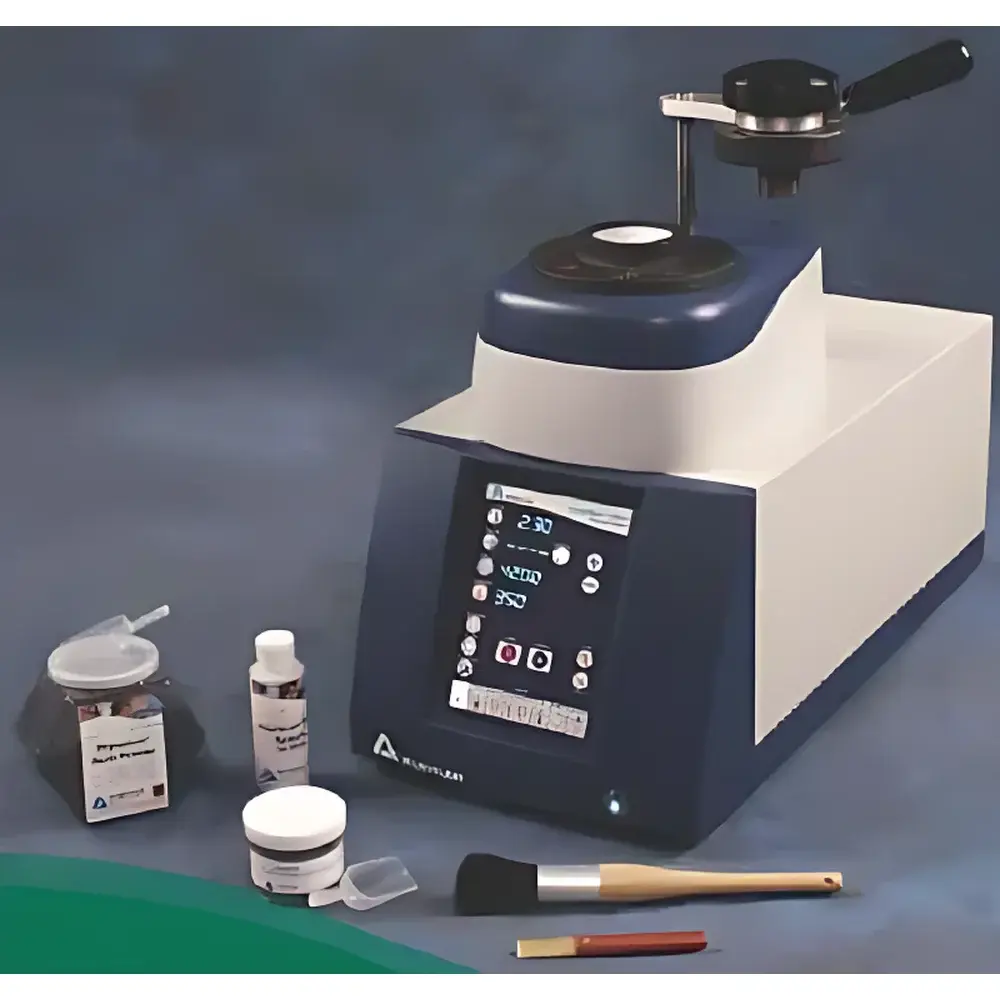
SimpliMet XPS1 Automated Hot Mounting Press by BUEHLER
| Brand | BUEHLER |
|---|---|
| Origin | USA |
| Model | SimpliMet XPS1 |
| Instrument Type | Hot Mounting Press |
| Cooling System | SmartCool™ Intelligent Water-Saving Cooling |
| Avg. Cycle Time | 3.5 min |
| Water Consumption Reduction | 50% |
| Operation | Single-Handed Locking Mechanism |
| Interface | LED Display with Real-Time Progress Bar |
| Thermal Safety | Insulated Mold Assembly |
| Footprint | Compact Benchtop Design |
| Compliance | Designed for ISO 14971 Risk Management & ASTM E3-22 Sample Preparation Standards |
Overview
The SimpliMet XPS1 Automated Hot Mounting Press is a discontinued but technically significant benchtop thermosetting embedding system engineered by BUEHLER (USA) for precision metallurgical, materials science, and failure analysis laboratories. It operates on the principle of hot compression molding—applying controlled heat (typically 120–180 °C), axial pressure (up to 12 MPa), and dwell time to consolidate thermosetting resins (e.g., phenolic, epoxy, or acrylic) around solid specimens. The system integrates a closed-loop thermal management architecture with proprietary SmartCool™ technology, which dynamically modulates coolant flow and heat dissipation based on real-time mold temperature feedback—enabling rapid thermal cycling without manual intervention or external chiller dependency. Unlike conventional hydraulic or pneumatic hot presses, the XPS1 employs an electromechanical actuation system with position-sensing feedback, ensuring repeatable force application and eliminating oil leakage risks. Its design prioritizes operational safety, reproducibility, and compliance with laboratory workflow standards—including GLP-aligned parameter traceability and ergonomic access protocols.
Key Features
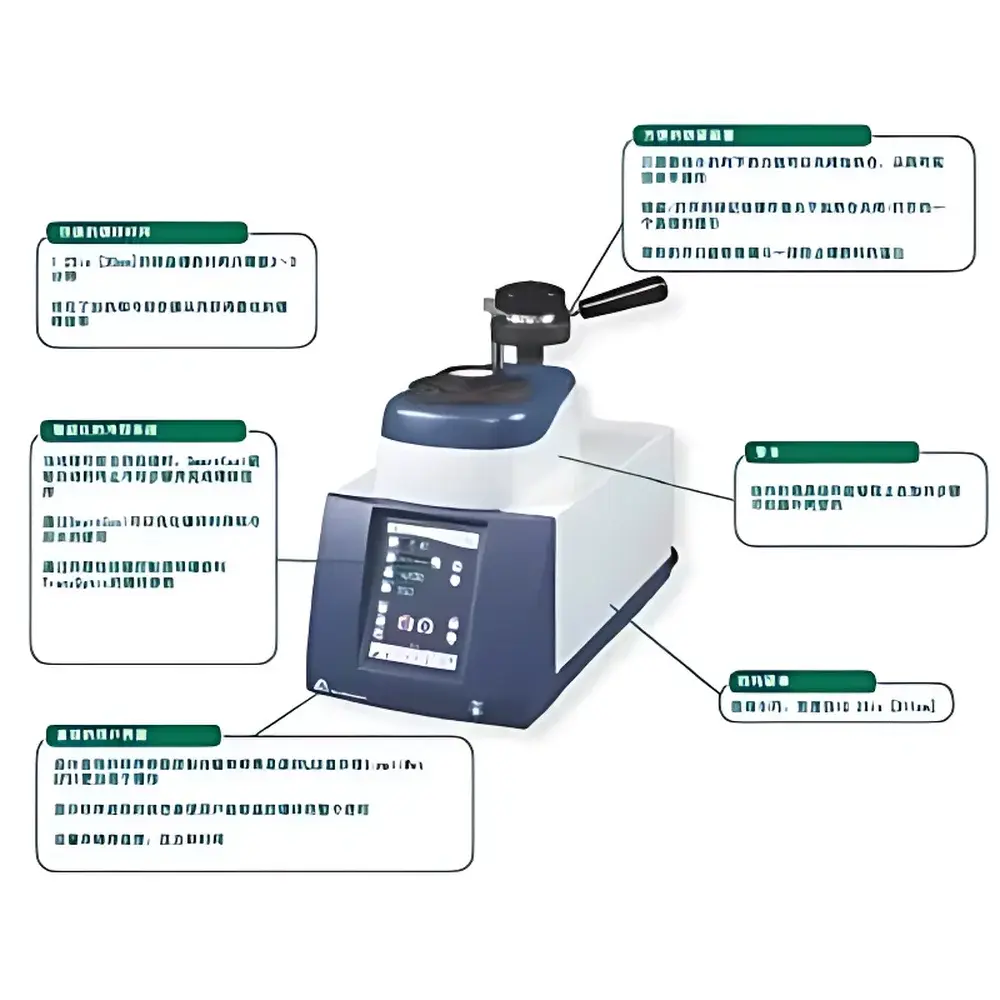
- SmartCool™ Intelligent Cooling System: Reduces average cycle time to 3.5 minutes and cuts water consumption by 50% versus legacy hot presses—achieving full resin cure and ambient-temperature ejection without post-cycle air-cooling delays.
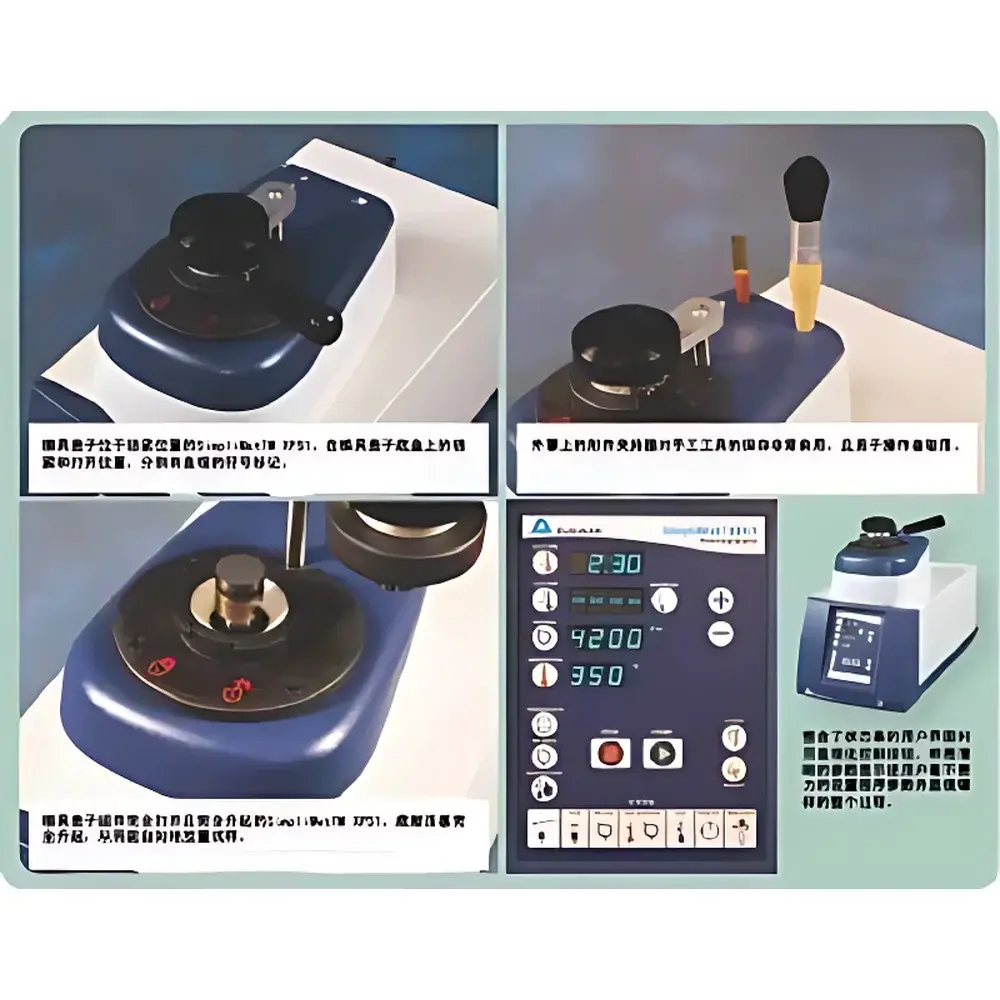
- Single-Handed Mold Locking Mechanism: Patented cam-and-lever assembly requires minimal actuation force (<15 N), enabling secure closure while maintaining operator hand clearance from heated zones.
- LED-Based Human-Machine Interface (HMI): Features a high-contrast monochrome display with real-time progress bar, step-by-step status indicators (heating → compression → curing → cooling → ejection), and tactile navigation buttons.
- Parameter Memory Function: Stores up to 10 user-defined programs—including temperature setpoint (±0.5 °C accuracy), pressure profile (ramp/hold), and dwell duration—with timestamped recall for audit-ready repeatability.
- Thermally Isolated Mold Assembly: Ceramic-fiber insulated cavity walls maintain external surface temperatures below 45 °C during operation, complying with IEC 61000-3-2 touch-safety requirements.
- Compact Benchtop Form Factor: Dimensions of 320 × 380 × 410 mm (W × D × H) and weight of 28 kg enable integration into space-constrained QA/QC labs or shared microscopy suites.
Sample Compatibility & Compliance
The SimpliMet XPS1 accommodates standard 25–30 mm diameter metallographic mounts using interchangeable mold inserts (phenolic, epoxy, and conductive carbon-filled variants). It supports heterogeneous samples—including sintered ceramics, composite laminates, electronic solder joints, and geological thin sections—provided maximum specimen height does not exceed 18 mm. All resin cycles conform to ASTM E3-22 “Standard Guide for Preparation of Metallographic Specimens” and ISO 15510:2021 “Metallic materials — Metallographic specimen preparation”. The device’s electrical architecture meets UL 61010-1 and CE/EMC Directive 2014/30/EU requirements. While not FDA-certified as a medical device, its parameter logging capability supports 21 CFR Part 11-compliant data integrity practices when integrated with validated LIMS environments.
Software & Data Management
Though the XPS1 lacks native PC connectivity or embedded firmware-upgrade capability, its HMI implements non-volatile memory for program storage with write-cycle endurance exceeding 100,000 cycles. Each stored method includes metadata fields for operator ID, date/time stamp, and resin batch reference—exportable via optional RS-232 serial interface (using ASCII protocol) for integration into laboratory documentation systems. Audit trails are maintained locally in EEPROM, retaining last 50 cycle logs with temperature-pressure-time arrays at 1-second resolution. No cloud functionality or remote diagnostics were implemented; all calibration and verification procedures follow BUEHLER’s Factory Service Bulletin FS-XPS1-REV4 (2019), which specifies annual thermocouple validation and load-cell linearity checks per ISO/IEC 17025 Clause 6.5.
Applications
- High-throughput metallographic sample preparation in automotive component QA labs, where cycle time reduction directly increases SEM/EDS throughput.
- Encapsulation of brittle fracture surfaces for subsequent ion milling or FIB-SEM cross-sectioning—minimizing edge rounding via precise thermal gradient control.
- Embedding of PCB microsections with low-void phenolic resin, leveraging uniform pressure distribution to prevent delamination of solder mask layers.
- Preparation of geological thin sections requiring thermal stability across multi-phase mineral assemblages (e.g., quartz-feldspar-mica systems).
- Academic research workflows involving comparative resin studies—where programmable dwell profiles enable direct correlation between cross-link density and Vickers hardness outcomes.
FAQ
Is the SimpliMet XPS1 still supported by BUEHLER for service or spare parts?
BUEHLER discontinued manufacturing and official technical support for the XPS1 in Q4 2021. Limited consumables (mold inserts, resin kits) remain available through authorized distributors until stock depletion.
Can the XPS1 be retrofitted with digital connectivity or modern software?
No. The unit lacks expansion headers, USB ports, or firmware update capability; hardware-level integration with modern LIMS or MES platforms is not feasible.
What safety certifications apply to the XPS1?
It carries UL 61010-1 (2nd Ed.), CE marking per EMC Directive 2014/30/EU and Low Voltage Directive 2014/35/EU, and complies with ISO 14971:2019 risk management principles for laboratory equipment.
Does the SmartCool™ system require special coolant or plumbing modifications?
It operates with standard deionized water at 2–4 bar inlet pressure and 15–25 °C supply temperature—no glycol mixtures or chilled water loops are needed.
How is calibration verified for temperature and pressure parameters?
Temperature is validated using NIST-traceable Class A PT100 probes inserted into designated mold ports; pressure calibration requires certified deadweight tester verification against the internal load cell at three points (25%, 50%, 100% range).



