
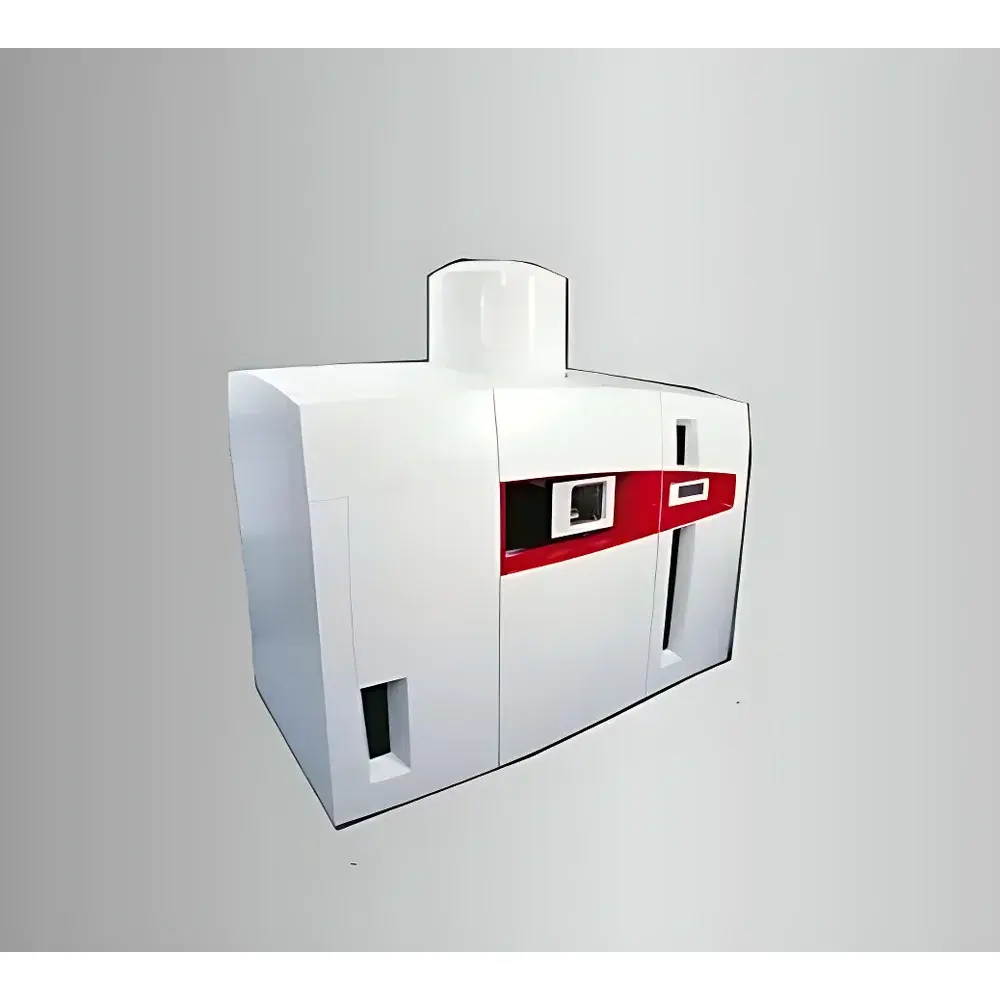
Shimadzu AXIS NOVA X-ray Photoelectron Spectrometer
| Brand | Shimadzu |
|---|---|
| Origin | Japan |
| Model | AXIS NOVA |
| Detector Type | Second-generation 2D Delay-Line Detector (DLD) |
| X-ray Source | Monochromated Al Kα (1486.6 eV) |
| Analyzer | 165 mm Mean Radius Double-Focusing Hemispherical Sector Analyzer |
| Charge Neutralization | Co-axial Low-Energy Single-Electron Flood Gun |
| Sample Stage | Motorized Large-Area Stage (Up to 100 mm Diameter) |
| Imaging Mode | Parallel Electron Imaging with Spherical Mirror Analyzer |
| Analysis Modes | Conventional XPS, Small-Area XPS, ISS, Fast XPS Imaging |
Overview
The Shimadzu AXIS NOVA is a high-performance X-ray Photoelectron Spectrometer (XPS) engineered for quantitative surface chemical analysis at the nanometer scale. Based on the photoelectric effect, it measures the kinetic energy of photoelectrons ejected from a sample surface upon irradiation with monochromated Al Kα X-rays (1486.6 eV), enabling precise determination of elemental composition, chemical state, and electronic structure within the top 0.5–10 nm of solid materials. Designed for laboratories requiring both high spectral resolution and spatially resolved chemical mapping, the AXIS NOVA integrates advanced electron optics, ultra-stable vacuum architecture, and automated sample handling to support routine and research-grade surface characterization in academic, industrial, and regulatory environments.
Key Features
- Monochromated Al Kα X-ray Source: Delivers high-flux, narrow-line-width excitation (FWHM < 0.3 eV) for improved energy resolution and reduced sample damage compared to non-monochromatic sources.
- 165 mm Double-Focusing Hemispherical Analyzer: Provides exceptional energy resolution (< 0.45 eV at Mg Kα pass energy) and high transmission efficiency, essential for resolving subtle chemical shifts (e.g., C–C, C–O, C=O).
- Second-Generation 2D Delay-Line Detector (DLD): Positioned at the focal plane of the analyzer, this detector simultaneously records photoelectron intensity and emission angle, enabling true parallel acquisition of full-spectrum XPS data in seconds — without scanning.
- Co-axial Low-Energy Single-Electron Flood Gun: Integrated into the electrostatic lens column, this charge neutralizer delivers uniform, low-energy electrons (< 5 eV) with precise energy and angular control, ensuring stable and reproducible charge compensation on insulating samples including powders, ceramics, polymers, and fractured surfaces.
- Spherical Mirror Energy Analyzer (SMEA) for Imaging: Enables parallel acquisition of photoelectron images with spatial resolution down to 3 µm (at optimal conditions), supporting chemical-state-specific 2D mapping (e.g., oxidation gradients, phase segregation, interface chemistry).
- Motorized Large-Area Sample Stage: Accommodates substrates up to 100 mm in diameter; combined with integrated optical microscope in the load-lock chamber, supports precise region-of-interest selection and fully automated positioning for unattended multi-point analysis.
Sample Compatibility & Compliance
The AXIS NOVA accommodates conductive, semi-conductive, and insulating solid samples—including thin films, catalysts, battery electrodes, polymer blends, corrosion layers, and cross-sectioned devices—without requiring conductive coating. Its robust charge neutralization system meets ASTM E1907-22 and ISO 18118:2017 requirements for reliable XPS analysis of heterogeneous and topographically complex specimens. The instrument operates under ultra-high vacuum (UHV) conditions (< 5 × 10⁻⁹ mbar base pressure), conforming to ISO 27427:2012 specifications for surface analysis instrumentation. Data acquisition and reporting workflows are compatible with GLP/GMP documentation standards, and optional audit-trail modules support compliance with FDA 21 CFR Part 11 for regulated pharmaceutical and medical device R&D.
Software & Data Management
Controlled via Shimadzu’s proprietary CASA (Curve Analysis Software for XPS) platform, the AXIS NOVA provides intuitive instrument operation, real-time spectral preview, and comprehensive post-processing capabilities—including peak fitting with Shirley/Tougaard background subtraction, quantification using Scofield sensitivity factors, chemical state deconvolution, depth profiling (with Ar⁺ sputtering integration), and overlay/mosaic imaging. All raw and processed data are stored in vendor-neutral formats (VAMAS, JCAMP-DX), facilitating third-party analysis and long-term archival. The software supports automated report generation with embedded metadata (instrument parameters, calibration history, operator ID), traceable to ISO/IEC 17025 quality management systems.
Applications
- Surface oxidation state analysis of transition metal oxides in catalysis and energy storage;
- Chemical mapping of functional groups across polymer blend interfaces;
- Quantitative thickness and stoichiometry measurement of ALD-grown dielectric layers;
- Failure analysis of microelectronic interconnects and solder joint interfaces;
- Characterization of passivation layers on biomedical implants;
- Corrosion product identification and layer sequencing on alloy surfaces;
- Validation of surface modification treatments (plasma, UV-ozone, silanization).
FAQ
What vacuum level does the AXIS NOVA maintain during analysis?
The system achieves and sustains a base pressure better than 5 × 10⁻⁹ mbar in the analysis chamber using a combination of turbomolecular pumping and cryo-trapping, ensuring minimal surface contamination during data acquisition.
Can the AXIS NOVA perform depth profiling?
Yes — when integrated with a differentially pumped Ar⁺ ion gun (optional), it supports high-resolution sputter depth profiling with simultaneous XPS acquisition, enabling 3D chemical reconstruction of multilayer structures.
Is the instrument compatible with external ion sources or synchrotron beamlines?
The AXIS NOVA is a self-contained laboratory XPS system optimized for Al Kα excitation; it is not designed for external photon or ion beam coupling. Synchrotron-based measurements require dedicated end-station instrumentation.
How is energy calibration performed and verified?
Calibration uses intrinsic reference peaks (e.g., Au 4f₇/₂ at 84.0 eV, Cu 2p₃/₂ at 932.7 eV, Ag 3d₅/₂ at 368.3 eV) and is traceable to NIST SRM standards; daily verification protocols are embedded in the CASA software.
Does the system support automated batch analysis of multiple samples?
Yes — the motorized stage, programmable optical microscope navigation, and scriptable CASA workflow engine enable unattended multi-sample, multi-location analysis sequences with full metadata logging.




