
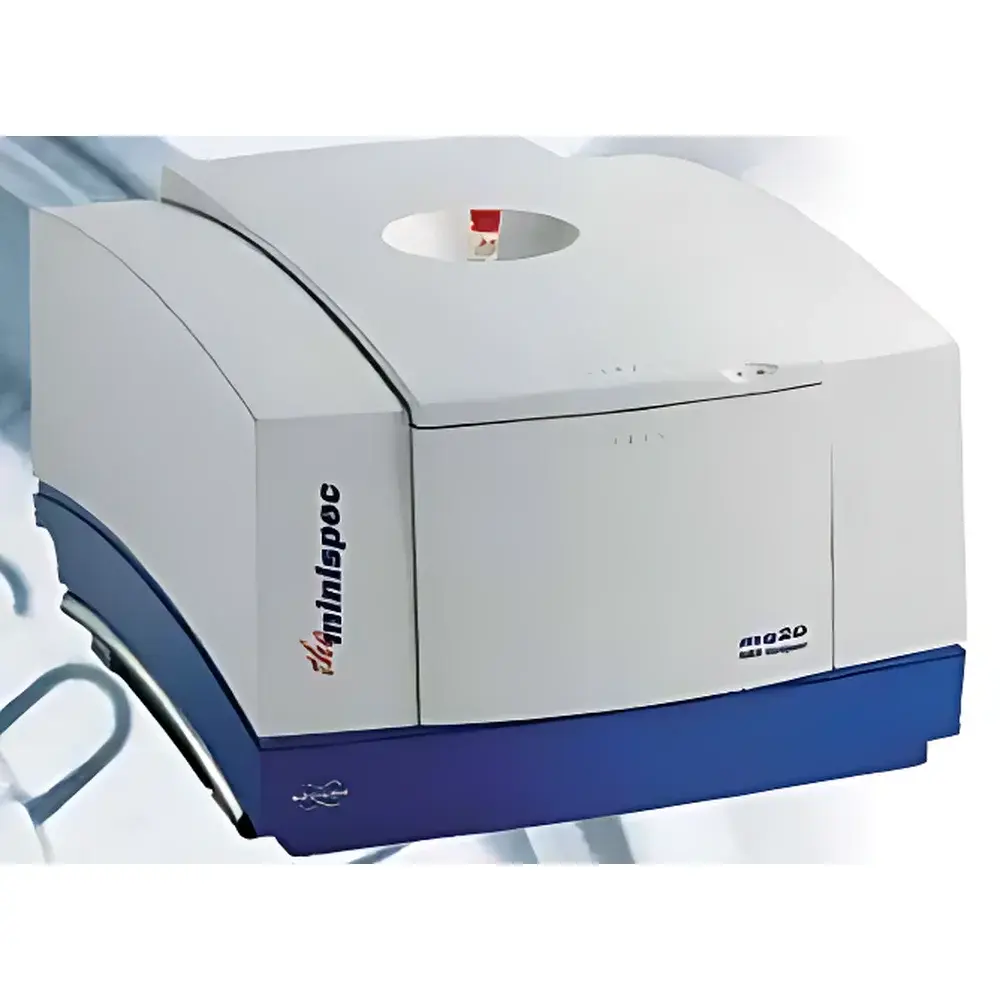
Bruker Minispec Fiber Oil Content Analyzer
| Brand | Bruker |
|---|---|
| Origin | Germany |
| Model | Minispec Fiber Oil Content Analyzer |
| Measurement Principle | Time-Domain Nuclear Magnetic Resonance (TD-NMR) |
| Analysis Time | < 60 s per sample |
| Sample Throughput | Up to 100 samples (with optional autosampler) |
| Compliance | FDA 21 CFR Part 11, GLP/GMP-ready |
| Software | Minispec FiberOil v5.x |
| Detection Target | Oil Pick-up (OPU), Fiber Oil Finish (FOF), Yarn Oil Finish (FOY) |
| Sample Form | Loose fibers, filaments, staple fibers, yarns, nonwovens |
| Calibration Options | Weighted and non-weighted methods |
| Sensitivity | Optimized for low-oil-content fibers (down to ~0.05 wt%) |
Overview
The Bruker Minispec Fiber Oil Content Analyzer is a benchtop time-domain nuclear magnetic resonance (TD-NMR) instrument engineered for rapid, precise, and non-destructive quantification of oil content in synthetic and semi-synthetic textile fibers. Unlike traditional solvent-based extraction methods—such as ASTM D2257 or ISO 1833-13—which require hours of sample preparation, hazardous solvents, operator-dependent handling, and irreversible sample destruction—the Minispec leverages the intrinsic magnetic relaxation behavior of hydrogen nuclei in oil versus polymer matrix and moisture. In TD-NMR, transverse relaxation decay (T₂) profiles are acquired following a 90°–180° pulse sequence; oil protons exhibit significantly longer T₂ values than those in solid polymer chains or bound water, enabling selective, calibration-based quantification without chemical separation. This principle delivers traceable, reproducible results compliant with ISO/IEC 17025 laboratory accreditation requirements and supports real-time process control in fiber spinning, texturing, and finishing lines.
Key Features
- Single-shot analysis in under 60 seconds—enabling on-line quality verification at production line speed
- No solvents, no consumables, no sample digestion—eliminating toxic waste disposal and regulatory reporting burdens
- Non-destructive measurement preserves sample integrity for downstream testing (e.g., tensile strength, dye uptake)
- Dual calibration modes: non-weighted (high-throughput screening) and weighted (trace-level accuracy, 0.05–15 wt% OPU range)
- Autosampler support for unattended analysis of up to 100 samples with barcode tracking and automated data logging
- Hermetically sealed electronics and robust RF architecture ensure long-term stability in industrial environments (e.g., spinning halls with dust, vibration, temperature fluctuation)
- Pre-certified reference standards included for rapid instrument qualification and routine performance verification
Sample Compatibility & Compliance
The Minispec Fiber Oil Content Analyzer accommodates a broad spectrum of fiber morphologies and chemistries, including continuous filaments (polyester, polyamide-6/6.6, polypropylene, acrylic), staple fibers, textured yarns, and nonwoven webs. It has been validated across fiber deniers from 1.0 to 150 dtex and oil finishes ranging from silicone-based lubricants to mineral-oil emulsions and bio-derived esters. Method validation studies confirm linearity (r² > 0.999), repeatability (RSD < 1.2%), and intermediate precision (RSD < 2.0%) per ISO 5725-2. The system meets GLP documentation requirements and supports full 21 CFR Part 11 compliance—including electronic signatures, audit trails, user role management, and secure data archiving—making it suitable for regulated manufacturing environments operating under ICH Q5C, USP , or ISO 9001 quality systems.
Software & Data Management
The FiberOil software suite provides an intuitive, workflow-driven interface designed for routine operation by production technicians and QA analysts alike. All measurement steps—from sample loading prompts to result export—are guided via step-by-step wizards. Raw FID data, T₂ decay curves, and calibration parameters are stored in encrypted, tamper-evident project files. The software enables cross-instrument calibration transfer: a master curve generated on one Minispec mq-series unit can be securely deployed to other units via encrypted USB key or network sync—reducing method validation effort across multi-site operations. Audit trail logs capture all user actions, parameter changes, and calibration events with timestamps and operator IDs. Export options include CSV, PDF reports, and direct integration with LIMS via ODBC.
Applications
This analyzer serves critical functions across the fiber value chain: optimizing spin-finish application rates during melt spinning; verifying oil uniformity after texturing or false-twist processes; validating finish removal efficiency in scouring lines; supporting R&D of low-oil, high-friction-control formulations; and ensuring batch-to-batch consistency prior to shipment. Its speed and reliability make it indispensable for lean manufacturing initiatives—replacing offline lab bottlenecks with in-process decision points that prevent off-spec material escalation. End users include global producers of tire cord, industrial filtration media, automotive composites, and technical textiles where oil content directly impacts adhesion, dyeability, static charge dissipation, and abrasion resistance.
FAQ
What types of oil finishes can be measured?
The system quantifies total mobile hydrogen-bearing compounds—including mineral oils, silicone fluids, fatty acid esters, and polyglycol-based finishes—provided they exhibit distinct T₂ relaxation signatures relative to the fiber matrix.
Is sample homogenization required?
No. Representative sub-sampling (e.g., 0.5–2.0 g of loose fiber) is sufficient. For heterogeneous yarns or core-sheath structures, multiple measurements per lot are recommended per ISO 10545-13 statistical sampling guidelines.
How often does the instrument require recalibration?
Initial calibration is performed using Bruker-supplied certified reference standards. Routine verification is conducted daily or per shift using a check standard; full recalibration is typically needed only after hardware maintenance or when introducing new fiber/oil combinations.
Can the system be integrated into a factory automation network?
Yes. The analyzer supports Modbus TCP and OPC UA protocols for bidirectional communication with MES/SCADA systems. Real-time OPU values can trigger automatic adjustments in finish applicator pumps via PLC interface.
Does the method require method validation for internal SOP adoption?
Yes. While the TD-NMR principle is scientifically established, each laboratory must perform method suitability testing per ICH Q2(R2), including specificity, linearity, accuracy, precision, and robustness assessments against their specific fiber-oil matrix.




