
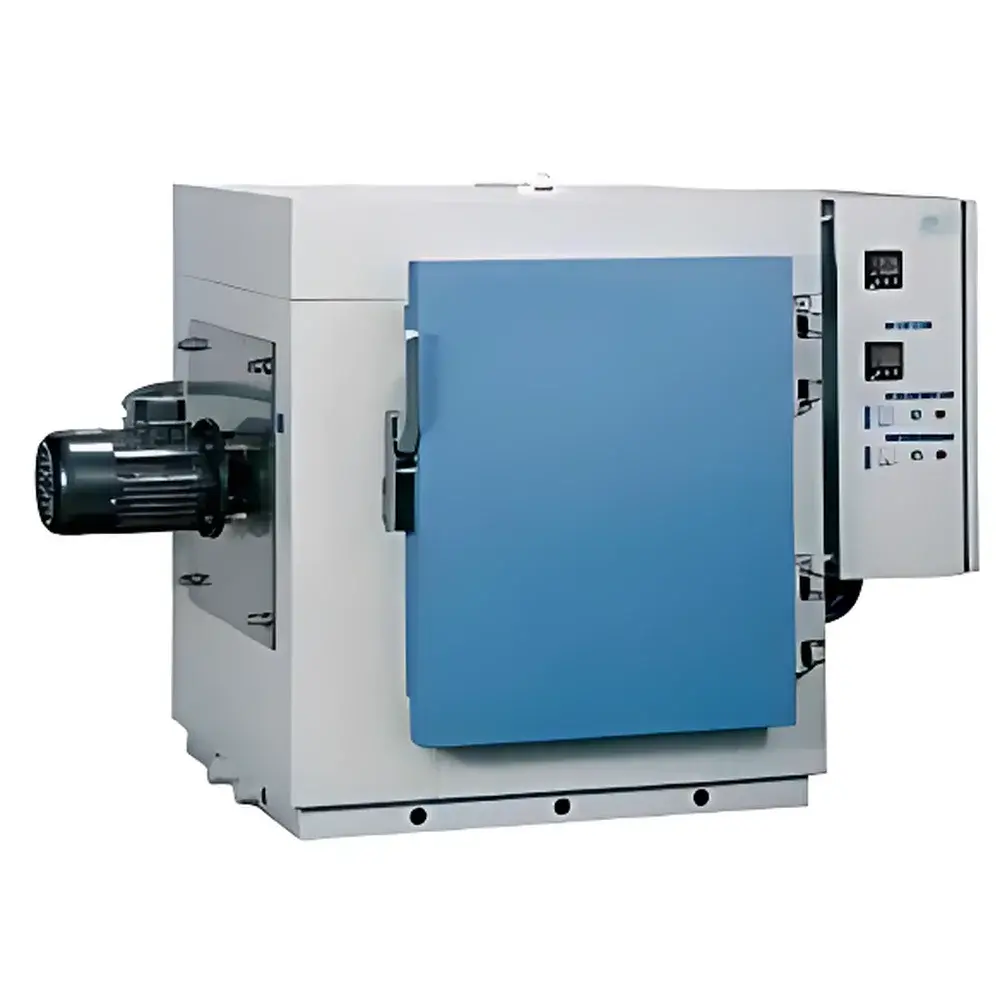
JP Hightemp High-Temperature Forced-Air Circulating Oven
| Brand | JP |
|---|---|
| Origin | Spain |
| Model | Hightemp |
| Temperature Range | 60–400 °C |
| Temperature Stability (≤300 °C) | ±1.0 °C |
| Temperature Uniformity (≤300 °C) | ±3.0 °C |
| Setpoint Accuracy | ±2% of working temperature |
| Resolution | 1.0 °C |
| Internal Dimensions (H×W×D) | 50×40×40 cm |
| External Dimensions (H×W×D) | 80×120×61 cm |
| Chamber Material | AISI 310 heat-resistant stainless steel |
| Heating Method | Forced-air convection with shielded heating elements |
| Fan Motor | Thermally protected, independently powered, operable during cooling cycle |
| Ventilation | Adjustable exhaust outlet |
| Cabinet Finish | Epoxy-polyester powder coating |
| Power Supply | 230/400 V three-phase |
| Rated Power | 4000 W |
| Net Weight | 75 kg |
| Shelf Positions | 4 fixed rails |
| Compliance | Designed for GLP-compliant thermal processing in R&D and QC laboratories |
Overview
The JP Hightemp High-Temperature Forced-Air Circulating Oven is an industrial-grade laboratory oven engineered for precise, repeatable thermal processing across demanding applications including material aging, polymer curing, metal stress-relieving, catalyst activation, and residual solvent removal. Based on the fundamental principle of forced-air convection, it maintains stable thermal environments by actively circulating heated air through a fully insulated chamber via a thermally isolated fan motor and strategically shielded heating elements. Unlike natural-convection ovens, this design ensures rapid heat-up times, minimized thermal gradients, and high reproducibility—critical for ASTM D570 (water absorption), ISO 293 (hot-plate molding), and USP extractables studies where temperature uniformity directly impacts material property outcomes.
Key Features
- Microprocessor-based digital temperature controller with dual-display interface for setpoint and real-time chamber temperature, supporting programmable time-based operation and automatic shutdown.
- Thermally decoupled control cabinet: The electronics housing is physically separated from the hot chamber using insulating barriers, reducing thermal drift and extending component service life under continuous high-temperature operation.
- AISI 310 stainless steel inner chamber: Selected for its superior oxidation resistance up to 1100 °C short-term and sustained mechanical integrity at 400 °C—significantly outperforming standard 304 or 316 grades in long-duration thermal cycling.
- Four fixed-position shelf rails: Precision-machined into the chamber walls to ensure consistent sample placement geometry and eliminate alignment variability between runs—a key requirement for inter-laboratory method transfer.
- Independent fan motor with thermal cut-off protection: Operates continuously during heating, cooling, and hold phases; automatically disengages if internal motor temperature exceeds safe thresholds, preserving motor longevity without interrupting process logic.
- Adjustable rear exhaust port: Enables controlled atmosphere exchange to manage volatile emissions or humidity buildup during extended drying cycles, compatible with optional ducting for fume extraction compliance.
- Epoxy-polyester powder-coated exterior: Provides corrosion resistance against cleaning agents and environmental moisture while maintaining structural rigidity under ambient lab conditions.
Sample Compatibility & Compliance
The Hightemp oven accommodates standard laboratory glassware (e.g., Petri dishes, crucibles, weighing boats), ceramic trays, and metal fixtures within its 50×40×40 cm usable volume. Its construction meets essential safety and performance benchmarks for Class II laboratory equipment per IEC 61010-1:2010 (Electrical Safety Requirements for Laboratory Equipment). While not intrinsically rated for hazardous area use, its sealed heating element layout and grounded chassis support integration into ISO 17025-accredited quality systems. The microprocessor firmware supports audit-ready operation logs when paired with external data acquisition systems compliant with FDA 21 CFR Part 11 requirements for electronic records.
Software & Data Management
The onboard controller does not include embedded data logging; however, it features a standardized 0–10 V analog output and RS-485 Modbus RTU interface for seamless integration with third-party SCADA platforms (e.g., LabVIEW, Ignition, Siemens Desigo). This architecture enables centralized monitoring of temperature profiles, alarm status, and run-time duration across multi-oven installations. For GLP/GMP environments, users may connect calibrated external temperature mapping probes (e.g., Fluke 1524 with Hygropalm HP23-A) to document chamber uniformity per IQ/OQ protocols—particularly recommended prior to validation of sterilization or stability testing procedures.
Applications
- Accelerated aging of plastics and composites per ASTM G154 and ISO 4892-3 (UV + thermal cycling).
- Pre-drying of moisture-sensitive reagents and reference standards before gravimetric analysis.
- Thermal desorption of adsorbed water from silica gel, molecular sieves, and catalyst supports.
- Heat treatment of metallurgical samples prior to hardness testing or microstructural analysis.
- Residual solvent removal from coated substrates in pharmaceutical film manufacturing.
- Calibration verification of thermocouples and RTDs using traceable NIST-traceable reference sensors.
FAQ
What is the maximum continuous operating temperature?
The oven is rated for continuous operation at 400 °C; however, temperature stability and uniformity specifications (±1.0 °C and ±3.0 °C, respectively) are validated only up to 300 °C per manufacturer test reports.
Can the oven be used for inert-atmosphere processing?
No—this model lacks gas inlet/outlet ports or pressure-sealed doors. For nitrogen or argon purging, consider the optional JP InertTemp variant with dual-gas manifold and O₂ sensor integration.
Is the temperature sensor calibrated traceably to national standards?
The built-in PT100 sensor is factory-calibrated; full traceability documentation (including as-found/as-left data) is available upon request for IQ/OQ validation packages.
How often should chamber uniformity mapping be performed?
Per ISO/IEC 17025:2017 Clause 7.8.2, uniformity verification is recommended semiannually—or after any major maintenance event affecting airflow or heater performance.
Does the unit comply with energy efficiency regulations such as EU Ecodesign Directive 2019/2021?
Yes—the 4000 W heating system incorporates duty-cycle optimization and intelligent fan speed modulation to meet Tier 2 energy consumption limits for laboratory ovens under EN 60335-2-91.



