
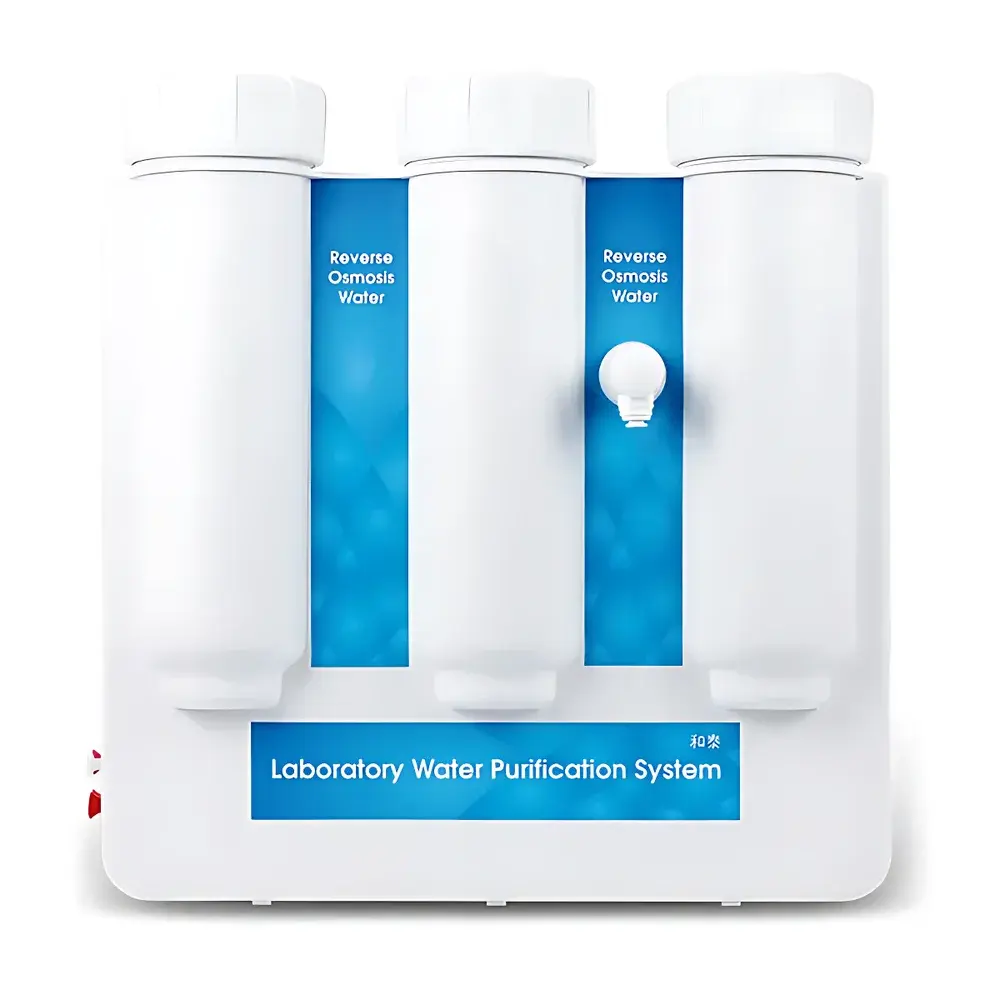
HHitech Smart-RO Reverse Osmosis Pure Water System (Municipal Tap Water Feed)
| Brand | HHitech |
|---|---|
| Origin | Shanghai, China |
| Manufacturer Type | Direct Manufacturer |
| Regional Classification | Domestic (China) |
| Model | Smart-RO |
| Price Range | USD 700–1,400 (est.) |
| Purified Water Grade | ASTM Type I Reagent Water (as per ASTM D1193-20) |
| Resistivity | ≥18.2 MΩ·cm @ 25°C |
| Heavy Metals & Soluble Silica | <0.1 ppb |
| Total Organic Carbon (TOC) | <3 ppb |
| Microbial Count | <0.01 CFU/mL |
| Endotoxins | <0.001 EU/mL |
| Particles (>0.1 µm) | <1 particle/mL |
| RO Membrane | Dow FilmTec™ FT30 (USA-sourced) |
| Pre-treatment Stages | PP Sediment Filter + Granular Activated Carbon + RO + Post-AC |
| Flow Rate | 15–30 L/h (model-dependent) |
| Ion Rejection Rate | ≥96% (fresh membrane) |
| Organic Rejection (MW >200 Da) | ≥99% |
| Microbial/Particulate Rejection | ≥99% |
| Power Supply | 220 VAC, 50 Hz |
| Power Consumption | 48 W (Smart-RO15) / 72 W (Smart-RO30) |
| Dimensions (L×W×H) | 41 × 22 × 42 cm |
| Weight | ~20 kg |
Overview
The HHitech Smart-RO Reverse Osmosis Pure Water System is an entry-tier, high-reliability laboratory water purification platform engineered for consistent production of ASTM Type I reagent-grade water from municipal tap feed. Utilizing a four-stage purification architecture—polypropylene sediment prefiltration, granular activated carbon adsorption, high-efficiency thin-film composite reverse osmosis (RO), and post-RO activated carbon polishing—the system delivers purified water with resistivity ≥18.2 MΩ·cm at 25°C, TOC <3 ppb, endotoxin <0.001 EU/mL, and particle count 0.1 µm). Its core RO module integrates Dow FilmTec™ FT30 membrane elements, selected for proven long-term stability under variable feedwater conditions and compliance with ISO 9001-certified manufacturing protocols. Designed for routine lab support applications—not ultratrace analytical workflows—the Smart-RO serves as a robust primary water source for glassware rinsing, buffer preparation, autoclave feed, environmental chamber humidification, and as pretreatment feed for downstream ultra-pure water systems.
Key Features
- Integrated, space-saving chassis fabricated from medical-grade polypropylene via one-piece injection molding—chemically inert, non-leaching, and compliant with USP Class VI biocompatibility requirements.
- Internalized cartridge design with quick-release top-access cover—enables full prefilter replacement without tooling or cabinet disassembly, supporting GLP-aligned maintenance documentation and reducing downtime.
- Microprocessor-controlled operation with real-time pressure sensing: automatic startup/shutdown on inlet water loss; auto-refill and overfill protection for connected pressure storage tanks; programmable daily RO membrane flush cycles to inhibit scaling and biofilm formation.
- Backlit LCD panel displaying real-time resistivity (MΩ·cm) and temperature-compensated conductivity (µS/cm) of RO output—calibrated per ASTM D1125 and traceable to NIST standards.
- Included handheld TDS/conductivity/temperature meter (battery-powered, no charging required) for rapid verification of feedwater quality and RO performance validation.
- NSF/ANSI Standard 58-certified fluid path components—including tubing, quick-connect fittings, and diaphragm pressure tanks—ensuring material safety and leachate control in regulated environments.
Sample Compatibility & Compliance
The Smart-RO is validated for continuous operation with municipally supplied tap water meeting ASTM D1193 input specifications: TDS ≤200 ppm, temperature 5–45°C, and inlet pressure 1.0–4.0 kgf/cm² (14–58 psi). Systems installed in regions with elevated hardness or chloride require optional external softening—documented in operational SOPs per ISO/IEC 17025 Clause 7.2.2. All electrical components conform to IEC 61010-1 safety standards. The unit’s firmware implements audit-trail-capable event logging (power cycles, alarm triggers, flush initiations), satisfying foundational requirements for GLP and GMP Annex 11 data integrity expectations. While not FDA 21 CFR Part 11–validated out-of-the-box, the system supports integration into validated water distribution networks when paired with qualified storage and dispensing modules.
Software & Data Management
The Smart-RO operates via embedded firmware with no external software dependency. All operational parameters—including cumulative runtime, total volume produced, number of membrane flushes, and fault history—are stored in non-volatile memory and retrievable via front-panel navigation. Event timestamps are synchronized to internal RTC (real-time clock) with ±2 sec/month accuracy. For laboratories requiring electronic record retention, HHitech provides CSV export capability via optional USB data logger (sold separately), enabling import into LIMS or ELN platforms. Calibration records for the integrated resistivity sensor follow ISO/IEC 17025 traceability pathways, with certificate of calibration available upon request.
Applications
- Routine laboratory glassware and plasticware rinsing where Type I water is specified but sub-part-per-quadrillion sensitivity is unnecessary.
- Feed water supply for steam autoclaves, lyophilizers, and environmental test chambers—reducing scale accumulation and extending service intervals.
- Pre-purification stage for multi-stage ultra-pure water systems (e.g., RO-DI-UV-TF configurations), lowering ion exchange resin consumption by >70% versus direct tap feed.
- General-purpose buffer and media preparation in cell culture, microbiology, and teaching labs where low endotoxin and particle counts are critical but organic purity demands remain moderate.
- Calibration and cleaning support for non-critical instrumentation including pH meters, spectrophotometers, and basic HPLC systems.
FAQ
What feedwater quality is required for optimal Smart-RO performance?
Municipal tap water with TDS ≤200 ppm, free chlorine <2 ppm, and iron/manganese <0.1 ppm is recommended. Higher TDS or hardness necessitates optional softener integration to prevent premature RO fouling.
Can the Smart-RO be connected to an existing lab water network?
Yes—via its standard 1/4″ quick-connect outlet. Integration with centralized storage tanks or booster pumps requires third-party pressure regulation and backflow prevention per ASSE 1017.
How often must the prefilter cartridges be replaced?
Typical service interval is 6 months or 3,000 liters—whichever occurs first—under average feedwater conditions. Replacement frequency increases proportionally with turbidity and chlorine load.
Is the system compatible with ISO 13485-certified medical device manufacturing?
While the Smart-RO itself is not ISO 13485-certified, its NSF-certified fluid path and GLP-aligned operational logic permit qualification within QMS frameworks when supported by site-specific IQ/OQ/PQ protocols.
Does the resistivity monitor require periodic recalibration?
Yes—annual calibration against NIST-traceable KCl standards (e.g., 1413 µS/cm at 25°C) is recommended and documented in the user manual’s maintenance schedule.



