
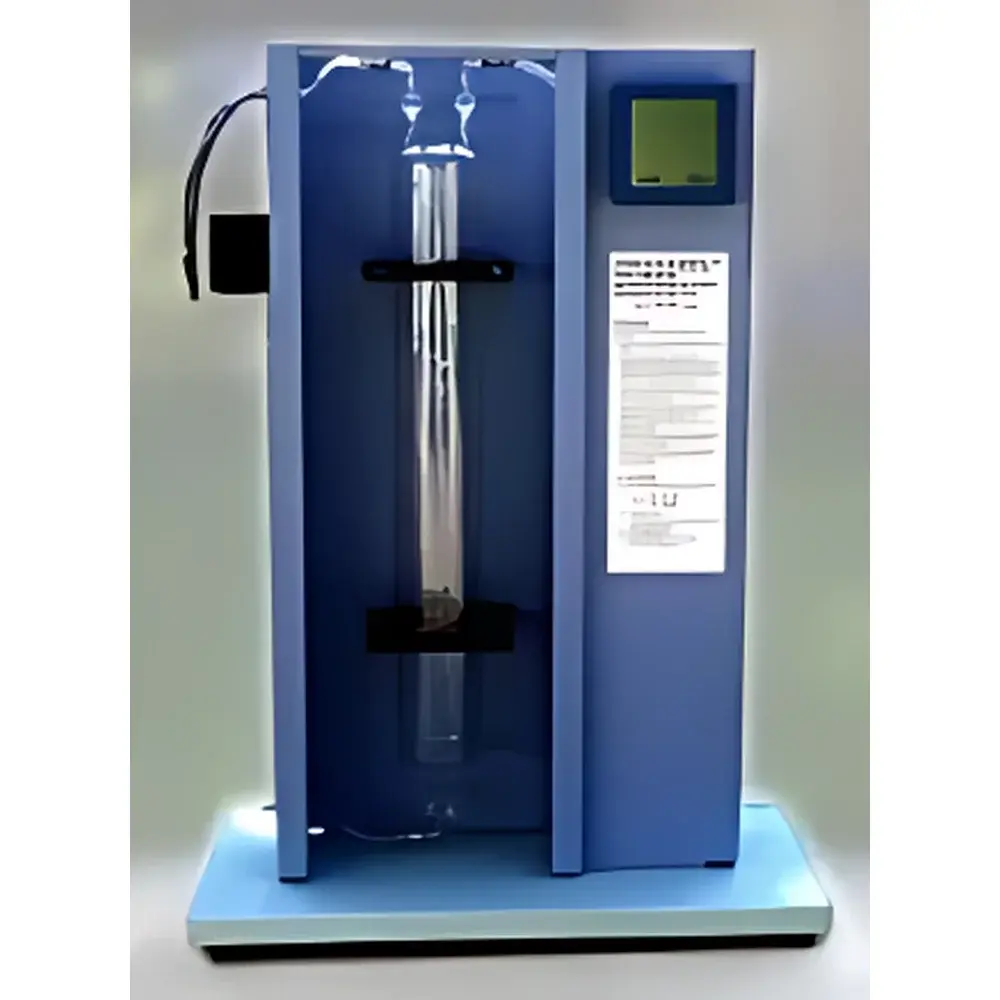
Gas Volume Measurement Instrument R&P Model Hazardous Materials Series
| Brand | R&P |
|---|---|
| Origin | Germany |
| Type | Imported Instrument |
| Application | Combustion Gas Volume Quantification |
| Measurement Principle | Pressure Differential Method in Sealed Vessel |
| Vessel Capacity | 3000 mL Borosilicate Glass Chamber |
| Combustion Sample Holder | 25 mL Support Fixture Compatible with MS10HE Calorimeter |
| Pressure Sensing | Digital Vacuum Gauge (Resolution: ≤0.1 mbar, Range: 0–1000 mbar abs) |
| Compliance | Designed for ASTM E681, ISO/IEC 17025-aligned testing environments |
Overview
The R&P Gas Volume Measurement Instrument (Hazardous Materials Series) is a precision-engineered laboratory system designed to quantify the total volume of non-condensable gases evolved during controlled combustion or thermal decomposition of solid or liquid samples under inert or oxidative atmospheres. It operates on the fundamental thermodynamic principle of pressure-volume-temperature (PVT) correlation in a rigid, sealed, constant-volume chamber. The instrument employs a high-stability digital vacuum gauge to record absolute pressure differentials before and after sample ignition within a calibrated 3000 mL borosilicate glass vessel. Using the ideal gas law—corrected for real-gas behavior at elevated temperatures—the evolved gas volume is calculated at standard temperature and pressure (STP: 0 °C, 101.325 kPa), enabling direct comparison across test series and regulatory frameworks. This method is particularly suited for hazard assessment of energetic materials, polymer flammability screening, and decomposition kinetics studies where volumetric gas yield serves as a critical safety parameter.
Key Features
- Rigid 3000 mL borosilicate glass measurement chamber with ground-glass joints and pressure-rated sealing interface, resistant to thermal shock and chemical exposure from common combustion byproducts (e.g., CO₂, HCl, NOₓ).
- Digital vacuum gauge with 0.1 mbar resolution and NIST-traceable calibration certificate; measurement range spans 0.1–1000 mbar absolute pressure, supporting both sub-atmospheric and near-ambient combustion conditions.
- Dedicated 25 mL combustion crucible support fixture engineered for mechanical compatibility and thermal alignment with the MS10HE oxygen bomb calorimeter—enabling synchronized heat release (ΔHc) and gas volume (Vg) determination in a single experimental setup.
- Modular stainless-steel support frame with adjustable height and lateral stability, accommodating integration into fume hoods or dedicated explosion-resistant enclosures per EN 14470-1 requirements.
- Pressure transducer output compatible with third-party data acquisition systems (e.g., National Instruments DAQ, Keysight 34972A) for time-resolved pressure logging and automated calculation scripting.
Sample Compatibility & Compliance
The instrument accepts solid, powdered, or low-viscosity liquid samples up to 5 g mass, provided they exhibit measurable gas evolution upon rapid heating (>1000 °C/s) in an oxygen-rich or nitrogen-purged environment. Sample containment uses platinum, quartz, or alumina crucibles (not supplied). It complies with methodology references in ASTM E681 (“Standard Test Method for Determination of Flammability Limits of Chemicals at Elevated Temperature and Pressure”) and supports test protocols aligned with UN Manual of Tests and Criteria, Part I, Section 12 (Test Series 1—Explosibility Screening). While the instrument itself is not CE-marked as a standalone explosive device, its mechanical design and pressure containment integrity meet DIN 55446-2 structural safety guidelines for closed-system gas evolution testing. All operational procedures assume adherence to institutional GLP practices, including equipment logbook entries, operator training records, and annual gauge recalibration.
Software & Data Management
No proprietary software is bundled with this instrumentation. Instead, raw pressure-time data is exported via analog voltage output (0–5 V) or RS-232 serial interface for ingestion into validated laboratory software platforms such as MATLAB, Python (with PySerial/Pandas), or LabVIEW. Users implement custom calculation scripts that apply the ideal gas law correction: Vg,STP = (Pinitial − Pfinal) × Vchamber × 273.15 / (Tavg × 101.325), where Tavg is the mean absolute temperature (K) of the vessel during equilibration. Audit trails, electronic signatures, and 21 CFR Part 11 compliance are achieved when integrated with enterprise-grade LIMS (e.g., Thermo Fisher SampleManager, LabWare LIMS) configured for instrument data import and metadata association.
Applications
- Quantification of total combustible gas yield from lithium battery cathode materials during thermal runaway simulation.
- Comparative evaluation of flame-retardant efficacy in polymeric composites (e.g., PVC, PET, epoxy resins) per ISO 5660-1 cone calorimetry correlative studies.
- Screening of pyrotechnic compositions and propellant formulations for UN Class 1 hazard classification.
- Decomposition stoichiometry validation for pharmaceutical intermediates subjected to ICH Q1A(R2) stability stress testing.
- Calibration verification of online FTIR gas analyzers used in continuous emission monitoring systems (CEMS).
FAQ
Is this instrument certified for use with explosive or highly reactive samples?
No certification is issued by R&P for inherently hazardous operation. Safe usage requires prior risk assessment, appropriate engineering controls (e.g., blast shield, remote ignition), and compliance with local occupational safety regulations (e.g., OSHA 1910.119, ATEX 2014/34/EU).
Can the 3000 mL chamber be replaced with a smaller volume option?
The vessel is a fixed component per model configuration. Custom chamber volumes are available only through R&P’s OEM engineering division under NDA and minimum order quantity agreements.
Does the system include temperature monitoring inside the chamber?
No integrated thermocouple is provided. External surface temperature may be measured using a K-type probe affixed to the vessel exterior; internal gas-phase temperature must be inferred from pressure decay kinetics or measured separately via fiber-optic pyrometry.
What calibration standards are recommended for routine verification?
Daily zero-check using atmospheric pressure reference; weekly span verification with certified gas mixture (e.g., 100 ppm CO in N₂) introduced via calibrated micro-syringe into evacuated chamber.
Related Products







