
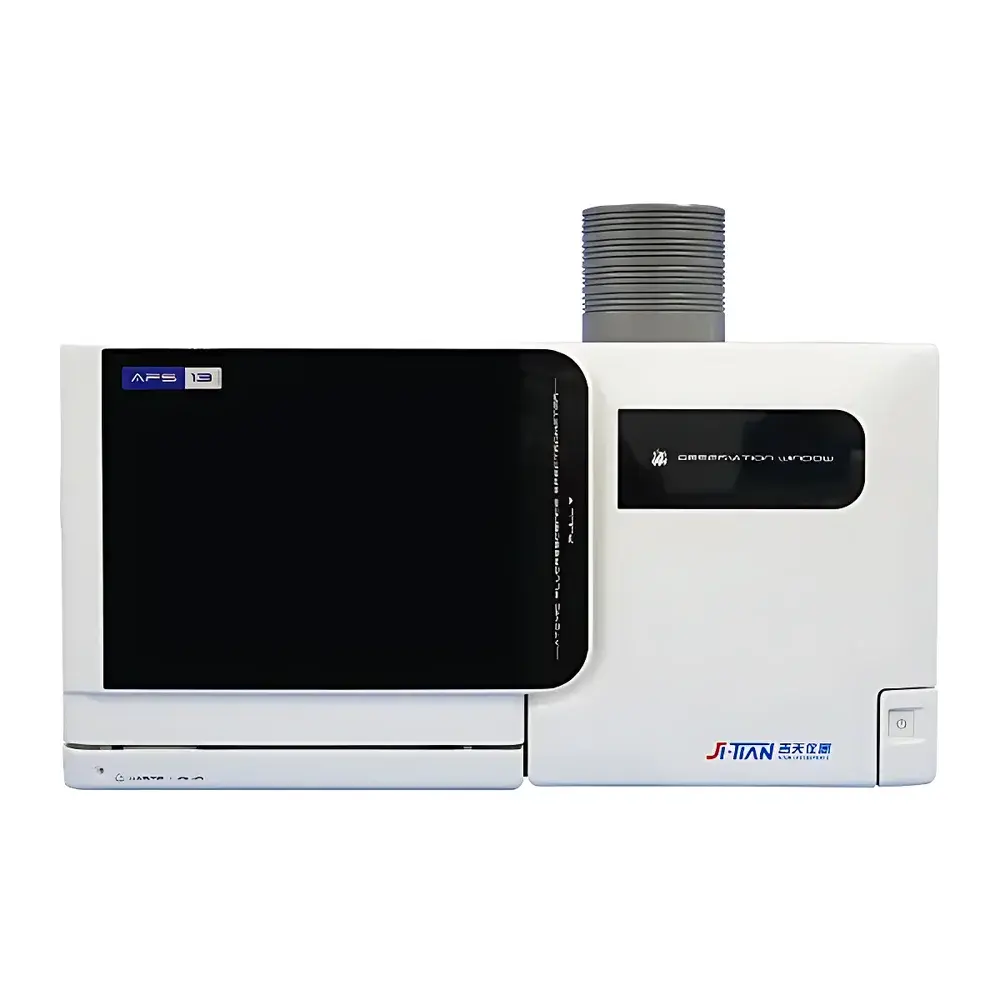
Titan Instruments AFS-13P Multi-Channel High-Intelligence Atomic Fluorescence Spectrometer
| Brand | Titan Instruments |
|---|---|
| Origin | Beijing, China |
| Manufacturer Type | Direct Manufacturer |
| Instrument Type | Multi-Channel Atomic Fluorescence Spectrometer |
| Model | AFS-13P |
| Configuration | Triple-channel, fixed-lamp-position optical system |
| Sample Introduction Modes | Dual sequential injection / Single syringe pump + peristaltic pump / Single peristaltic pump |
| Hydride Generation | Gradient-temperature-controlled vapor generation system |
| Atomization | Stable quartz-trap flame-in-quartz atomizer with intelligent ignition (voltage-adjustable) |
| Monitoring | Real-time pressure, current, temperature (reaction block, gas–liquid separator, sample loop), atmospheric pressure, waste volume, and atomicizer video feed |
| Compliance Support | Designed for GLP/GMP-aligned workflows |
| Connectivity | Wi-Fi, USB 2.0, LAN (RJ45), RS-232 |
| Optional Modules | Refrigerated reagent organizer, LC-AFS hyphenated interface, on-line microwave-assisted digestion module |
Overview
The Titan Instruments AFS-13P Multi-Channel High-Intelligence Atomic Fluorescence Spectrometer is an advanced analytical platform engineered for trace-level quantification of hydride-forming elements—including As, Se, Bi, Sb, Te, Pb, Sn, Ge, Cd, and Hg—using the principle of atomic fluorescence spectroscopy (AFS). Unlike absorption-based techniques, AFS relies on the measurement of characteristic fluorescent emission following ground-state atom excitation by a high-intensity, element-specific hollow cathode lamp (HCL) or electrodeless discharge lamp (EDL). The AFS-13P implements a triple-channel, fixed-optical-path design that enables simultaneous, independent detection of three elements without mechanical alignment or real-time lamp repositioning—significantly reducing photometric drift and enhancing inter-day reproducibility. Its core architecture integrates a gradient-temperature-controlled hydride generation system, a voltage-tunable quartz-trap atomizer with continuous ignition capability, and a fully sensor-networked operational environment—making it suitable for regulated laboratories requiring long-term stability, method robustness, and comprehensive instrument state documentation.
Key Features
- Triple-channel fixed-lamp-position optical system: Three independently aligned HCL/EDL sources operate in parallel, enabling true simultaneous multi-element analysis without signal crosstalk or positional recalibration.
- Multi-mode sample introduction: Automatic switching among dual sequential injection (for highest precision), syringe-pump–peristaltic hybrid (for variable flow control), and single peristaltic (for routine high-throughput screening) configurations.
- Gradient-temperature vapor generation: Reaction block temperature is dynamically modulated across the hydride formation cycle to optimize reduction kinetics, suppress memory effects in high-concentration samples, and minimize water vapor interference at the atomization stage.
- Voltage-adjustable intelligent ignition: Solid-state ignition circuit maintains stable plasma initiation under variable ambient humidity and barometric conditions, eliminating manual electrode cleaning or gap adjustment.
- Comprehensive real-time monitoring suite: Integrated sensors track gas inlet/outlet pressure, lamp operating current, quartz trap surface temperature, gas–liquid separator thermal stability, sample loop thermal profile, waste reservoir fill level, and ambient atmospheric pressure—each logged with timestamps for traceability.
- Integrated safety subsystems: On-board activated carbon–based tail-gas capture and acid-vapor adsorption ensure compliance with OSHA PEL and WHO indoor air quality guidelines during routine operation.
Sample Compatibility & Compliance
The AFS-13P accepts liquid samples prepared via standard acid digestion (e.g., HNO₃–H₂O₂ microwave or hot-block protocols) or direct dilution for low-matrix waters and beverages. It supports both KBH₄- and NaBH₄-based hydride generation chemistries and accommodates pH-sensitive analytes through programmable pre-reduction delay and post-reduction quench steps. Method validation aligns with ISO 17025 requirements for uncertainty estimation and linearity verification (r² ≥ 0.999 over 3–4 orders of magnitude). Instrument firmware and optional software modules support 21 CFR Part 11-compliant electronic signatures, role-based access control, and immutable audit trails—facilitating readiness for FDA, EPA, and CNAS inspections. Routine performance verification follows ASTM D5673 (for drinking water arsenic) and GB/T 223.74–2008 (Chinese national standard for food arsenic and mercury).
Software & Data Management
The AFS-13P operates via Titan’s proprietary TitanAFS Control Suite—a Windows-based application supporting method development, sequence scheduling, real-time spectral visualization, and automated calibration curve fitting (linear, quadratic, or weighted least-squares). Raw intensity data are stored in vendor-neutral .csv and .txt formats; peak integration parameters (baseline correction, dwell time, smoothing window) are user-definable and saved with each method. The software includes built-in QC tools: spike recovery calculation, duplicate RSD assessment, blank drift trending, and lamp lifetime tracking. When connected to LIMS via LAN or USB, instrument status and result metadata (including all monitored sensor values at acquisition time) are auto-exported using ASTM E1384-compliant messaging structures.
Applications
The AFS-13P delivers validated performance across environmental monitoring (EPA Method 1632 for Hg in wastewater), food safety testing (GB 5009.11/5009.17 for As/Hg in rice, milk, and seafood), clinical toxicology (urinary As speciation when coupled with HPLC), pharmaceutical excipient screening (ICH Q2(R2)-aligned validation), and geological surveying (trace Sb and Bi in ore leachates). Its triple-channel capability is particularly advantageous for regulatory batch release—e.g., simultaneous quantification of As, Se, and Hg in infant formula—reducing total analysis time by >60% compared to sequential single-channel instruments.
FAQ
What hydride-forming elements can be measured simultaneously on the AFS-13P?
As, Se, Bi, Sb, Te, Pb, Sn, Ge, Cd, and Hg—up to three at once, depending on lamp configuration and spectral separation requirements.
Is the instrument compatible with existing hollow cathode lamps from other manufacturers?
Yes—the optional universal lamp holder supports standard 1/4-inch pin-base HCLs and EDLs without modification.
How does the gradient-temperature vapor generation improve accuracy for high-salinity samples?
By lowering reaction temperature during initial mixing and elevating it during hydride release, the system minimizes chloride-induced interference and suppresses foam formation in seawater or brine extracts.
Can the AFS-13P be integrated into an automated sample preparation line?
Yes—via RS-232 or LAN, it accepts external start/stop commands and reports completion status, enabling synchronization with autosamplers and online digesters.
What maintenance intervals are recommended for the quartz trap atomizer?
Under typical usage (≤ 100 samples/day), visual inspection is advised every 200 runs; replacement is recommended after 1,000–1,500 analyses or upon observed signal attenuation >15% relative to initial baseline.




