
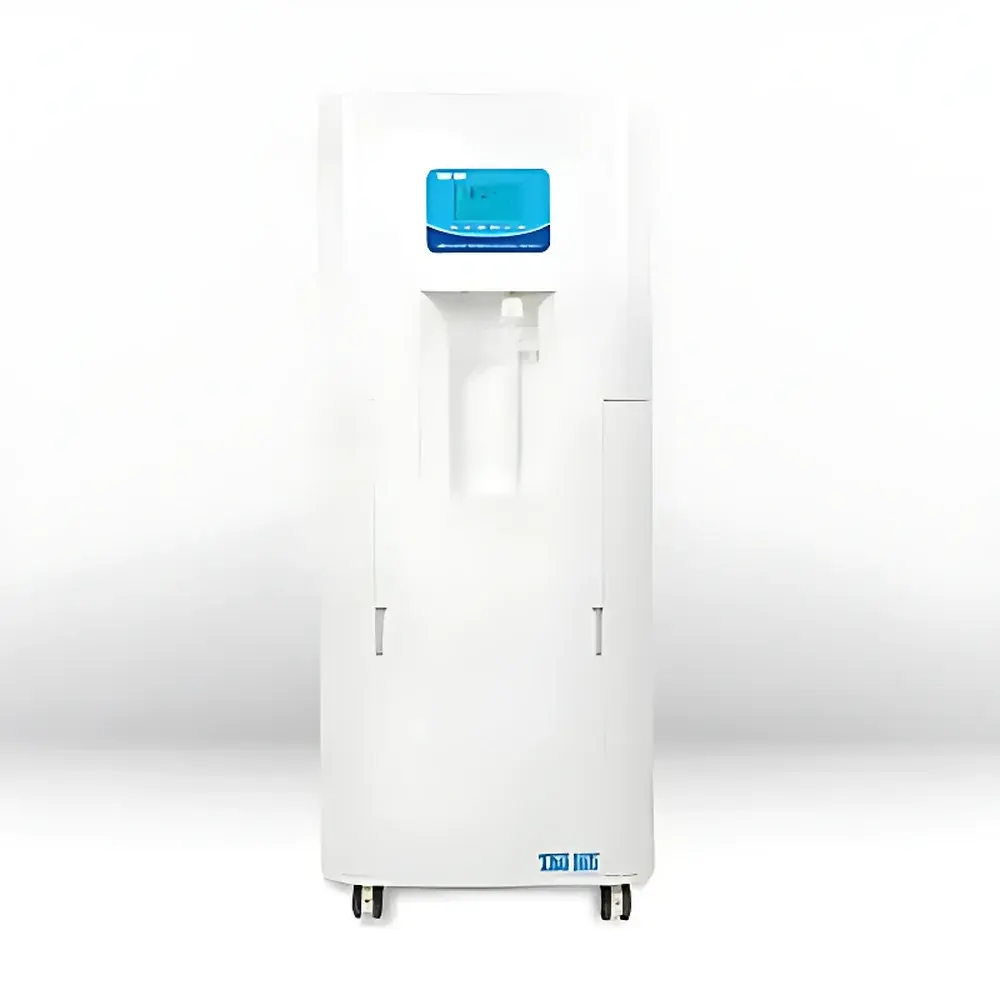
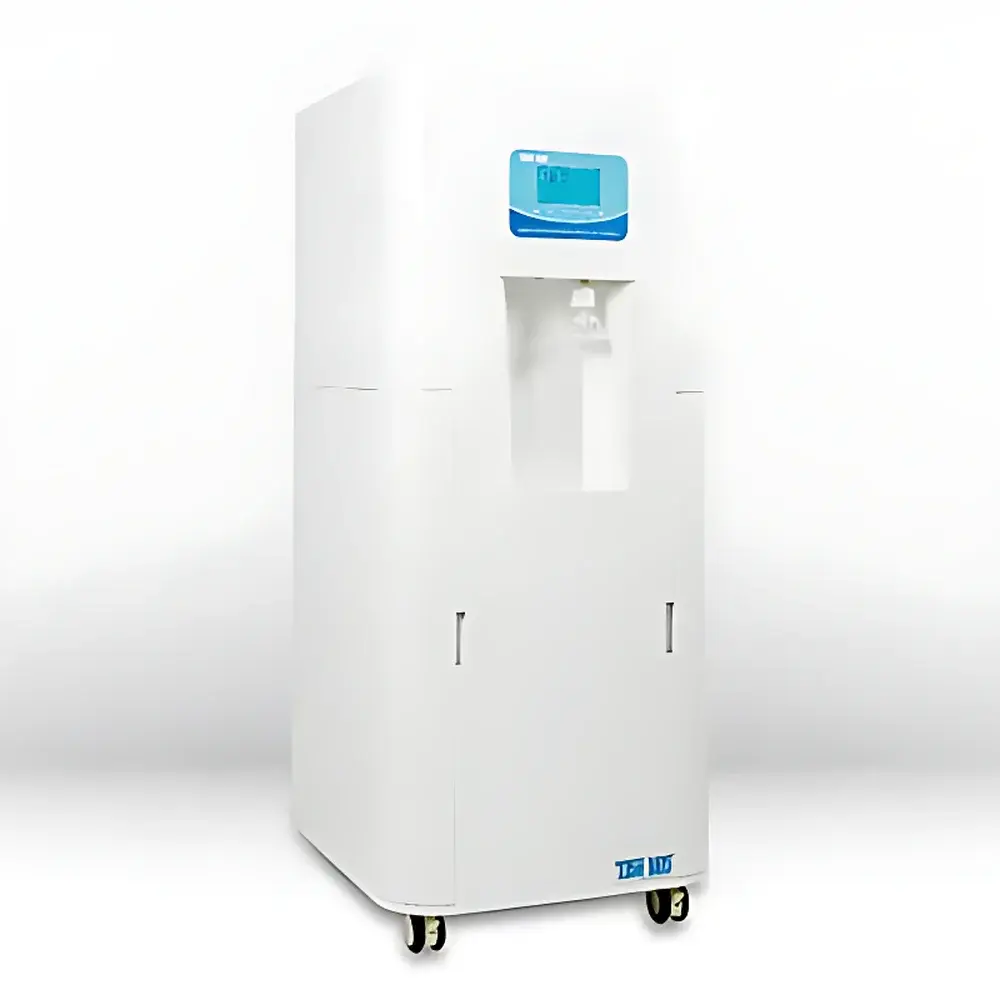
The Lab Center 60/90/120D Ultra Pure Water System (Municipal Tap Water Feed)
| Brand | The Lab |
|---|---|
| Origin | USA |
| Manufacturer Type | Authorized Distributor |
| Origin Category | Imported |
| Model | Center 60/90/120D |
| Pure Water Grade | Type I (ASTM D1193-20) |
| Resistivity | >10 MΩ·cm |
| Heavy Metals & Soluble Silica | <0.1 ppb |
| Total Organic Carbon (TOC) | <3 ppb |
| Microbial Count | <1 CFU/mL |
| Endotoxin | <0.001 EU/mL |
| Particles (>0.1 µm) | <1 particle/mL |
| RO Water TDS | ≤5% of feedwater TDS (≥95% salt rejection) |
| Power | AC 220 V ±10%, 50 Hz, 240 W |
| Dimensions (L×W×H) | 57×60×150 cm |
| Weight | ~70 kg |
| Integrated Storage Tank | 20 L |
| Display | 240×128 pixel LCD (106×57 mm) |
| Data Logging | RS232/USB, 1-year traceable records compliant with GLP |
Overview
The Lab Center 60/90/120D Ultra Pure Water System is an integrated, dual-output laboratory water purification platform engineered for continuous production of both reverse osmosis (RO) water and Type I ultrapure water directly from municipal tap feed. Utilizing a multi-stage purification architecture—including sediment prefiltration, activated carbon adsorption, high-rejection RO membrane separation, and dual-bed ion exchange with high-purity Dow® resin—the system achieves consistent resistivity >10 MΩ·cm at 25 °C, TOC <3 ppb, endotoxin <0.001 EU/mL, and bacterial retention <1 CFU/mL. Designed to meet stringent analytical and life science requirements, the Center series complies with ASTM D1193-20 (Type I), NCCLS (now CLSI) standards, and CAP accreditation criteria for clinical laboratory water. Its modular construction supports scalable deployment across core labs, QC environments, and regulated pharmaceutical R&D settings where water quality directly impacts assay validity, instrument longevity, and regulatory audit readiness.
Key Features
- Modular spiral-interface pretreatment cartridges—imported OEM components enabling tool-free, one-turn replacement with leak-proof sealing and full traceability.
- Integrated post-RO purification module housing a 22 L high-capacity mixed-bed ion exchange column, optimized for maximum inorganic ion removal efficiency and extended service life under variable feedwater conditions (TDS ≤200 ppm).
- Dual independent outlets: dedicated RO water port (TDS ≤5% of inlet) and Type I ultrapure water port (resistivity >10 MΩ·cm, TOC <3 ppb, particles 0.1 µm).
- 20 L built-in NSF-certified pressurized storage tank; optional external tank expansion for high-throughput applications (e.g., automated analyzers, cell culture incubators, hydrogen generators).
- Real-time three-point conductivity/resistivity monitoring (feed, RO, DI) with automatic alarm triggers for low feed pressure, tank overflow, low water level, and cartridge exhaustion.
- 240×128 pixel backlit LCD interface with animated status visualization, multilevel menu navigation, and remaining cartridge lifetime estimation based on actual usage metrics.
- GLP-compliant data management: onboard RS232 and USB interfaces log timestamped conductivity, TOC, pressure, and alarm events for ≥12 months—fully exportable for 21 CFR Part 11–aligned review and audit trails.
- NSF/ANSI 58-certified fittings and tubing throughout; 0.45 + 0.1 µm PES composite final filter certified for bacterial and particulate retention per ISO 8573-7.
Sample Compatibility & Compliance
The Center 60/90/120D delivers water suitable for critical applications requiring ultrapure input, including HPLC and LC-MS mobile phase preparation, ICP-MS calibration standard dilution, molecular biology reagent formulation (e.g., PCR, electrophoresis buffers), mammalian cell culture media supplementation, and pharmaceutical stability testing per USP and EP 2.2.44. All wetted materials—including Dow® SRT-600 resin, GE Healthcare hollow-fiber RO membranes, and PES terminal filters—are extractables-tested and compliant with USP Class VI biocompatibility standards. System validation documentation supports IQ/OQ protocols aligned with ISO 9001, ISO/IEC 17025, and GMP Annex 1 water system qualification requirements.
Software & Data Management
No proprietary software installation is required. The embedded microcontroller logs all operational parameters—including feed conductivity, RO rejection rate, DI resistivity, tank level, and alarm history—to internal non-volatile memory. Data exports via USB mass storage mode as CSV files with ISO 8601 timestamps, compatible with LIMS integration and statistical process control (SPC) platforms. Audit trail functionality records user actions (e.g., parameter changes, cartridge resets) with operator ID and timestamp—meeting FDA 21 CFR Part 11 electronic record integrity requirements when paired with institutional access controls. Optional Ethernet gateway module (sold separately) enables remote monitoring via SNMP or Modbus TCP.
Applications
- HPLC, UHPLC, and GC mobile phase and blank preparation
- ICP-OES and ICP-MS sample dilution and standard calibration
- Cell culture media, transfection reagents, and ELISA buffer formulation
- Pharmaceutical primary packaging rinse validation per USP
- Stability chamber humidification and environmental test equipment feed
- Photographic film processing and semiconductor wafer rinsing (Class 100 cleanroom compatible)
- Hydrogen generator feedwater for fuel cell and GC carrier gas applications
FAQ
What feedwater specifications are required for optimal performance?
Municipal tap water with TDS ≤200 ppm, temperature 5–45 °C, pressure 1.0–4.0 kgf/cm² (14–57 psi), and free chlorine <0.5 ppm. Higher TDS or oxidant levels reduce RO membrane lifespan and increase DI column consumption.
Can the system be validated for GMP compliance?
Yes—full IQ/OQ documentation packages, including calibration certificates for conductivity sensors and pressure transducers, are available upon request. The system supports periodic PQ verification per USP and ISO 20981.
Is external storage tank support included?
The base configuration includes the 20 L internal tank. External tanks (up to 100 L) can be connected via NSF-certified quick-coupling fittings; automatic level synchronization and overflow protection are maintained.
How frequently must consumables be replaced?
Under typical lab use (TDS ≈150 ppm, 8 h/day), the RO membrane lasts 2–3 years, while the 22 L mixed-bed cartridge requires replacement every 6–12 months depending on total ion load—monitored continuously and displayed on the LCD.
Does the system meet ASTM D1193 Type I specifications?
Yes—verified at point-of-use under steady-state operation: resistivity >10.0 MΩ·cm, TOC <3 ppb, bacteria <1 CFU/mL, endotoxin <0.001 EU/mL, and particles 0.1 µm), per ASTM D1193-20 Section 4.1.



