
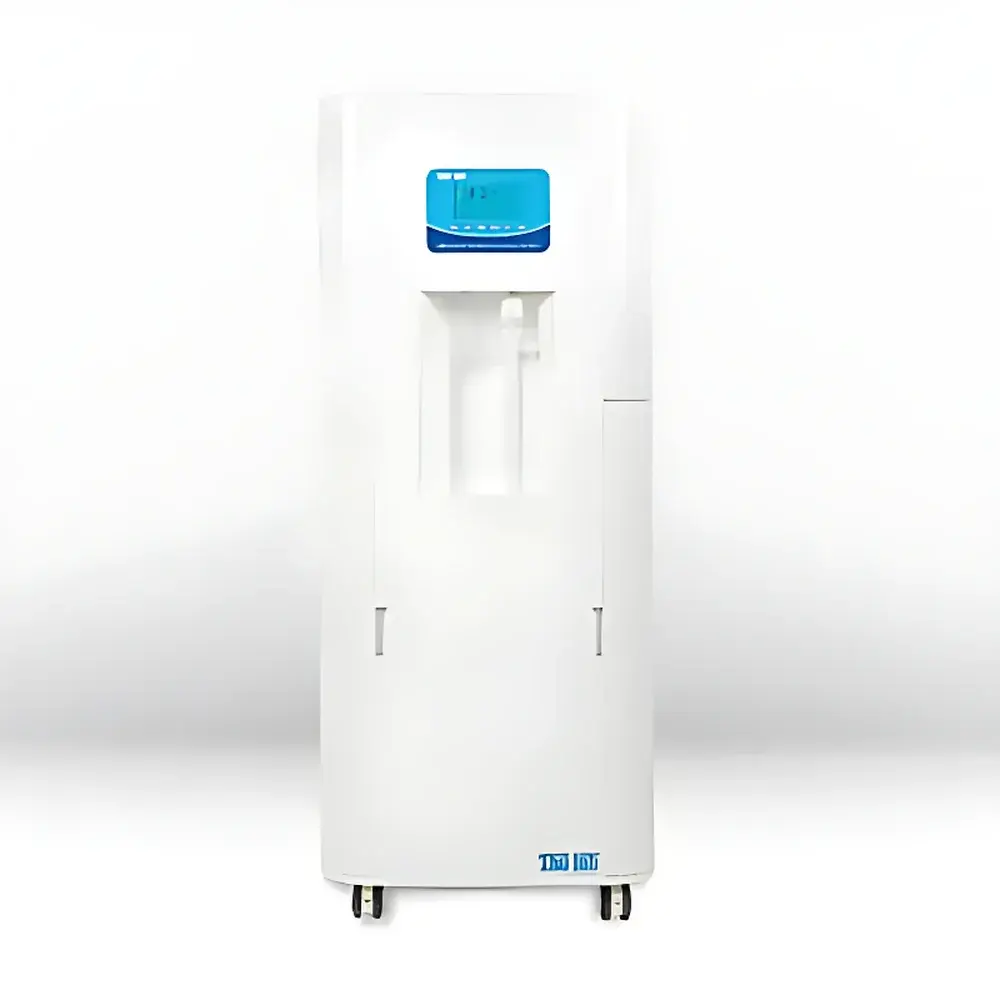
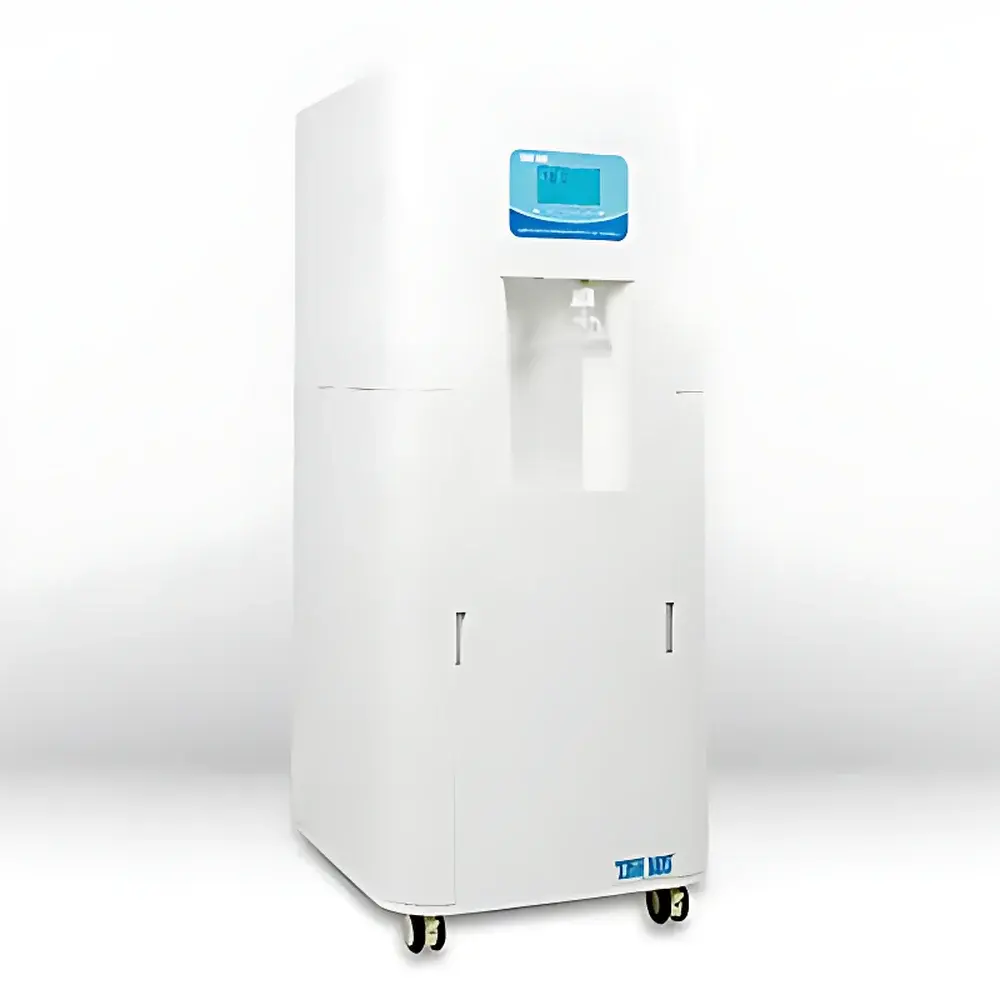
Zelab Center 60/90/120/F/V/FV Ultra-Pure Water System
| Brand | Zelab |
|---|---|
| Origin | USA |
| Manufacturer Type | Authorized Distributor |
| Origin Category | Imported |
| Model | Center 60 / 90 / 120 / F / V / FV |
| Pure Water Grade | ASTM Type I |
| Resistivity | 18.2 MΩ·cm @ 25°C |
| Heavy Metals & Soluble Silica | < 0.1 ppb |
| Total Organic Carbon (TOC) | < 3 ppb |
| Microbial Count | < 1 CFU/mL |
| Endotoxin | < 0.001 EU/mL |
| Particles (> 0.1 µm) | < 1 particle/mL |
| RO Water Yield | 60–120 L/h |
| Input Water Requirement | Municipal tap water, TDS < 200 ppm, 5–45°C, pressure 1.0–4.0 kgf/cm² |
| Power Supply | AC 220 V ±10%, 50 Hz, 240 W |
| Dimensions (L×W×H) | 57 × 60 × 150 cm |
| Weight | ~70 kg |
Overview
The Zelab Center Ultra-Pure Water System is an integrated, high-reliability laboratory water purification platform engineered to deliver continuous, on-demand ASTM Type I ultrapure water for critical analytical, life science, and materials research applications. It employs a multi-stage purification architecture—including pretreatment, reverse osmosis (RO), dual-wavelength UV photooxidation (254 nm + 185 nm), mixed-bed ion exchange with nuclear-grade Dow resin, ultrafiltration (MWCO 5,000 Da), and final 0.45 + 0.1 µm PES membrane filtration—to achieve stringent performance benchmarks in resistivity, TOC, endotoxin, and particle control. Designed for full compliance with NCCLS (now CLSI), ASTM D1193-20, and CAP water quality standards, the system supports mission-critical workflows where trace-level contamination compromises data integrity—such as HPLC, IC, ICP-MS, CF-AAS, electrochemical studies, cell culture, and molecular biology assays.
Key Features
- Modular, tool-free spiral-interface pre-treatment cartridges—imported OEM components enabling rapid, leak-free replacement without disassembly.
- Integrated post-RO purification module housing a 22 L high-capacity mixed-bed column using Dow’s nuclear-grade ion exchange resin—optimized for >99.999% ionic removal and extended service life.
- Internal 20 L pressurized storage tank (NSF-certified materials); optional external tank expansion for high-throughput labs.
- Real-time, three-point online water quality monitoring: feed water conductivity, RO permeate TDS, and UP water resistivity/TOC—each displayed with trend logging.
- Large backlit LCD display (240 × 128 pixels, 106 × 57 mm) with animated GUI, multilevel menu navigation, and intuitive status visualization.
- Automated diagnostics and alarm system: low-pressure, no-water, tank-full, cartridge exhaustion, resistivity/TOC deviation, and endotoxin breach alerts.
- Onboard disinfection protocol with programmable chemical dosing and recirculation—validated for microbial load reduction across entire UP loop.
- Continuous recirculation loop with UV sterilization and 0.1 µm terminal filtration maintains bacterial counts below 1 CFU/mL during standby.
- RS232 and USB interfaces support automated GLP-compliant data logging—including timestamped resistivity, TOC, pressure, temperature, and alarm events—for ≥12 months.
Sample Compatibility & Compliance
The Center system is validated for compatibility with sensitive instrumentation requiring ultra-low background interference, including but not limited to: capillary electrophoresis, atomic absorption spectroscopy (CF-AAS), inductively coupled plasma mass spectrometry (ICP-MS), ion chromatography (IC), and high-performance liquid chromatography (HPLC). Its output meets or exceeds requirements defined in ASTM D1193-20 (Type I), CLSI C3-A4 (formerly NCCLS), and College of American Pathologists (CAP) guidelines for reagent-grade water. All wetted materials—including 316L stainless steel UV chambers, NSF-certified tubing and fittings, and PES membrane filters—are compliant with USP and FDA 21 CFR Part 11 data integrity principles when paired with validated software configurations. Endotoxin retention is verified per ISO 13485 bioburden testing protocols using LAL assay methodology.
Software & Data Management
Embedded microcontroller firmware supports fully autonomous operation with hierarchical access control (operator/admin modes), configurable alarm thresholds, and user-defined disinfection cycles. All operational parameters—including flow rates, pressure differentials, UV lamp intensity, and cartridge usage metrics—are stored locally with automatic time-stamped backups. Exportable CSV logs via USB include full audit trails required under GLP and GMP environments. Optional integration with LabVantage or Thermo Fisher SampleManager enables direct ingestion into enterprise LIMS platforms. Data encryption and write-protection features ensure regulatory alignment with 21 CFR Part 11 electronic record requirements when deployed with qualified third-party validation packages.
Applications
- Preparation of mobile phases and standards for HPLC, UHPLC, and LC-MS.
- Blank matrix generation and diluent preparation for trace-element analysis by ICP-MS and GF-AAS.
- Cell culture media formulation and passaging solutions for primary mammalian and plant cell lines.
- Electrochemical sensor calibration and interfacial tension measurements requiring ultra-low ionic strength.
- Synthesis of nanomaterials and quantum dots where metal ion catalysis must be excluded.
- Next-generation sequencing library prep and CRISPR reagent dilution where nuclease-free, endotoxin-free water is mandatory.
FAQ
What inlet water specifications are required for optimal system performance?
Municipal tap water with TDS ≤ 200 ppm, temperature between 5–45°C, and feed pressure of 1.0–4.0 kgf/cm² (14–58 psi) is recommended. Higher TDS or hardness may reduce RO membrane lifespan and increase frequency of pretreatment servicing.
How often must consumables be replaced under typical lab usage?
At 100 L/day average demand and 150 ppm inlet TDS, the RO membrane lasts ~24 months, the UP column ~12–18 months, and the UF/terminal filter ~6 months—exact intervals depend on feed water quality and are tracked automatically via the system’s lifetime counter.
Is the system compatible with external water distribution loops?
Yes. The Center F/V/FV variants include dedicated ports and pressure-regulated UP outlet valves designed for integration with point-of-use dispensers, wall-mounted taps, or centralized piping networks up to 30 m in length.
Does the system support remote monitoring or network connectivity?
Standard RS232/USB interfaces enable local PC-based supervision; optional Ethernet/Wi-Fi modules (sold separately) allow SNMP-based status polling and email alerting via institutional IT infrastructure.
Can the system be validated per IQ/OQ/PQ protocols?
Full qualification documentation—including FAT/SAT templates, test scripts, and raw data worksheets—is provided with each unit. Zelab also offers on-site OQ execution and IQ support through certified field service engineers.



