
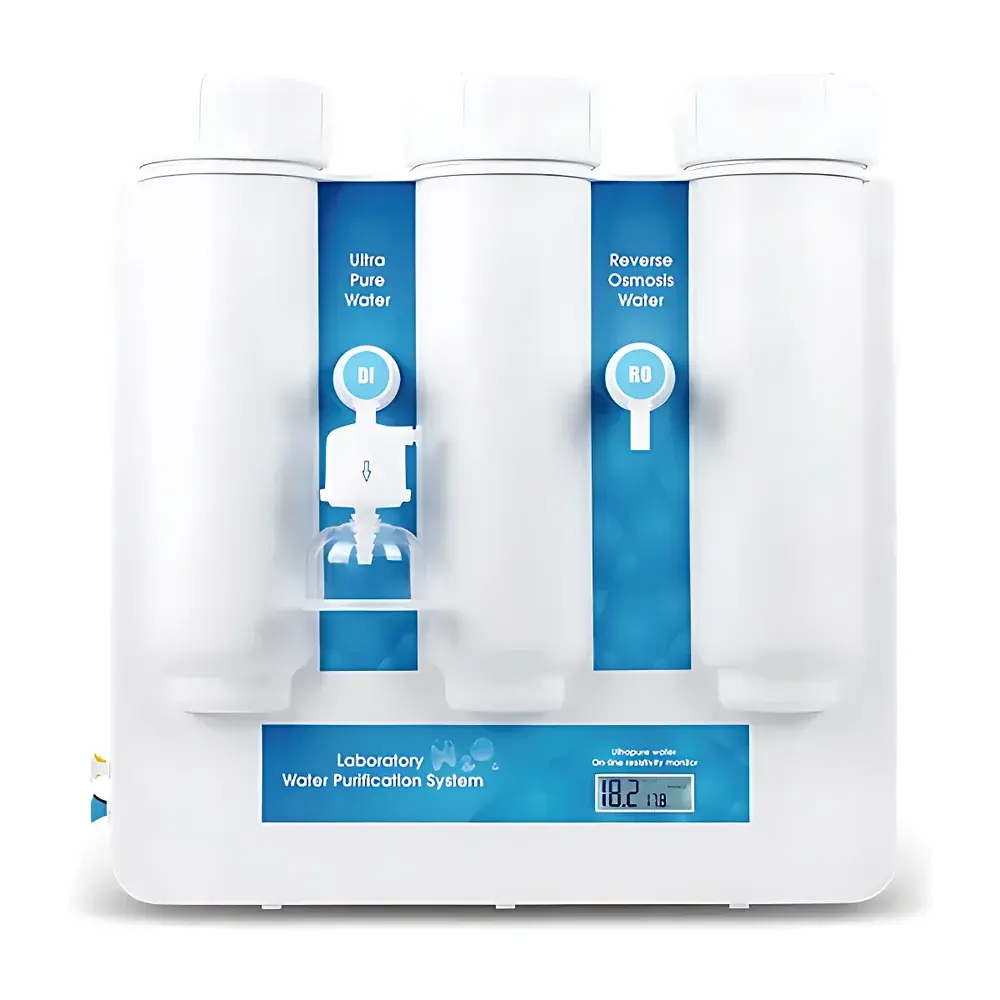
HHitech Smart-Q Ultra Pure Water System (Municipal Tap Water Feed)
| Brand | HHitech |
|---|---|
| Origin | Shanghai, China |
| Manufacturer Type | Direct Manufacturer |
| Product Category | Domestic |
| Model | Smart-Q |
| Price Range | USD 1,400 – 4,200 (est.) |
| Purified Water Grade | ASTM Type I / ISO 3696 Grade 1 |
| Resistivity | 15–18.2 MΩ·cm |
| Heavy Metals & Soluble Silica | <0.1 ppb |
| Total Organic Carbon (TOC) | <3 ppb |
| Microbial Count | <0.01 CFU/mL |
| Endotoxin | <0.001 EU/mL |
| Particles (>0.1 µm) | <1 particle/mL |
| UV Wavelengths | 185 nm & 254 nm |
| Final Filtration | 0.45 + 0.1 µm PES membrane |
| RO Membrane | Dow FilmTec™ certified |
| Compliance | Meets GB/T 6682–2008 Class I, ASTM D1193–20, ISO 3696:1995 |
Overview
The HHitech Smart-Q Ultra Pure Water System is a compact, integrated laboratory water purification platform engineered for consistent production of Type I ultrapure water from municipal tap feed. It employs a multi-stage purification architecture grounded in established physicochemical separation principles: particulate prefiltration (PP), activated carbon adsorption (AC), high-rejection reverse osmosis (RO) using Dow FilmTec™ thin-film composite membranes, dual-wavelength (185/254 nm) ultraviolet photo-oxidation, and final polishing via mixed-bed ion exchange (DI) coupled with terminal ultrafiltration (0.45 + 0.1 µm PES). This configuration ensures removal of ions, organic compounds (MW > 200 Da), colloids, microorganisms, endotoxins, and sub-micron particles—meeting or exceeding the performance criteria defined in ASTM D1193–20 (Type I), ISO 3696:1995 (Grade 1), and GB/T 6682–2008 (Class I). Designed for ambient lab environments (5–45 °C), it delivers stable resistivity up to 18.2 MΩ·cm at 25 °C, with TOC consistently below 3 ppb and bacterial counts under 0.01 CFU/mL—making it suitable for HPLC mobile phase preparation, cell culture media formulation, molecular biology reagent dilution, and trace elemental analysis.
Key Features
- Integrated sanitary PP housing manufactured via one-piece injection molding—chemically inert, non-leaching, and compliant with GLP spatial and maintenance documentation requirements.
- Internalized modular cartridge design: all consumables (pre-filter, AC, RO, DI, UV, TF) are housed within the chassis, minimizing footprint and eliminating external tubing clutter.
- Tool-free top-access service: rotating lid enables rapid replacement of the pre-filter cartridge without opening the main enclosure—reducing contamination risk and supporting audit-ready workflows.
- Intelligent microprocessor control with real-time pressure sensing: automates RO membrane antiscalant flushing, tank-level management (auto-fill/auto-shutoff), dry-run protection, and fault-triggered shutdown during inlet water interruption.
- Backlit LCD resistivity monitor (0.01 MΩ·cm resolution) with continuous online measurement of DI water effluent; includes handheld battery-powered TDS/conductivity/temperature meter for feedwater and RO permeate verification.
- NSF-certified fluid path: all wetted materials—including quick-connect fittings, tubing, and pressure vessel components—meet NSF/ANSI Standard 61 for drinking water system components.
- Optimized RO assembly featuring Dow FilmTec™ FT30 elements, delivering ≥96% ion rejection and >99% organic removal (MW > 200 Da) under standard operating conditions (25 °C, 50 psi, 15% recovery).
Sample Compatibility & Compliance
The Smart-Q system is validated for use with municipal tap water sources exhibiting TDS ≤ 200 ppm, temperature between 5–45 °C, and inlet pressure of 1.0–4.0 kgf/cm² (14–57 psi). When feedwater exceeds these thresholds—particularly elevated hardness or silica—the optional external softener module is recommended to prevent premature RO scaling. All purification stages operate within defined hydraulic and thermal parameters to ensure reproducible output quality across daily operation cycles. The system conforms to Good Laboratory Practice (GLP) documentation standards through automated event logging (e.g., filter change timestamps, pressure anomalies, resistivity excursions). While not inherently 21 CFR Part 11 compliant out-of-the-box, its digital interface supports integration with third-party LIMS or ELN platforms for electronic record retention where required by GMP or regulated QC environments.
Software & Data Management
The Smart-Q operates via embedded firmware with no external PC dependency. Core operational data—including real-time resistivity, cumulative runtime, filter service intervals, and pressure differentials across RO and DI stages—are retained in non-volatile memory. Event logs (e.g., “RO flush initiated”, “tank full signal received”) are timestamped and viewable on the LCD interface. For extended traceability, users may export calibration and maintenance records manually via USB or print via optional thermal printer module (sold separately). The system does not include cloud connectivity or remote diagnostics; however, its standardized analog/digital I/O ports allow integration into facility-wide building management systems (BMS) for centralized utility monitoring.
Applications
- HPLC and UHPLC mobile phase and blank preparation, where low TOC and ionic background are critical for baseline stability and column longevity.
- Preparation of buffers and reagents for PCR, qRT-PCR, NGS library construction, and CRISPR-based assays requiring endotoxin-free water.
- Cell culture media supplementation and sterile filtration processes demanding <0.001 EU/mL endotoxin levels.
- Atomic absorption spectroscopy (AAS), inductively coupled plasma mass spectrometry (ICP-MS), and total reflection X-ray fluorescence (TXRF) sample dilution, where sub-ppt metal contamination must be avoided.
- General analytical chemistry applications including titration, spectrophotometry, and electrochemical measurements governed by ISO/IEC 17025 method validation protocols.
FAQ
What feedwater specifications are required for optimal Smart-Q performance?
Municipal tap water with TDS ≤ 200 ppm, temperature 5–45 °C, and pressure 1.0–4.0 kgf/cm² is recommended. Higher TDS or hardness necessitates an external softener to preserve RO membrane integrity.
Can the Smart-Q supply water directly to sensitive instruments without a storage tank?
Yes—when equipped with an optional pressurized reservoir (15 L or 30 L), the system delivers up to 2.0 L/min at the RO and DI outlets. For continuous flow instruments, a dedicated recirculation loop with 0.22 µm point-of-use filter is advised.
How often must consumables be replaced?
Pre-filter: every 3–6 months depending on feedwater turbidity; AC: 6–12 months; RO membrane: 2–3 years under proper pretreatment; DI cartridge: 6–12 months or upon resistivity drop below 15 MΩ·cm.
Is UV lamp output monitored or calibrated?
The 185/254 nm dual-wavelength UV module includes intensity monitoring via photodiode feedback; lamp replacement is scheduled at 9,000 hours or when TOC reduction efficiency declines per periodic validation testing.
Does the system support IQ/OQ protocol execution?
Yes—HHitech provides factory-verified installation and operational qualification templates aligned with ISO 9001 and ASTM E2500, including test methods for resistivity, TOC, microbial count, and particle enumeration using USP and EP 2.2.44 guidelines.



