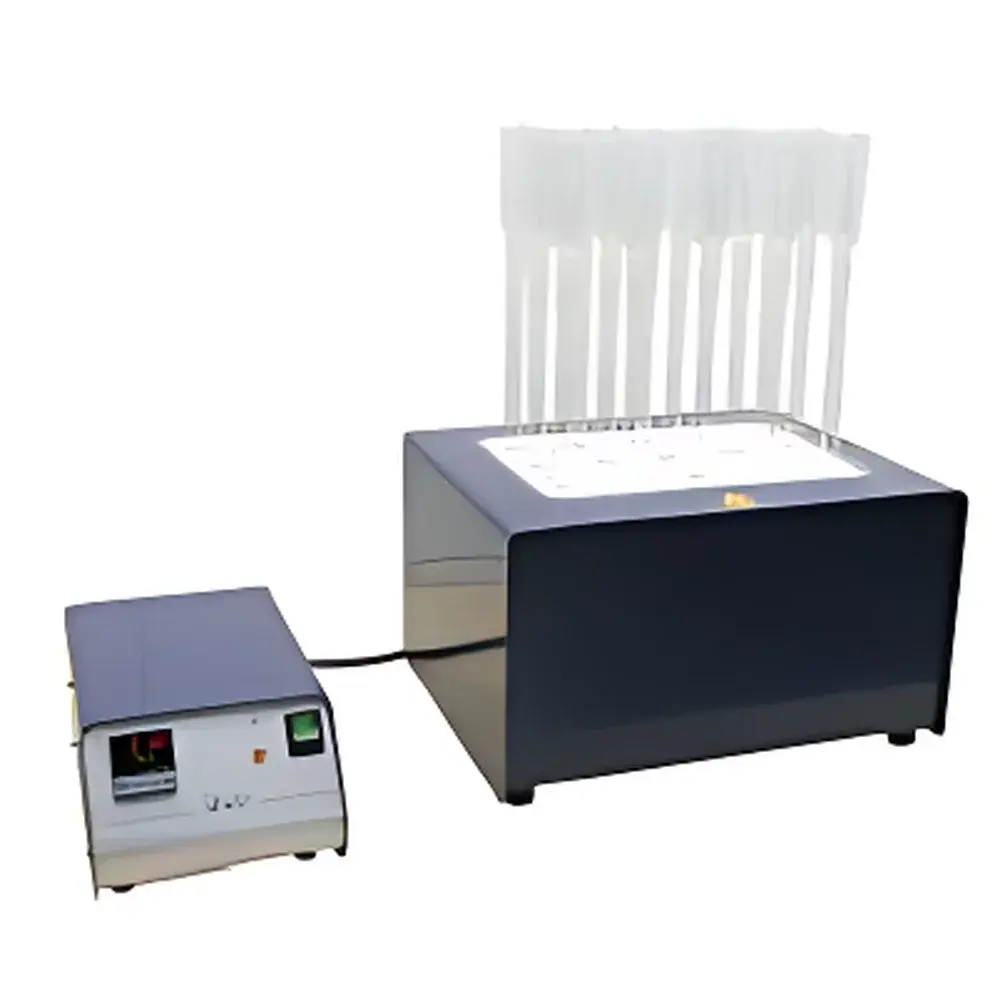
Bergmann-Junk Thermal Stability Tester Model 5A/B by R&P Germany
| Brand | R&P |
|---|---|
| Origin | Germany |
| Model | 5A/B |
| Heating Block | Heavy-duty cast aluminum with PID-controlled electric heating |
| Temperature Range | Ambient to 135 °C |
| Control Accuracy | ±0.1 °C |
| Test Temperature | 132 °C (STANAG 4178 Method 5A/B) |
| Sample Holders | 15 × Ø19 ±0.5 mm × 350 mm borosilicate glass tubes |
| Heating Block Bore Dimensions | 15 holes, Ø20 ±0.2 mm × 150 mm depth |
| Insulation | 5 mm ISO-standard thermal insulation board |
| Temperature Sensor | PT100 platinum resistance probe |
| Over-Temperature Cut-Off | 150 °C (independent safety circuit) |
| Display & Control | Digital PID controller with dual LED readout (setpoint / actual temperature) |
| Power Supply | 230 V AC, 50 Hz, 1600 VA |
| Compliance | STANAG 4178 Ed. 4 (2021), NATO AEP-97, ISO 24817 (thermal stability testing of energetic materials) |
Overview
The Bergmann-Junk Thermal Stability Tester Model 5A/B is a precision-engineered instrument designed and manufactured in Germany by R&P for the quantitative assessment of thermal decomposition behavior in energetic materials—specifically single-base and double-base propellants, nitrocellulose, and other nitro-compounds. It implements the standardized Bergmann-Junk test method as defined in STANAG 4178 (Edition 4, 2021), which specifies exposure at a precisely maintained 132 °C for fixed durations (typically 40 hours) while monitoring nitrogen oxide (NOx) evolution as an indicator of thermal degradation kinetics. The instrument operates on the principle of controlled isothermal heating within a thermally homogeneous massive aluminum block, ensuring high spatial uniformity and temporal stability across all 15 sample positions. Its design reflects decades of refinement in defense-related propellant qualification testing, where reproducibility, traceability, and compliance with NATO and ISO frameworks are non-negotiable requirements.
Key Features
- Heavy-duty cast aluminum heating block with optimized thermal mass and uniform bore geometry—engineered to minimize axial and radial temperature gradients (<±0.3 °C across all 15 positions at 132 °C).
- PID-controlled digital temperature regulation with dual-display LED interface: real-time setpoint and measured block temperature, both resolved to 0.1 °C.
- Independent over-temperature safety circuit (cut-off at 150 °C) using a redundant PT100 sensor—fully isolated from the main control loop per IEC 61508 SIL 2 functional safety principles.
- Fifteen precisely dimensioned bores (Ø20 ±0.2 mm × 150 mm depth) accommodating standard Ø19 ±0.5 mm × 350 mm borosilicate glass test tubes, compliant with STANAG 4178 Annex C specifications.
- Integrated 5 mm ISO-certified thermal insulation board beneath the heating block to reduce heat loss and improve energy efficiency without compromising thermal response time.
- Robust electrical architecture rated for continuous operation at 1600 VA (230 V/50 Hz), with industrial-grade terminal blocks and EMI-suppressed power input.
Sample Compatibility & Compliance
The Model 5A/B is validated for use with Class 1.1–1.3 explosive formulations as defined in UN Recommendations on the Transport of Dangerous Goods. It supports standardized sample preparation per STANAG 4178 Section 5.2—including controlled drying, weighing (±0.1 mg), and tube sealing with inert gas purging (N2 or Ar). All components contacting samples (glass tubes, metal caps, gaskets) are chemically inert and non-catalytic toward nitrocellulose decomposition. The system meets the mechanical and metrological requirements of NATO AEP-97 (Test Methods for Propellants), and its temperature calibration protocol aligns with ISO/IEC 17025:2017 clause 6.4.3 for thermal instrumentation. Full documentation—including factory calibration certificate (traceable to PTB, Germany), installation qualification (IQ), and operational qualification (OQ) templates—is supplied.
Software & Data Management
While the Model 5A/B operates as a standalone hardware platform per STANAG 4178’s analog methodology, it integrates seamlessly into modern QA/QC workflows via optional RS-485 Modbus RTU output (available as field-upgrade kit). This enables connection to laboratory information management systems (LIMS) or SCADA platforms for automated logging of temperature setpoints, actual block temperatures, and runtime duration. All recorded data comply with FDA 21 CFR Part 11 requirements when paired with validated software—supporting electronic signatures, audit trails, and user access controls. Calibration records and maintenance logs are stored in human-readable CSV format, compatible with GLP/GMP-compliant archival protocols.
Applications
- Thermal stability screening of nitrocellulose-based propellants during formulation development and batch release testing.
- Qualification of new binder systems, plasticizers, and stabilizers under accelerated aging conditions (132 °C/40 h).
- Comparative analysis of shelf-life degradation kinetics across multiple lots or suppliers.
- Supporting hazard classification per GHS and UN transport regulations through NOx evolution rate quantification.
- Reference testing in national defense laboratories conducting NATO interoperability assessments (AEP-97 Annex D).
FAQ
What standards does the Model 5A/B explicitly support?
It is fully aligned with STANAG 4178 Edition 4 (2021), NATO AEP-97, and ISO 24817 for thermal stability evaluation of energetic materials.
Is the heating block calibrated before shipment?
Yes—each unit undergoes full-block temperature mapping at 132 °C using NIST-traceable PT100 probes, and a certified calibration report (PTB-accredited) is included.
Can the instrument be used for non-propellant materials?
While optimized for nitrocellulose and double-base propellants, it may be applied to other thermally labile organic nitrates—but method validation per ISO 17025 is required prior to regulatory use.
What maintenance is required for long-term accuracy?
Annual verification of temperature uniformity and PID controller linearity is recommended; R&P provides certified service engineers and spare parts kits (including replacement PT100 sensors and insulation boards).
Does the system include NOx detection hardware?
No—the Model 5A/B is the thermal exposure module only. Quantitative NOx measurement requires integration with a certified chemiluminescence analyzer (e.g., Thermo Scientific 42i-TL) per STANAG 4178 Annex D.