
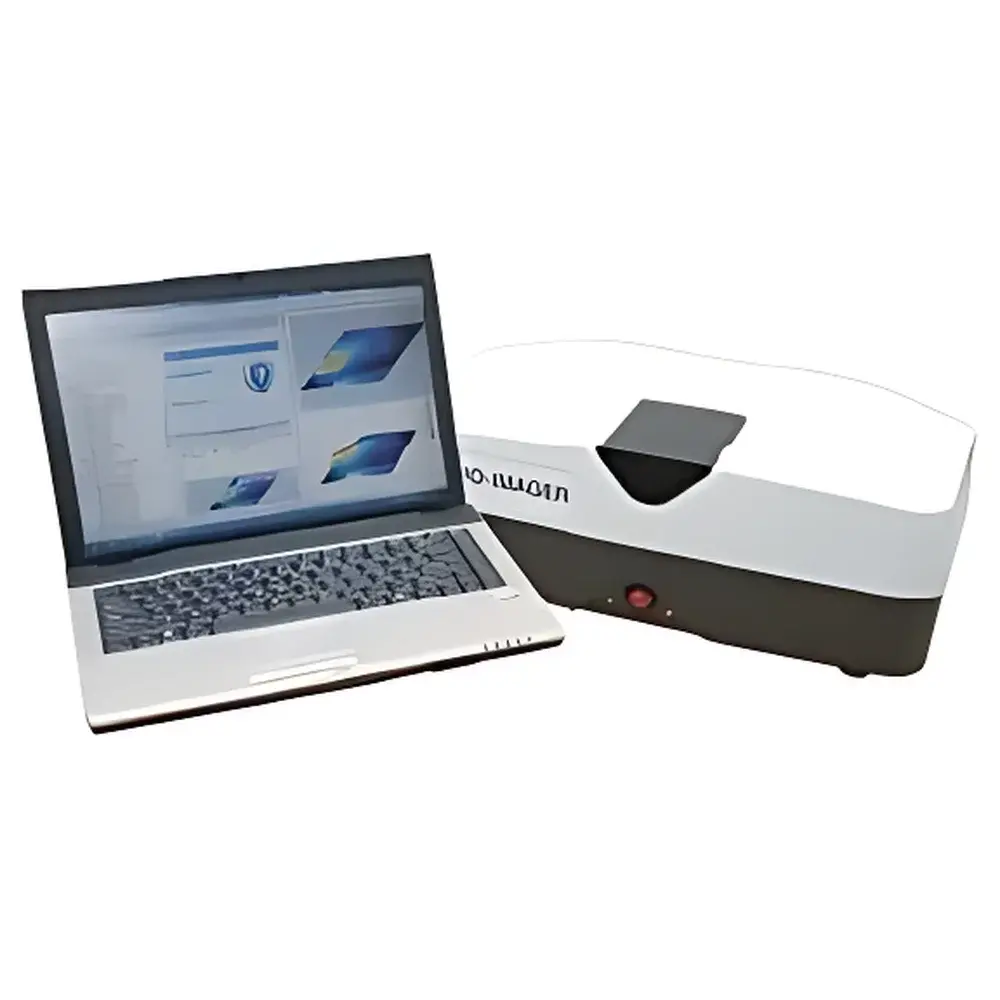
LDI FLUO-IMAGER Compact 3D Fluorescence Spectrophotometer for Oil-in-Water and Phytoplankton Analysis
| Brand | Jinhengxiang (JHX) |
|---|---|
| Origin | France |
| Distribution Model | Authorized Distributor |
| Instrument Type | Benchtop |
| Excitation Source | Pulsed Xenon Flash Lamp |
| Simultaneous Measurement | Synchronous Fluorescence Scanning (SFS/EEM) + Absorbance Spectra |
| Flow-Through Option | Available |
| Weight | 5 kg (Compact Model) / 17 kg (Field-Deployable Model) |
| Detection Limits | Crude Oil 0.5 mg/L, Gasoline 0.2 mg/L, Phenol 0.01 mg/L, Anthracene 1 µg/L, Chlorophyll-a 1 µg/L |
| Compliance | Designed for ISO 17025-compliant environmental labs |
Overview
The LDI FLUO-IMAGER Compact 3D Fluorescence Spectrophotometer is an engineered solution for rapid, reagent-free detection and quantification of hydrocarbon contaminants—including petroleum fractions, PAHs, phenolic compounds—and phytoplankton pigments (e.g., chlorophyll-a, phycocyanin) in aqueous matrices. Unlike conventional single-wavelength fluorimeters, the FLUO-IMAGER employs synchronous fluorescence scanning (SFS) to acquire excitation-emission matrices (EEMs), generating true three-dimensional fluorescence landscapes (Ex/Em/F intensity). This technique enables spectral deconvolution of overlapping fluorophores in complex natural waters—such as humic substances, fulvic acids, and anthropogenic pollutants—without chemical derivatization or solvent extraction. The system integrates a high-stability pulsed xenon flash lamp (1–10 Hz repetition rate) with dual-monochromator optics, delivering high signal-to-noise ratio across 200–750 nm excitation and 220–850 nm emission ranges. Its compact benchtop architecture (5 kg) and optional flow-cell configuration support both discrete laboratory analysis and semi-continuous monitoring in water treatment plants, offshore platforms, and environmental field stations.
Key Features
- Simultaneous acquisition of SFS-based EEMs and UV-Vis absorbance spectra (200–800 nm), enabling correction for inner-filter effects and non-fluorescent turbidity
- Automated, self-optimizing spectral library: user-customizable EEM feature database adapts to site-specific water chemistry via PCA- or PARAFAC-assisted calibration
- No reagents required: eliminates hazardous waste generation and preserves sample integrity for downstream analysis (e.g., GC-MS, ICP-MS)
- Dual operational modes: discrete cuvette-based measurement (lab mode) and continuous flow-through analysis (field-deployable 17 kg variant with integrated peristaltic pump)
- Real-time FDOM (fluorescent dissolved organic matter) baseline subtraction to isolate contaminant signals from natural organic background
- Configurable alarm thresholds for up to 12 target analytes; event-triggered data logging compliant with ISO 14001 environmental monitoring protocols
Sample Compatibility & Compliance
The FLUO-IMAGER is validated for direct analysis of unfiltered or 0.45 µm-filtered samples across diverse aqueous media: natural surface water, groundwater, boiler feedwater, cooling tower effluent, industrial wastewater, and seawater. It meets methodological requirements for ASTM D7678 (Standard Test Method for Determination of Hydrocarbons in Water by Fluorescence), EPA Method 418.1 (Oil and Grease by Infrared), and ISO 11929 (Determination of fluorescence properties of water). Instrument firmware and software support 21 CFR Part 11-compliant electronic signatures, audit trails, and role-based access control—essential for laboratories operating under GLP or ISO/IEC 17025 accreditation. All spectral data are stored in vendor-neutral HDF5 format, ensuring long-term archival integrity and third-party software interoperability.
Software & Data Management
The proprietary FLUO-Suite v4.2 software provides end-to-end workflow management—from instrument control and real-time spectral visualization to multivariate calibration (PLS-R, MCR-ALS) and automated peak integration. Raw EEMs undergo mandatory scatter correction (Rayleigh and Raman peaks), followed by normalization to Raman unit (RU) or internal standard. The software includes built-in spectral libraries for >40 common aquatic fluorophores (e.g., naphthalene, pyrene, chlorophyll-a, tryptophan-like humics) and supports user-defined library expansion. All processing steps are logged with timestamp, operator ID, and parameter settings. Export options include CSV, MATLAB .mat, and netCDF for integration into LIMS or statistical modeling platforms (R, Python scikit-learn).
Applications
- Early-warning detection of oil spills and hydrocarbon leaks in drinking water sources and marine environments
- Quantitative monitoring of PAH contamination in sediment pore water and dredged material leachates
- Phytoplankton community profiling via pigment-specific EEM fingerprints (e.g., distinguishing diatom vs. cyanobacterial blooms)
- Process control in wastewater reclamation plants: tracking humic removal efficiency during ozonation or activated carbon treatment
- Regulatory compliance testing for phenolic compounds in pharmaceutical manufacturing effluents (USP /)
- Research applications in biogeochemistry: FDOM characterization as a proxy for carbon cycling and microbial activity
FAQ
Does the FLUO-IMAGER require daily recalibration?
No—optical stability is maintained via internal reference photodiode and xenon lamp energy monitoring; full system verification is recommended weekly using NIST-traceable quinine sulfate and potassium dichromate standards.
Can it distinguish between biogenic and petrogenic hydrocarbons?
Yes—through PARAFAC modeling of EEMs, the system resolves diagnostic peaks (e.g., Ex/Em = 230/320 nm for tryptophan-like proteins vs. 230/350 nm for alkylbenzenes), enabling source apportionment in mixed contamination scenarios.
Is flow-through operation compatible with online telemetry?
Yes—the 17 kg field model outputs Modbus TCP and OPC UA data streams for integration into SCADA systems; measurement interval is configurable from 30 seconds to 24 hours.
What is the maximum sample turbidity the system tolerates?
Up to 200 NTU when using absorbance-corrected EEM processing; beyond this, pre-filtration is advised to minimize Mie scattering artifacts.
How is spectral interference from chloride ions mitigated?
The software applies empirical correction based on concurrent conductivity measurements and leverages the inherent insensitivity of SFS to halide quenching compared to steady-state fluorescence.
Related Products






