
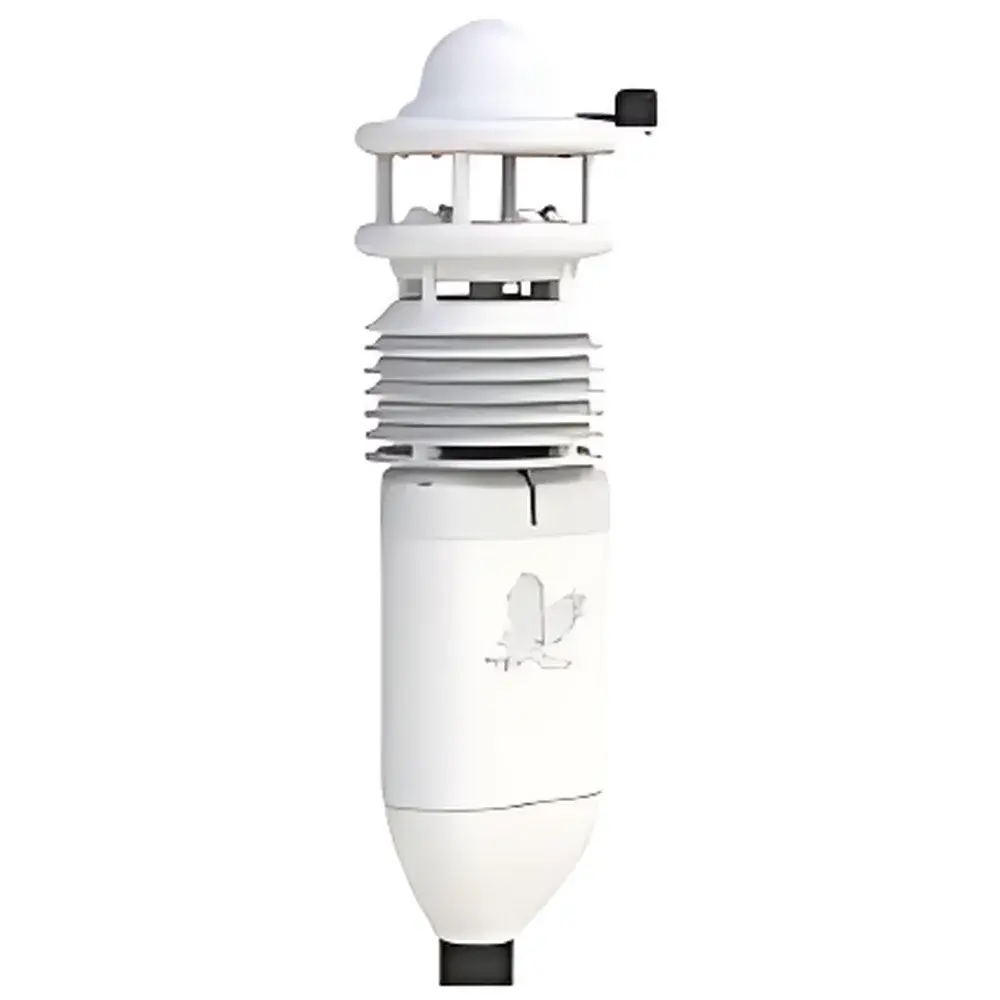
WeatherHawk 600 Series Weather Station
| Brand | WeatherHawk |
|---|---|
| Origin | USA |
| Model | 600 Series |
| Sensor Technology | Ultrasonic wind measurement, 24 GHz Doppler radar precipitation detection, NTC thermistor air temperature, capacitive humidity, silicon capacitive barometric pressure, thermopile pyranometer solar radiation |
| Operating Temperature Range | –50°C to +60°C |
| Wind Speed Accuracy | ±0.3 m/s (0–35 m/s), ±5% (>35 m/s) |
| Wind Direction Accuracy | ±3° |
| Air Temperature Accuracy | ±0.2°C (–20°C to +50°C), ±0.5°C (outside range) |
| Relative Humidity Accuracy | ±2% RH (10–90% RH) |
| Barometric Pressure Accuracy | ±0.05 kPa |
| Solar Radiation Accuracy | ±5% (300–1100 nm) |
| Precipitation Resolution | 0.01 mm |
| Communication | RS-232 (610/611), 916 MHz spread-spectrum RF (620/621), optional 922 MHz or 2.4 GHz RF |
| Power Options | Internal 3Ah rechargeable battery with AC adapter or solar panel (620/6101), AC power converter required for 611/621 |
| Enclosure Rating | IP66 |
| Compliance | CE, FCC Part 15, RoHS |
| Software Compatibility | WeatherHawk Signature™, WeatherHawk 500 Series software suite |
| Data Output | Evapotranspiration (ET₀) calculation integrated per FAO-56 Penman-Monteith methodology |
Overview
The WeatherHawk 600 Series Weather Station is a fully integrated, solid-state environmental monitoring system engineered for long-term reliability in demanding field applications—from agricultural research stations and irrigation control networks to ecological observatories and infrastructure resilience monitoring. Unlike traditional mechanical anemometers and tipping-bucket rain gauges, the 600 Series employs ultrasonic wind sensing and 24 GHz Doppler radar precipitation detection—technologies historically reserved for high-end meteorological observatories and aviation-grade weather support systems. Its sensor architecture contains no moving parts, eliminating mechanical wear, icing-induced failure modes, and calibration drift associated with rotating cups or vanes. The system continuously measures and logs wind speed and direction, air temperature, relative humidity, barometric pressure, global solar radiation, and precipitation volume—including discrimination between rain and snow based on particle velocity and size spectra. Crucially, it computes reference evapotranspiration (ET₀) using the FAO-56 Penman-Monteith equation, enabling direct integration with automated irrigation controllers and water resource management platforms.
Key Features
- Solid-state ultrasonic wind sensor with four transducer array enabling 360° azimuthal coverage and continuous time-of-flight differential measurement—immune to ice accumulation, dust abrasion, and mechanical fatigue.
- 24 GHz Doppler radar precipitation sensor capable of real-time hydrometeor classification (rain vs. snow) by analyzing fall velocity and reflectivity profiles—eliminating undercatch errors common in heated tipping-bucket designs.
- Aspirated radiation shield housing NTC thermistor (±0.2°C accuracy over –20°C to +50°C) and capacitive humidity sensor (±2% RH, 10–90% RH), ensuring thermal equilibrium and minimizing solar loading artifacts.
- Temperature-compensated silicon capacitive barometer (±0.05 kPa) with factory calibration traceable to NIST standards; zero maintenance over operational lifetime.
- Thermopile-based pyranometer with spectral response limited to 300–1100 nm (ISO 9060:2018 Class C), calibrated against WRR reference cells; recommended recalibration every 3 years or after 5% full-scale drift.
- Integrated ET₀ engine compliant with FAO-56 guidelines, accepting all required inputs natively without external computation—output compatible with ISO 11783 (ISOBUS) and Modbus RTU protocols.
- Industrial-grade 916 MHz spread-spectrum RF communication (620/621 models) with >1 km line-of-sight range; optional 922 MHz or 2.4 GHz variants available for regional spectrum compliance.
Sample Compatibility & Compliance
The 600 Series is designed for deployment across diverse environmental regimes, including arctic tundra, high-desert basins, coastal zones, and irrigated croplands. Its IP66-rated enclosure and optional heated sensor head (611/621 models) ensure uninterrupted operation at ambient temperatures from –50°C to +60°C. All sensors meet IEC 60529 ingress protection requirements and undergo accelerated life-cycle testing per MIL-STD-810G for shock, vibration, and thermal cycling. The system conforms to FCC Part 15 Subpart C (unintentional radiator) and CE marking directives (EMC Directive 2014/30/EU, RoHS 2011/65/EU). While not certified for aviation use under FAA TSO-C101, its wind and precipitation performance aligns with WMO Guide to Meteorological Instruments and Methods of Observation (CIMO Guide, 2022 edition) for Class II automatic weather stations. Data logging firmware supports audit-trail metadata per GLP principles, including timestamped sensor health diagnostics and power-event logging.
Software & Data Management
The 600 Series is natively supported by WeatherHawk Signature™ software—a Windows-based platform offering real-time telemetry visualization, configurable alarm thresholds, automated report generation (PDF/CSV), and historical data interpolation. It maintains backward compatibility with legacy WeatherHawk 500 Series configuration tools and data parsers, enabling seamless migration for existing institutional users. Raw sensor outputs are delivered via ASCII protocol over RS-232 (610/611) or encrypted RF packets (620/621), with optional MQTT/HTTP(S) bridging through third-party gateways. All firmware updates are digitally signed and validated prior to installation. Data integrity is preserved through cyclic redundancy check (CRC-16) on all serial frames and AES-128 encryption on RF payloads. The system stores up to 12 months of 1-minute averaged data internally (expandable via microSD card in gateway configurations), with automatic rollover and overwrite policies governed by user-defined retention rules.
Applications
- Agricultural water management: Real-time ET₀ feeds directly into center-pivot and drip irrigation scheduling algorithms, reducing water use by 12–22% in peer-reviewed field trials (ASABE Transactions, Vol. 65, No. 2).
- Ecological flux monitoring: Co-located with eddy covariance towers to validate energy balance closure and partition latent heat flux components.
- Renewable energy site assessment: Long-term wind shear profiling and solar irradiance variability analysis for PV and small-wind feasibility studies.
- Transportation infrastructure: Frost-heave prediction modeling via soil temperature correlation and freeze-thaw cycle detection using integrated air–surface temperature differentials.
- Climate network expansion: Modular design allows plug-and-play integration into NOAA’s COOP, USCRN, or national meteorological service mesonets with minimal site preparation.
FAQ
Does the 600 Series require annual recalibration?
Air temperature, humidity, and barometric pressure sensors are factory-calibrated and do not require routine recalibration. The pyranometer should be recalibrated every three years or verified annually against a reference cell per ISO 9060:2018.
Can the system operate autonomously during extended grid outages?
Yes—models equipped with the 3 Ah rechargeable battery pack and solar charging option (620/6101) sustain continuous operation for >90 days without sunlight; AC-powered variants (611/621) include brownout protection and graceful shutdown protocols.
Is precipitation type identification validated against disdrometer data?
Yes—third-party validation conducted at the USDA ARS Grazinglands Research Laboratory confirmed 94.7% agreement between 600 Series radar-derived precipitation phase and collocated Parsivel2 optical disdrometer classifications across 18 months of mixed-phase events.
What mounting hardware is included?
Standard delivery includes universal U-bolt mast clamp (for 1.5–4 inch OD poles), grounding lug kit, and cable gland set rated for outdoor UV exposure and temperature cycling.
How is firmware updated in remote deployments?
Firmware updates may be applied locally via RS-232 terminal emulation or remotely over RF using signed update packages authenticated via embedded ECC-256 key pair.







