
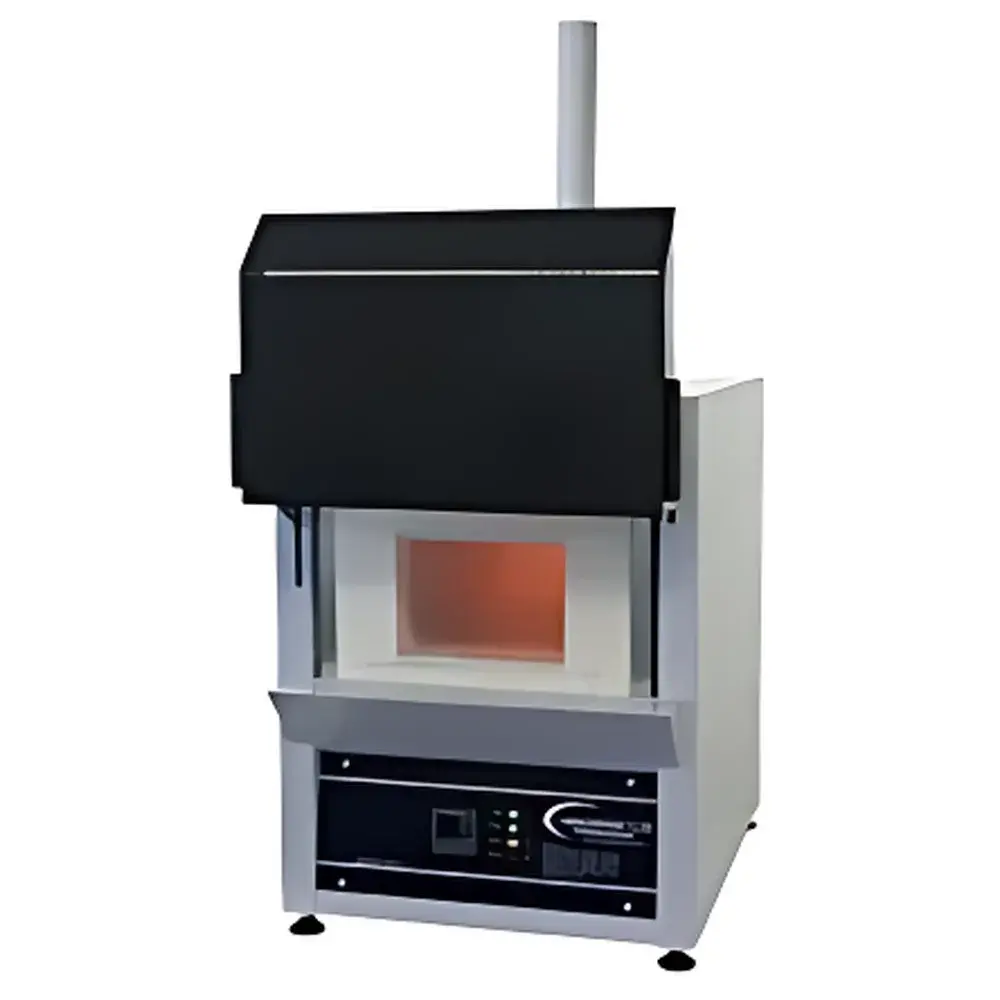
Vecstar AF Series 1200 °C High-Temperature Ashing Muffle Furnace
| Brand | Vecstar |
|---|---|
| Origin | United Kingdom |
| Model | AF-Series |
| Furnace Type | Box-Type Muffle Furnace |
| Max Operating Temperature | 1200 °C |
| Max Continuous Operating Temperature | 1150 °C |
| Chamber Volume | 5.7 L / 7.2 L (selectable) |
| Max Power Consumption | 3 kW |
| Temperature Uniformity | ±1 °C at 1100 °C |
| Control System | Solid-State Relay (SSR) with Digital PID Controller |
| Heating Element | High-Purity Kanthal A1 Resistance Wire Wound on Ceramic Core |
| Insulation | Dual-Layer High-Performance Ceramic Fiber Insulation |
| Door Mechanism | Vertical Lift with Safety Interlock |
| Exhaust | Integrated Aluminum Chimney with Passive Ventilation Port |
| Over-Temperature Protection | Independent Bimetallic Cut-Out |
| External Casing | Corrosion-Resistant Anodized Aluminum |
| Power Supply | Single-Phase, 230 V AC, 50/60 Hz |
| Internal Dimensions | 350 × 350 × 410 mm (W × D × H) |
Overview
The Vecstar AF Series 1200 °C High-Temperature Ashing Muffle Furnace is a precision-engineered laboratory furnace designed for controlled thermal decomposition of organic matrices in analytical sample preparation workflows. Operating on the principle of resistive heating via high-stability Kanthal A1 alloy wire wound uniformly around a monolithic ceramic chamber core, the furnace delivers exceptional temperature homogeneity and long-term thermal stability—critical for quantitative ash content determination per ASTM D3174, ISO 1171, and USP . Its muffle architecture isolates samples from direct flame or combustion gases, ensuring contamination-free residue collection. Unlike general-purpose kilns, the AF Series is specifically calibrated and validated for ashing applications requiring reproducible 1100–1200 °C dwell cycles under inert or ambient air atmospheres. The vertical-lift door design, combined with dual-layer ceramic fiber insulation and thermally decoupled aluminum casing, ensures surface temperatures remain below 50 °C during continuous operation—meeting IEC 61010-1 safety requirements for laboratory equipment.
Key Features
- Vertically opening muffle chamber with mechanical safety interlock: automatically de-energizes heating elements upon door actuation, eliminating risk of operator exposure to radiant heat.
- Ceramic core construction with embedded resistance wire winding: eliminates hot spots and provides ±1 °C uniformity across the full working volume at 1100 °C (verified per ISO/IEC 17025 calibration protocol).
- Dual-layer insulation system: outer layer of low-conductivity ceramic fiber (≤0.09 W/m·K at 1000 °C) plus inner reflective barrier minimizes radial heat loss and enables stable setpoint maintenance with minimal overshoot.
- Integrated passive exhaust path: anodized aluminum chimney with adjustable aperture facilitates controlled removal of volatile combustion by-products without compromising chamber integrity or airflow uniformity.
- Programmable digital PID controller (optional): supports multi-step ramp-soak profiles, real-time deviation logging, and configurable alarm thresholds—including independent overtemperature cut-out via redundant bimetallic switch.
- Corrosion-resistant enclosure: anodized aluminum housing resists degradation from halogenated fumes and acidic condensates common in coal, biomass, or polymer ashing protocols.
Sample Compatibility & Compliance
The AF Series accommodates standard crucibles (alumina, platinum, silica) up to 100 mL capacity and supports batch processing of up to 12 × 30 mL porcelain crucibles per cycle. It complies with key regulatory frameworks governing thermal analysis instrumentation: IEC 61010-1 (safety), EN 60529 (IP20 ingress protection), and meets electromagnetic compatibility requirements per EN 61326-1. For GLP/GMP environments, optional controllers support audit-trail-enabled operation compliant with FDA 21 CFR Part 11 when paired with validated data acquisition software. The furnace is routinely deployed in accredited testing laboratories performing ash content analysis per AOAC 942.05 (food), EPA Method 1694 (pharmaceutical residues), and ISO 1171 (solid fuels).
Software & Data Management
While the base configuration includes a standalone digital controller with LED display and manual setpoint adjustment, Vecstar offers two certified upgrade paths: (1) a DIN-rail-mounted programmable logic controller (PLC) with RS-485 Modbus RTU interface for integration into centralized lab automation systems; and (2) PC-based control suite with USB connectivity, supporting CSV export of time-temperature-residue mass logs, automated report generation (PDF/XLS), and electronic signature capability for 21 CFR Part 11 compliance. All firmware revisions undergo traceable validation per GAMP 5 guidelines, and calibration certificates are supplied with NIST-traceable reference thermocouples (Type S, Class 1).
Applications
- Quantitative ash determination in foodstuffs, animal feed, and dietary supplements per AOAC and Codex Alimentarius standards.
- Mineral residue analysis in coal, coke, and biomass feedstocks per ASTM D3174 and ISO 1171.
- Preparation of inorganic residues for subsequent elemental analysis (ICP-OES, AAS) following EPA SW-846 Methods 3010A and 3050B.
- Thermal conditioning of catalyst supports and ceramic precursors in materials R&D labs.
- Residue quantification in pharmaceutical excipients and active ingredients per USP and Ph. Eur. 2.4.15.
FAQ
What is the maximum recommended continuous operating temperature?
The furnace is rated for continuous operation up to 1150 °C. Extended use above this temperature may accelerate element aging and compromise long-term calibration stability.
Can this furnace be used under inert gas atmosphere?
Yes—optional quartz or stainless-steel gas inlet/outlet ports (with Viton-sealed fittings) can be factory-installed to enable nitrogen or argon purging for reducing or oxygen-sensitive ashing protocols.
Is third-party calibration certification available?
Vecstar provides UKAS-accredited calibration certificates (traceable to NPL) upon request, covering temperature uniformity, accuracy, and repeatability across three load points (800 °C, 1000 °C, 1150 °C).
How often should the ceramic insulation be inspected?
Visual inspection is recommended every 200 operational hours; replacement is advised after 5,000 cumulative hours at ≥1100 °C or if visible cracking or delamination is observed.
Does the furnace meet CE marking requirements for export to the EU?
Yes—the unit carries full CE marking under the Low Voltage Directive (2014/35/EU) and EMC Directive (2014/30/EU), with technical documentation available upon order confirmation.



