
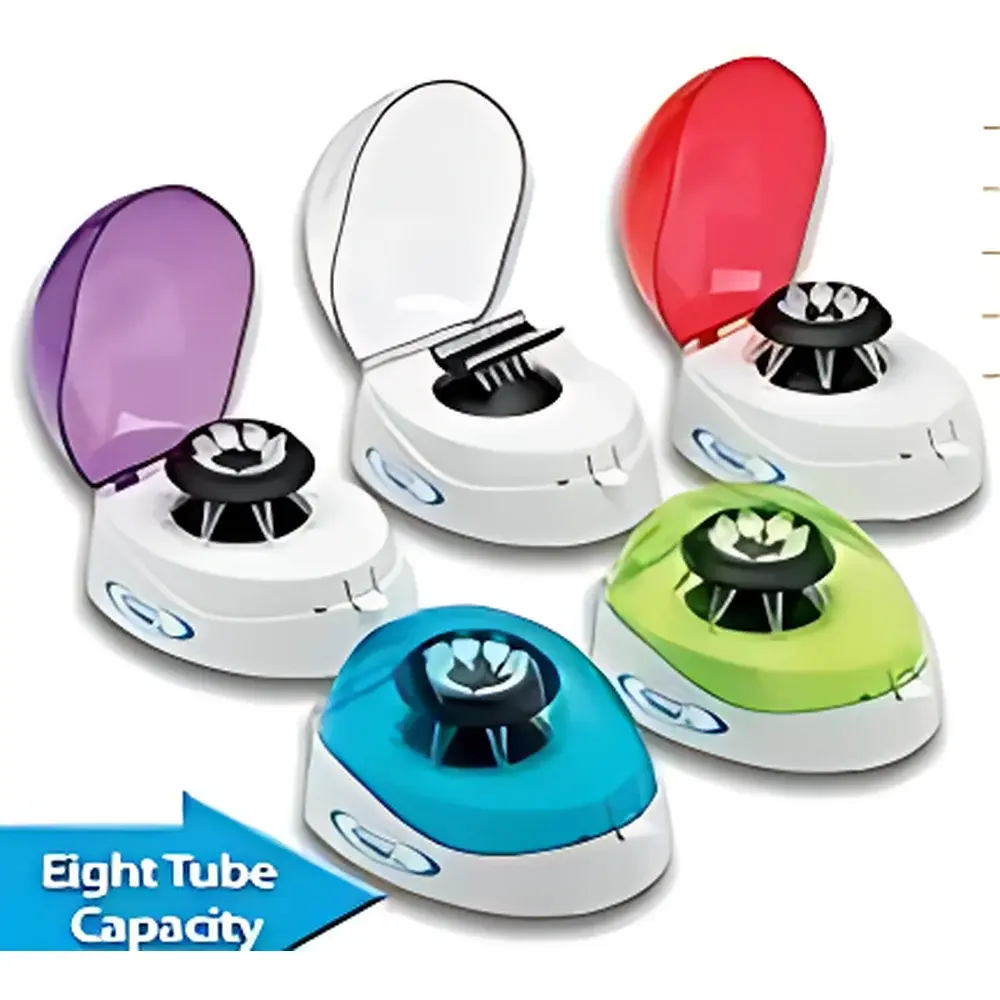
Benchmark MyFuge Mini Benchtop Centrifuge C1008
| Brand | Benchmark |
|---|---|
| Origin | USA |
| Model | MyFuge Mini |
| Instrument Type | Benchtop Centrifuge |
| Speed Range | 0–6000 rpm |
| Relative Centrifugal Force (RCF) | up to 2000 × g |
| Capacity | 8 × 1.5/2.0 mL microtubes or 16 × 0.2 mL PCR tubes |
| Dimensions | 11.4 × 15 × 11.4 cm (W × D × H) |
| Weight | 5 kg |
| Power Supply | 100–240 V AC, 50–60 Hz |
| Rotor Configuration | Fixed-angle rotor (standard), additional PCR rotor included |
| Application Class | Cellular and bacterial pelleting |
| Compliance | CE, UL/CSA certified |
Overview
The Benchmark MyFuge Mini Benchtop Centrifuge C1008 is a compact, high-efficiency microcentrifuge engineered for rapid, reliable pelleting of biological samples in demanding laboratory environments. Designed around a brushless DC motor and precision-machined fixed-angle rotor system, it operates on the principle of centrifugal sedimentation—applying controlled radial acceleration to separate particles based on density, size, and shape within low-volume samples. With a maximum speed of 6000 rpm and an RCF of 2000 × g, the MyFuge Mini delivers sufficient force for routine cell harvesting, bacterial pellet formation, nucleic acid precipitation, and post-PCR cleanup—without requiring refrigeration or complex setup. Its ultra-compact footprint (11.4 × 15 × 11.4 cm) and lightweight construction (5 kg) make it ideal for benchtop deployment in biosafety cabinets, cleanrooms, mobile labs, or point-of-care settings where space and portability are critical constraints.
Key Features
- Instant start-stop operation: Rotor reaches 6000 rpm within seconds of lid closure; decelerates to rest immediately upon lid opening—eliminating wait time between runs and enhancing workflow continuity.
- Dual-rotor configuration: Includes a standard 8-position fixed-angle rotor for 1.5/2.0 mL microcentrifuge tubes and a dedicated 16-position PCR rotor for 0.2 mL tubes—both pre-balanced and autoclavable (up to 121 °C, 20 min).
- Integrated rotor storage: A recessed compartment beneath the base securely houses the spare PCR rotor, preventing loss, contamination, or mechanical damage during transport or daily use.
- Intuitive single-knob interface: No programming required—speed is set manually with tactile feedback; LED display shows real-time rpm and run status.
- Robust safety architecture: Automatic lid interlock prevents operation with the lid open; imbalance detection halts rotation if load asymmetry exceeds tolerance; rotor recognition ensures only validated rotors engage the drive shaft.
- Universal power compatibility: Operates across global mains voltages (100–240 V AC, 50–60 Hz), eliminating need for external transformers in multi-site or international deployments.
Sample Compatibility & Compliance
The MyFuge Mini accommodates standard polypropylene microcentrifuge tubes (1.5 mL and 2.0 mL) and thin-walled 0.2 mL PCR tubes without adapters. It supports common molecular biology workflows including spin-down of enzymatic reactions, column-based DNA/RNA purification, and microbial cell harvesting (e.g., E. coli, S. cerevisiae). The device complies with IEC 61010-1:2010 for laboratory electrical equipment safety and carries CE marking under the EU Machinery Directive. It meets UL 61010-1 and CSA C22.2 No. 61010-1 safety standards. While not designed for clinical diagnostics under FDA 21 CFR Part 820, its consistent performance and traceable operational parameters support GLP-compliant documentation when integrated into validated lab procedures.
Software & Data Management
The MyFuge Mini is a standalone, non-networked instrument with no embedded software or data logging capability—by design. This architecture minimizes validation overhead for regulated environments and eliminates cybersecurity vulnerabilities associated with connected peripherals. All operational parameters (speed, run duration, rotor type) are recorded manually in lab notebooks or LIMS via standardized SOP templates. For laboratories requiring audit trails, integration with external timers or barcode-scanned run logs ensures full traceability per ISO/IEC 17025 and CAP accreditation requirements.
Applications
- Routine pelleting of bacterial cultures prior to lysis or genomic DNA extraction.
- Quick spin-down of enzymatic reaction mixtures (e.g., restriction digests, ligations, phosphorylations) to collect condensate and ensure complete reagent contact.
- Clarification of lysates and supernatants in protein purification workflows.
- Post-PCR tube consolidation before electrophoresis or sequencing library preparation.
- Field-deployable sample stabilization: Used in environmental sampling, veterinary clinics, and outbreak response units where portable, battery-independent centrifugation is essential.
FAQ
Is the MyFuge Mini suitable for centrifuging viscous or dense samples such as whole blood or tissue homogenates?
No—it is optimized for low-viscosity aqueous solutions and standard microvolume biological suspensions. Whole blood or high-density lysates require higher RCF (>3000 × g) and refrigerated models with swing-bucket rotors.
Can the rotors be sterilized in an autoclave?
Yes—both the standard and PCR rotors are constructed from medical-grade aluminum alloy and rated for autoclaving at 121 °C for 20 minutes. Verify rotor integrity visually before each use.
Does the device retain speed settings after power cycling?
No—the MyFuge Mini has no memory function. Speed must be manually reset for each run, ensuring intentional operator confirmation and reducing risk of accidental over-speed operation.
What maintenance is required?
Routine cleaning of the chamber and rotor surfaces with 70% ethanol; annual inspection of the drive coupling and lid switch actuation by authorized service personnel. No lubrication or calibration is required under normal usage conditions.
Is rotor imbalance compensation available?
The unit includes passive imbalance detection that halts rotation if mass asymmetry exceeds ±0.1 g per position. Manual balancing remains the recommended practice per ISO 15190:2022 for microcentrifuge operation.



