
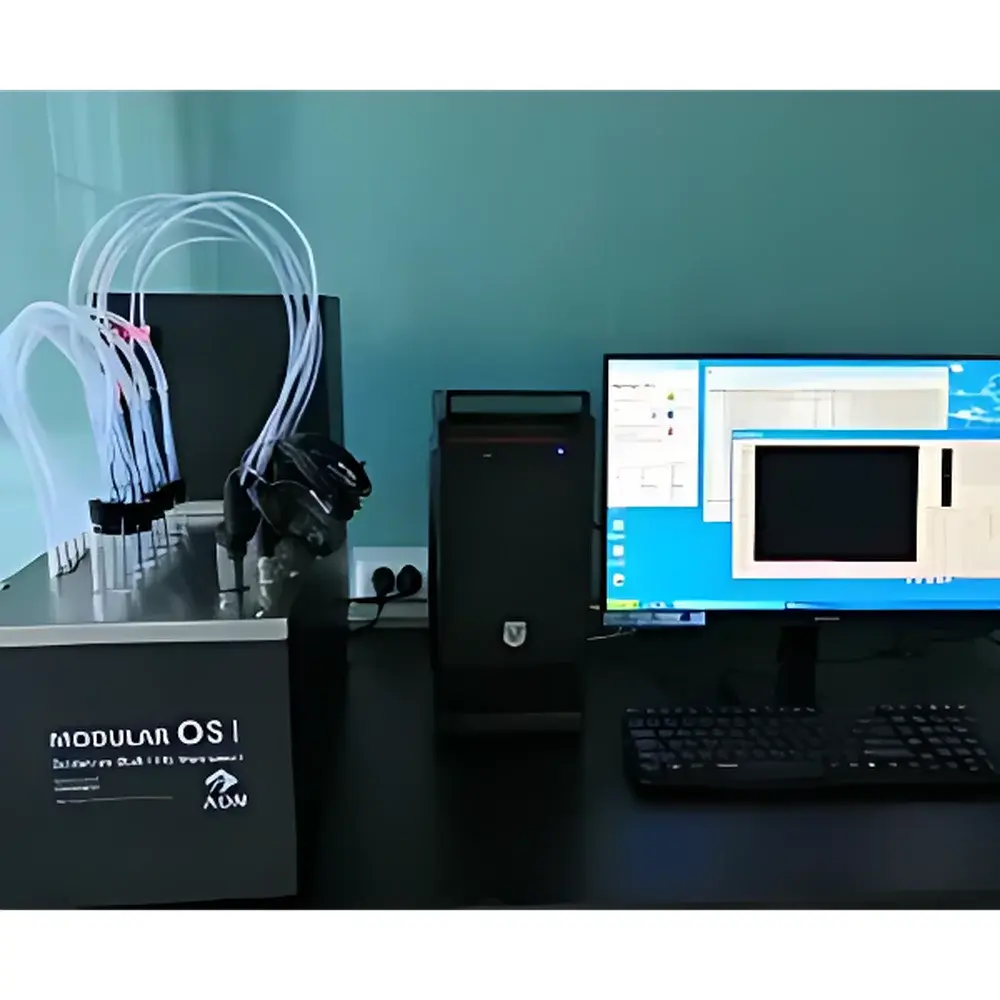
Omnion OSI-6 Oil Stability Index Analyzer
| Brand | Omnion |
|---|---|
| Origin | USA |
| Model | OSI-6 |
| Temperature Range | 40–200 °C |
| Sample Capacity | 6 positions (expandable to 12 or 18) |
| Data Channels | 24 simultaneous real-time monitoring channels |
| Measurement Principle | Oxygen uptake via conductometric detection of peroxide formation during accelerated oxidation |
| Compliance | ASTM D5768, AOCS Cd 12b-92, ISO 6886 |
Overview
The Omnion OSI-6 Oil Stability Index Analyzer is a dedicated benchtop instrument engineered for the precise, automated determination of oxidative stability in lipids and lipid-containing materials under controlled thermal-oxidative stress. It implements the standardized Oxygen Stability Index (OSI) method—an accelerated oxidation test that quantifies the induction period prior to rapid peroxide accumulation—replacing the labor-intensive, subjective, and hazardous Active Oxygen Method (AOM). Unlike AOM, which relies on manual iodometric titration at discrete time intervals, the OSI-6 employs continuous, real-time conductometric monitoring of oxygen consumption in sealed reaction vessels. As oxidation proceeds, hydroperoxides form and decompose, altering solution conductivity; this change is detected with high temporal resolution across up to 24 independent channels. The system automatically identifies the inflection point marking the onset of autocatalytic oxidation—the OSI value—expressed in hours under specified temperature and airflow conditions.
Key Features
- Thermostatically controlled reaction chamber with precise temperature regulation from 40 °C to 200 °C (±0.1 °C stability), enabling method flexibility across diverse sample matrices and regulatory requirements.
- Modular sample carousel accommodating six standard reaction vessels; optionally expandable to 12 or 18 positions to support higher-throughput screening without compromising thermal uniformity or airflow consistency.
- 24-channel parallel data acquisition architecture ensures no endpoint is missed—even for heterogeneous samples exhibiting variable oxidation kinetics—providing robust statistical confidence in replicate measurements.
- Conductometric sensor array calibrated for low-noise, drift-compensated signal detection over extended run times (up to 100+ hours), eliminating operator bias and chemical reagent handling associated with titrimetric approaches.
- Rugged, corrosion-resistant construction with integrated mass-flow-controlled air/oxygen supply and pressure-regulated purge system compliant with ASTM D5768 airflow specifications (10–20 L/h).
- Front-panel touchscreen interface with embedded firmware for method setup, real-time curve visualization, and automatic OSI calculation—including slope-based derivative analysis for ambiguous endpoints.
Sample Compatibility & Compliance
The OSI-6 is validated for use with a broad spectrum of lipid-rich and semi-solid matrices, including but not limited to edible oils (soybean, palm, sunflower, canola), animal fats (tallow, lard, butteroil), specialty lipids (cocoa butter, coconut oil), food products (snack chips, baked goods, pet food, dehydrated meats), biofuels (biodiesel B100), polymer additives (PVC stabilizers), cosmetic emollients, and feed ingredients (fish oil powders, vitamin premixes). Its operational protocol aligns with internationally recognized standards: ASTM D5768 (Standard Test Method for Oxidative Stability of Lubricants by Pressurized Differential Scanning Calorimetry—adapted for OSI equivalence), AOCS Cd 12b-92 (Official Method for Determination of Oxidative Stability of Fats and Oils by the Rancimat Method), and ISO 6886 (Animal and Vegetable Fats and Oils — Determination of Oxidative Stability — Rapid Method Using the Rancimat Instrument). While not a direct Rancimat clone, the OSI-6 delivers equivalent thermodynamic and kinetic fidelity through its proprietary conductometric transduction pathway.
Software & Data Management
Data acquisition and analysis are managed via the embedded OmniControl™ firmware, supporting audit-trail-enabled operation per GLP and GMP guidelines. Each measurement session logs timestamped raw conductivity curves, environmental parameters (temperature, flow rate, pressure), user ID, method name, and calibration history. Export options include CSV and PDF reports compliant with FDA 21 CFR Part 11 requirements when paired with networked enterprise software (optional OmniLink™ Suite). The system supports user-defined pass/fail criteria, statistical process control (SPC) charting for batch release, and integration into LIMS environments via standard OPC UA or Modbus TCP protocols. All data files are cryptographically hashed and stored with immutable metadata to satisfy traceability mandates in regulated food safety and pharmaceutical excipient testing workflows.
Applications
- Quality control of refined edible oils to verify antioxidant efficacy (e.g., TBHQ, BHA, rosemary extract) and shelf-life prediction.
- Stability benchmarking of novel fat substitutes and structured lipids in low-calorie food development.
- Feed formulation optimization—evaluating oxidative resistance of omega-3 enriched fishmeal or microencapsulated oils in aquaculture diets.
- Raw material qualification for cosmetic actives and emollient blends where rancidity compromises product integrity and consumer acceptability.
- Biodiesel certification per EN 14214, where minimum induction period thresholds govern commercial acceptance.
- Accelerated aging studies for lipid-based drug delivery systems (e.g., nanoemulsions, self-emulsifying drug delivery systems) under ICH Q1A(R3) stress conditions.
FAQ
What distinguishes the OSI-6 from traditional Rancimat instruments?
The OSI-6 utilizes conductometric detection rather than conductivity measurement of volatile organic acids—a fundamental difference in sensing mechanism that improves specificity for early-stage hydroperoxide dynamics and reduces interference from non-lipid volatiles.
Can the OSI-6 be used for solid or semi-solid samples like margarine or chocolate?
Yes—samples are homogenized or melted prior to loading; the system accommodates viscosities up to 500 cP at test temperature using optimized vessel geometry and airflow profiles.
Is method validation documentation available for regulatory submissions?
Omnion provides IQ/OQ/PQ protocol templates, system suitability test procedures, and a full technical validation report aligned with ISO/IEC 17025 principles upon request.
Does the instrument require routine sensor recalibration?
No—conductometric sensors are factory-calibrated and field-verified using NIST-traceable reference oils; annual verification against certified standards is recommended for GLP compliance.
How is airflow accuracy maintained across multiple channels?
Each sample position features an independently metered, laminar-flow air stream regulated by precision thermal mass flow controllers, ensuring ±1% volumetric consistency per channel across the full operating range.



