
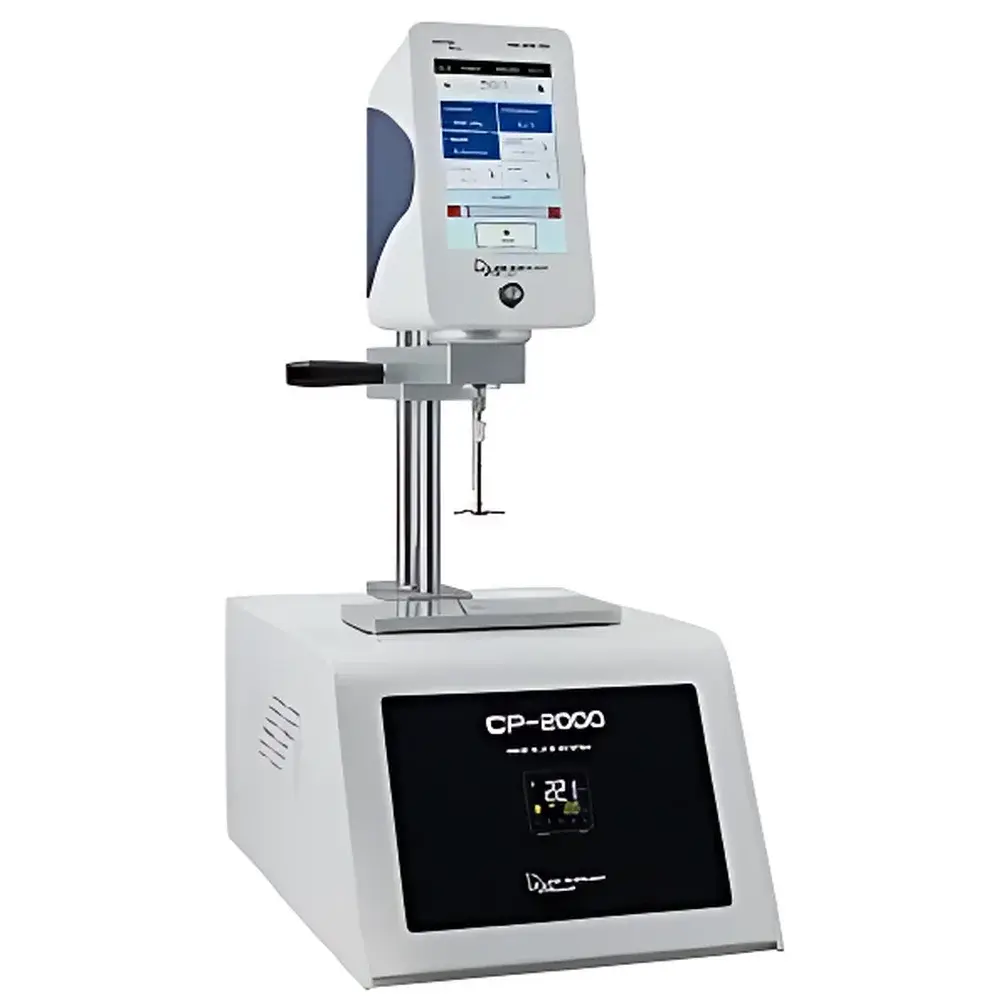
Lamy Rheology RM100 TOUCH CP2000 Cone-Plate Viscometer
| Brand | Lamy Rheology |
|---|---|
| Origin | France |
| Model | CP2000 |
| Instrument Type | Rotational Viscometer (Fixed Benchtop) |
| Viscosity Range | 1–450,000,000 mPa·s |
| Rotational Speed | 0.3–1500 rpm |
| Torque Range | 0.05–30 mN·m |
| Temperature Control | 5–80 °C (Peltier air-air), ±0.1 °C accuracy |
| Display | 7″ capacitive touchscreen |
| Compliance | ASTM D2196, ISO 2555, ISO 3219, USP <911> |
| Data Output | RS232, USB, 4–20 mA analog |
| Security | User authentication with 4-digit PIN |
| Weight | 22 kg (head + CP2000 stand) |
Overview
The Lamy Rheology RM100 TOUCH CP2000 Cone-Plate Viscometer is a precision-engineered rotational viscometer designed for high-shear rheological characterization of low-volume, thermally sensitive, or difficult-to-clean samples. Operating on the principle of controlled shear between a rotating cone and a stationary plate—where the gap geometry defines a constant shear rate across the measurement zone—the instrument delivers true shear-rate-controlled viscosity data under defined boundary conditions. This geometry eliminates wall slip artifacts common in coaxial cylinder systems and ensures accurate determination of apparent viscosity, yield stress, thixotropic breakdown/recovery, and structural recovery kinetics. The CP2000 temperature-controlled cone-plate stage utilizes solid-state Peltier elements for rapid, solvent-free thermal regulation from 5 °C to 80 °C with ±0.1 °C stability—critical for simulating process-relevant thermal histories in coatings, pharmaceutical suspensions, and cosmetic emulsions. Its compact design accommodates sample volumes as low as 0.5 mL, making it ideal for R&D labs where material scarcity or contamination risk restricts conventional testing.
Key Features
- 7-inch high-resolution capacitive touchscreen interface with intuitive icon-based navigation and real-time graphical display of viscosity, torque, speed, temperature, and time
- Peltier-driven cone-plate temperature control (5–80 °C) enabling rapid ramping, plateau stabilization, and isothermal holds without external coolant circulation
- Shear rate range up to 10,000 s−1, programmable via continuous or stepped profiles for transient and steady-state flow analysis
- Motorized torque sensing system with dual-range capability (0.05–30 mN·m standard) and ±0.2% repeatability (full scale)
- Integrated Pt100 temperature sensor embedded in the plate for direct sample-contact thermal feedback
- User-accessible security protocol: configurable username and mandatory 4-digit PIN authentication prior to operation
- Multi-interface connectivity including RS232, USB 2.0, and industrial-standard 4–20 mA analog output for SCADA integration
- Onboard memory for storage of up to 1,000 measurement curves, timestamps, and metadata—including operator ID and environmental logs
Sample Compatibility & Compliance
The RM100 TOUCH CP2000 supports a broad spectrum of non-Newtonian and structured fluids—including solvent-borne and water-based paints, polymer melts, pharmaceutical gels, food pastes, and nanosuspensions—without requiring dilution or pre-conditioning. Its cone-plate geometry minimizes edge effects and enables reliable measurement of yield-stress fluids (e.g., bentonite dispersions, carbomer gels) and thixotropic systems (e.g., lithium greases, ink formulations). All operational protocols align with internationally recognized standards: viscosity measurements conform to ASTM D2196 (non-Newtonian fluids), ISO 2555 (single-point viscosity), and ISO 3219 (rheological classification of polymer solutions); temperature calibration follows ISO/IEC 17025 traceable procedures. For regulated environments, the system supports audit-trail generation, electronic signature capture, and user-level access control—facilitating compliance with FDA 21 CFR Part 11, EU Annex 11, and GLP/GMP documentation requirements when paired with validated VISCO RM software.
Software & Data Management
The instrument operates natively via its embedded firmware but integrates seamlessly with Lamy’s VISCO RM software suite (Windows-compatible, version 4.2+). This application provides advanced data acquisition, curve fitting (Bingham, Herschel-Bulkley, Casson models), comparative overlay of multiple runs, automated yield stress calculation using dynamic oscillatory sweeps, and export to CSV, PDF, or XML formats compliant with LIMS ingestion. All raw torque/time/temperature datasets are timestamped and stored with full metadata—including operator ID, ambient humidity (optional external sensor), and calibration certificate references. The software supports method templates for routine QC testing, with password-protected parameter locking to prevent unauthorized deviation from SOPs. Audit trails record all configuration changes, measurement starts/stops, and user logins—retained for ≥36 months per default retention policy.
Applications
- Coatings & Inks: Shear-thinning behavior prediction for spray application, yield stress quantification for sag resistance, and thixotropic recovery assessment after film formation
- Pharmaceuticals: Viscosity profiling of topical gels and ointments under physiological shear rates; sedimentation stability evaluation via time-dependent structural recovery tests
- Food Science: Mouthfeel simulation through high-shear viscosity mapping; starch gelatinization onset detection via temperature-ramped viscosity sweeps
- Chemical R&D: Polymer solution rheology at processing-relevant shear rates; surfactant micelle disruption thresholds; nanoparticle dispersion stability screening
- Academic Research: Fundamental studies of colloidal glass transitions, jamming phenomena, and nonlinear viscoelasticity in soft matter systems
FAQ
What sample volume is required for accurate cone-plate measurements?
Minimum recommended volume is 0.5 mL for standard 2°/40 mm cones. Larger cones (e.g., 1°/60 mm) accommodate up to 1.2 mL and extend low-viscosity sensitivity.
Can the CP2000 stage be upgraded for sub-ambient or high-temperature operation?
The base CP2000 uses air-air Peltier cooling/heating (5–80 °C). For extended ranges, optional liquid-circulated plates (−20 to 120 °C) or electrically heated CP2000H variants (up to 300 °C) are available—both require separate bath controllers.
Is the instrument compatible with Good Manufacturing Practice (GMP) workflows?
Yes. With VISCO RM software validation packages, electronic signatures, and configurable audit trail depth, the system meets ALCOA+ data integrity principles and supports 21 CFR Part 11 compliance when deployed on locked-down domain networks.
How is torque calibration performed and how often is it required?
Factory-calibrated using NIST-traceable dead-weight standards. Routine verification is recommended every 6 months or after mechanical impact; full recalibration is advised annually or following transducer replacement.
Does the system support oscillatory frequency sweeps?
No—this is a steady-state rotational viscometer. For dynamic oscillatory testing (G′, G″, tan δ), Lamy’s RM200 TOUCH series with parallel-plate or cone-plate geometries is recommended.



