
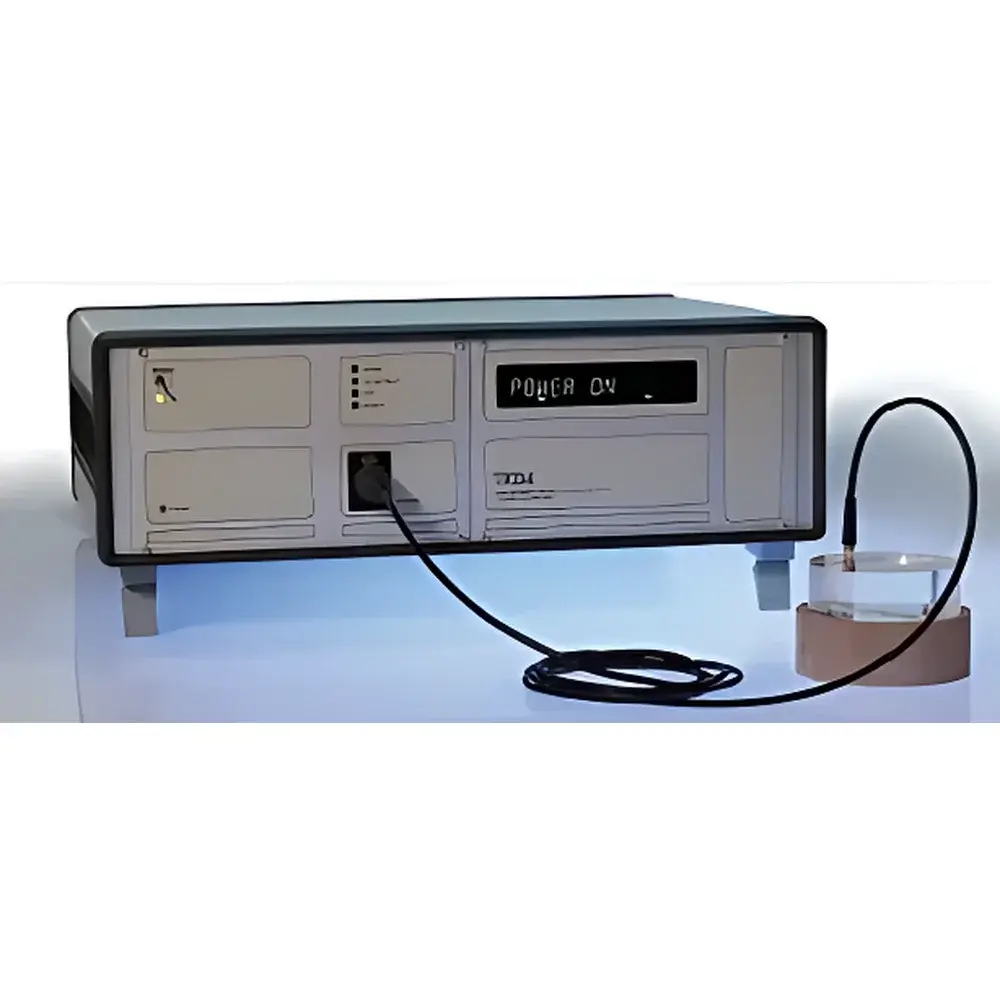
Teka KT04 Transient Line Source Thermal Conductivity Analyzer
| Brand | Teka |
|---|---|
| Origin | Germany |
| Model | KT04 |
| Measurement Principle | Transient Line Source Method (Needle Probe) |
| Thermal Conductivity Range | 0.1–10 W/(m·K) |
| Accuracy | ±2% |
| Repeatability | ±1.5% |
| Heating Current Accuracy | ±0.01% |
| Single Measurement Duration | 80 s (probe-dependent) |
| Max. Auto-Repeat Tests | 99 |
| Sample Temperature Range | −25 °C to +75 °C (up to +125 °C with optional probe) |
| Operating Ambient Temperature | 0–45 °C |
| Power Supply | 220–240 VAC, 50 Hz / 110–120 VAC, 60 Hz |
| Power Consumption | ~40 W |
| Dimensions (W×H×D) | 471 × 147 × 391 mm |
| Weight | 11 kg |
| Interface | RS232 serial or USB (via USB-to-serial adapter) |
| Sample Compatibility | Solids, granules, powders, viscous liquids |
| Probe Interchangeability | Yes |
| Real-time Temperature Drift Monitoring | Yes |
| Software-Controlled Operation | Yes |
Overview
The Teka KT04 Transient Line Source Thermal Conductivity Analyzer is a precision-engineered instrument designed for rapid, non-destructive determination of thermal conductivity in heterogeneous and industrially relevant materials. Unlike steady-state methods—which require extended equilibration times and complex boundary condition control—the KT04 implements the transient line source (TLS) technique using a calibrated needle probe as both heater and temperature sensor. This method relies on measuring the time-dependent temperature rise in the sample following a short-duration constant-power heating pulse, enabling direct calculation of thermal conductivity from the slope of the ln(t)-vs-T curve in the intermediate time domain. The KT04’s architecture eliminates dependence on reference standards or pre-calibration routines, delivering traceable results under ISO 22007-2 and ASTM D5334 compliance frameworks. Its robust design supports laboratory benchtop use as well as field-deployable measurements across R&D, quality control, and materials certification workflows.
Key Features
- Transient line source (TLS) measurement principle with integrated needle probe—no external calibration required
- ±2% absolute accuracy and ±1.5% repeatability across the full 0.1–10 W/(m·K) range
- Real-time monitoring of sample temperature drift during acquisition to ensure data integrity
- Interchangeable probe configurations optimized for solids, granular media, powders, and high-viscosity liquids
- Software-controlled test sequencing with programmable auto-repetition (up to 99 cycles per session)
- Wide operational sample temperature range: −25 °C to +75 °C (extendable to +125 °C with high-temp probe option)
- Compact footprint (471 × 147 × 391 mm) and low power consumption (~40 W) for integration into regulated lab environments
Sample Compatibility & Compliance
The KT04 accommodates diverse physical forms without requiring sample shaping or mounting fixtures: bulk solids (e.g., polymers, ceramics, composites), irregular fragments, loose powders (including nanoparticle dispersions), and viscous fluids (e.g., thermal pastes, gels, slurries). Minimal sample volume requirements are dictated solely by probe geometry—no lower dimensional limits apply when using standard 30-mm probes. All measurements adhere to ISO 22007-2 (Plastics — Determination of thermal conductivity and thermal diffusivity — Part 2: Transient plane source (hot disc) and transient line source methods) and align with ASTM D5334 (Standard Test Method for Determining Thermal Conductivity of Soil and Soft Rock Using a Thermal Needle Probe). Instrument firmware supports GLP-compliant audit trails, including operator ID, timestamped test logs, and raw data export with metadata tagging.
Software & Data Management
The KT04 is operated via dedicated Windows-based software that provides full control over measurement parameters—including heating duration, current amplitude, sampling rate, and repetition count. Real-time graphical visualization displays temperature vs. time curves, ln(t) vs. T plots, and derived thermal conductivity values with statistical summaries (mean, SD, CV%). Data are stored in ASCII-compatible .csv format for seamless import into LIMS, MATLAB, or Python-based analysis pipelines. The software includes built-in uncertainty propagation tools based on probe geometry tolerances and signal-to-noise ratios. Communication occurs via RS232 serial interface (standard) or USB (with included USB-to-serial converter), supporting integration into automated test stations compliant with FDA 21 CFR Part 11 requirements when paired with validated electronic signature modules.
Applications
- Thermal interface material (TIM) qualification for electronics cooling systems
- Quality assurance of insulating foams, aerogels, and refractory ceramics
- R&D of battery electrode composites and phase-change materials (PCMs)
- In-process monitoring of polymer melt thermal behavior during extrusion
- Geotechnical characterization of soil thermal properties for ground-source heat pump design
- Validation of thermal models in multiphysics simulation environments (e.g., COMSOL, ANSYS)
FAQ
Does the KT04 require periodic recalibration against certified reference materials?
No. The TLS method is inherently self-referencing; calibration is embedded in probe geometry and electrical constants. Verification is performed via internal diagnostic routines prior to each measurement sequence.
Can the KT04 measure anisotropic materials?
Yes—by orienting the needle probe along principal axes and comparing directional conductivity values. Anisotropy ratio calculations are supported in post-processing.
Is the instrument compatible with hazardous or reactive samples?
The probe assembly is chemically inert (stainless steel 316L sheath); however, exposure to corrosive vapors or extreme pH environments requires optional protective coatings, specified at time of order.
What data security protocols are implemented for regulated environments?
The software supports role-based access control, electronic signatures, and immutable audit logs meeting ALCOA+ principles for GxP applications.
How is temperature uniformity ensured during measurement?
The KT04 does not impose thermal gradients—it measures local conductivity at the probe–sample interface. For bulk homogeneity assessment, multiple spatially distributed measurements are recommended and statistically aggregated.




