
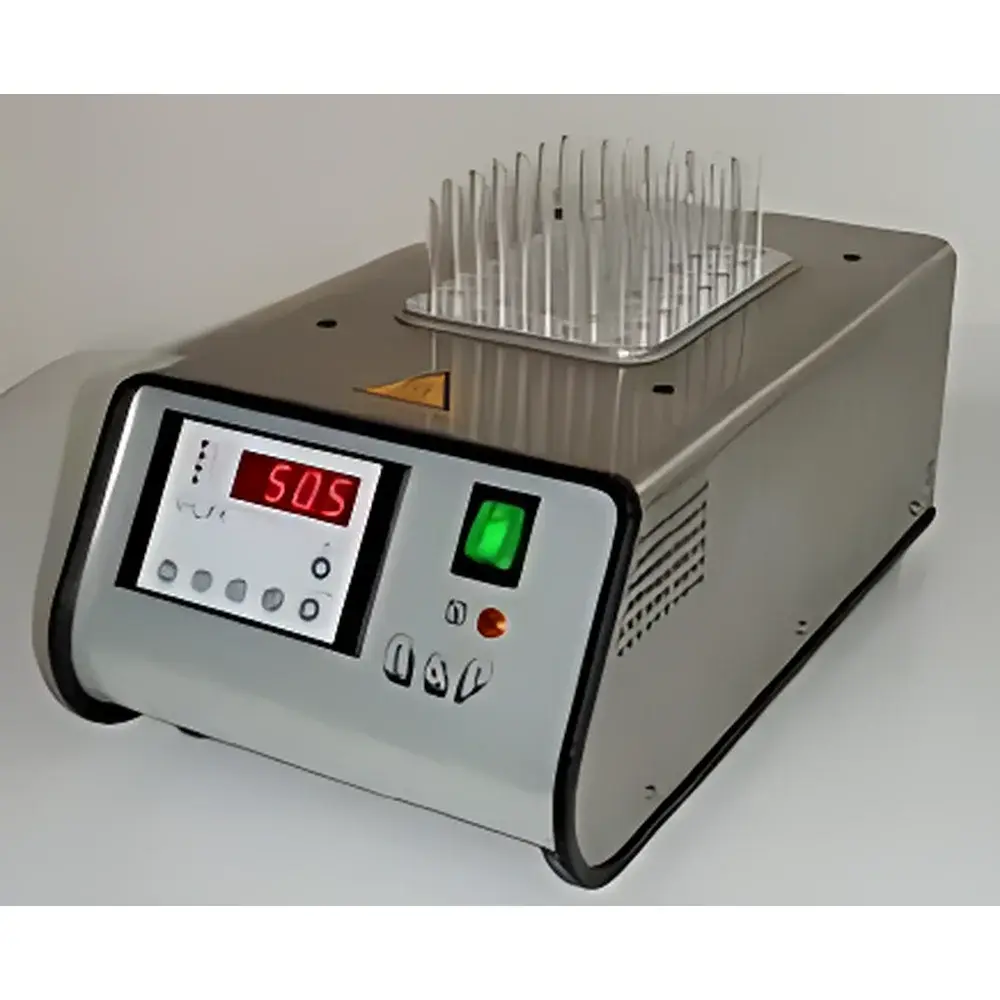
R&P PVC Thermal Stability Tester
| Brand | R&P |
|---|---|
| Origin | Germany |
| Model | PVC |
| Heating Range | RT–210 °C |
| Temperature Control Accuracy | ±0.1 °C |
| Heating Block | 40-position, Ø5.2 × 65 mm wells |
| Temperature Sensor | PT100 |
| Controller | Digital PID |
| Sample Tubes | 100 pcs, Ø5 × 110 mm |
| Power Consumption | 500 W |
| Electrical Supply | 230 V / 50 Hz |
| Weight | 8.5 kg |
Overview
The R&P PVC Thermal Stability Tester is a precision-engineered instrument designed specifically for the quantitative assessment of thermal degradation behavior in polyvinyl chloride (PVC) compounds and related thermoplastic formulations. It operates on the principle of accelerated thermal aging under controlled, isothermal conditions—directly aligned with the gravimetric and colorimetric evaluation methodology specified in EN 60811-3-2 (equivalent to DIN VDE 0473). This standardized test determines the onset temperature and rate of dehydrochlorination—a primary degradation pathway in PVC—by monitoring discoloration (yellowing index) and/or mass loss over time at fixed elevated temperatures. The system enables laboratories to benchmark formulation stability, validate heat stabilizer efficacy, and ensure compliance with cable insulation, pipe compound, and building material specifications.
Key Features
- 40-well aluminum heating block with precisely machined Ø5.2 × 65 mm cavities, optimized for uniform thermal distribution and minimal inter-well temperature deviation (<±0.05 °C at steady state)
- Digital PID temperature controller with real-time feedback from calibrated PT100 sensors, delivering ±0.1 °C setpoint accuracy across the full operating range (room temperature to 210 °C)
- Independent thermal zoning ensures consistent heating profiles regardless of ambient fluctuations or load distribution
- Integrated safety cutoffs—including overtemperature protection and automatic power disengagement upon door opening—meet IEC 61010-1 requirements for laboratory electrical equipment
- Compact footprint (320 × 280 × 240 mm) and low power demand (500 W) support integration into QC labs with limited bench space and standard 230 V/50 Hz infrastructure
- Stainless-steel housing with anodized aluminum front panel provides corrosion resistance and long-term mechanical integrity in humid or chemically exposed environments
Sample Compatibility & Compliance
The tester accommodates standard PVC test specimens prepared as cylindrical rods (Ø5 × 110 mm), conforming to EN 60811-3-2 specimen geometry requirements. Up to 100 pre-conditioned samples can be stored and staged externally using the included sample tube set. The instrument supports both single-point stability screening (e.g., 200 °C for 60 min) and multi-temperature kinetic profiling (e.g., 180–210 °C in 10 °C increments) to derive activation energy via Arrhenius analysis. Test reports generated using this system are admissible in regulatory submissions where EN, IEC, or UL standards apply—including cable certification (IEC 60502, UL 1581), construction product declarations (CE marking under CPR), and raw material qualification per ISO 9001:2015 Clause 8.5.2.
Software & Data Management
While the base configuration operates via standalone hardware control, optional USB data-logging firmware enables timestamped temperature recording at 1-second intervals. Output files are saved in CSV format for post-processing in Excel, MATLAB, or LIMS-integrated analytics platforms. When deployed in GLP- or GMP-regulated environments, the instrument may be operated under documented SOPs with manual entry of operator ID, batch number, and calibration certificate traceability. Full audit trails—including parameter changes, run start/stop timestamps, and sensor calibration history—can be maintained externally via laboratory documentation systems compliant with FDA 21 CFR Part 11 requirements.
Applications
- Quality control of PVC insulation compounds for power and communication cables
- Development and optimization of mixed-metal stabilizer systems (e.g., Ca/Zn, Pb-free alternatives)
- Comparative evaluation of recycled PVC feedstock thermal resilience
- Supporting ISO 11357-1 DSC correlation studies by identifying onset degradation temperatures prior to calorimetric analysis
- Internal specification validation for automotive interior trim, flooring, and medical tubing compounds
- Third-party testing services accredited to ISO/IEC 17025 for polymer thermal performance certification
FAQ
What standards does this instrument directly support?
EN 60811-3-2 (DIN VDE 0473), with methodological alignment to ASTM D2849 and IEC 60811-3-2.
Is calibration traceable to national standards?
Yes—PT100 sensors are supplied with individual calibration certificates traceable to PTB (Physikalisch-Technische Bundesanstalt, Germany).
Can the heating block accommodate non-standard sample geometries?
No—the 40-position block is dimensionally fixed to Ø5.2 × 65 mm; alternative fixtures require custom engineering and are not covered under warranty.
Does the system include software for automatic result interpretation?
No—color change evaluation remains visual or spectrophotometric per EN 60811-3-2 Annex A; automated image analysis modules are available as third-party add-ons.
What maintenance is required for long-term accuracy?
Annual verification of temperature uniformity and PID response using NIST-traceable reference thermometers is recommended; no user-serviceable components exist within the heating assembly.






