
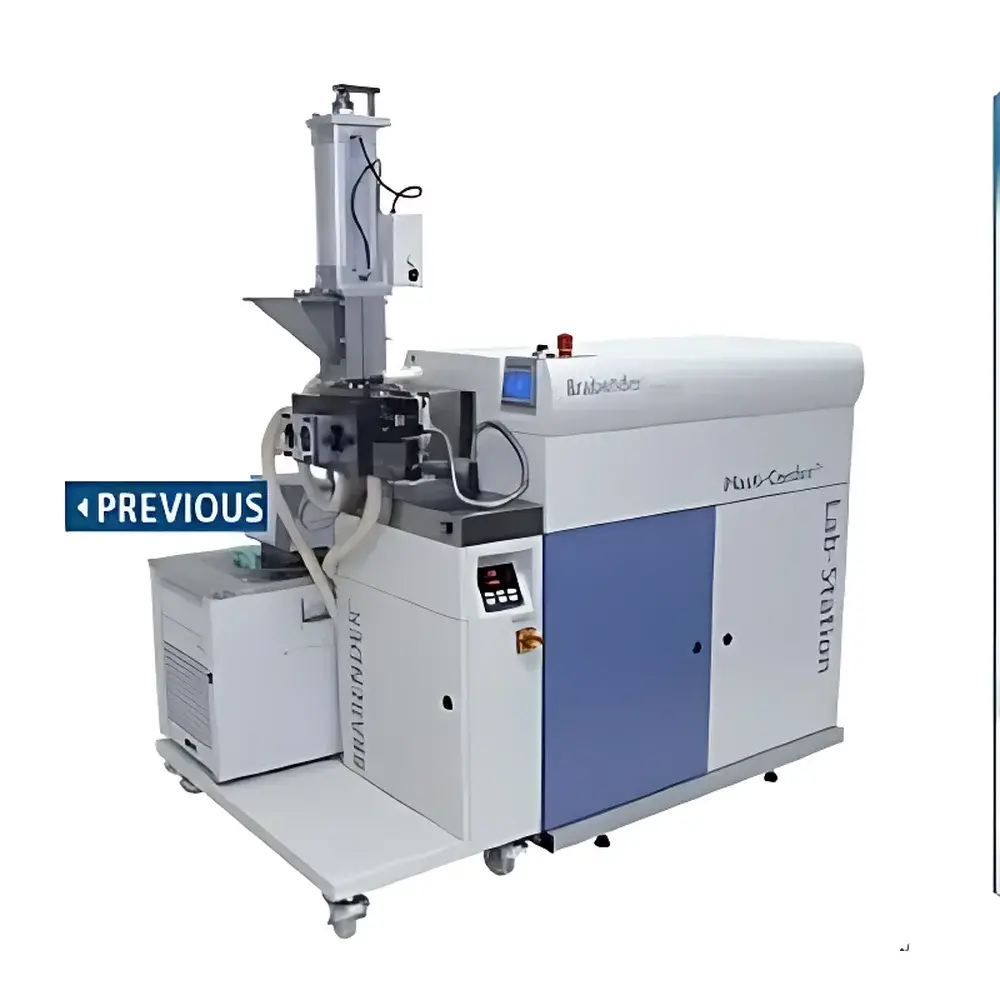
Brabender Plasti-Corder Lab-Station Torque Rheometer
| Brand | Brabender |
|---|---|
| Origin | Germany |
| Model | Plasti-Corder® Lab-Station |
| Instrument Type | Torque Rheometer |
| Motor Bearing | Mechanical Bearing |
| Minimum Speed | 0.2 rpm |
| Maximum Speed | 275 rpm |
| Frequency Range | 10⁻³–628 rad/s |
| Maximum Torque | 400 N·m |
| Torque Resolution | < 100 nN·m |
| Temperature Control Zones | 8–12 |
| Max Heating Temperature | 500 °C |
| Torque Accuracy | ±0.15% of full scale |
| Speed Accuracy | ±0.2% (closed-loop control) |
| Mixer Chamber Volume | ~55 cm³ |
| Mixer Max Torque | 200 N·m |
| Single-Screw Extruder L/D Ratio | 19/25, Max Pressure: 700 bar, Max Temp: 450 °C, Max Torque: 150 N·m |
| Die Options | Ø2.0/3.0/4.0 mm round |
Overview
The Brabender Plasti-Corder® Lab-Station is a modular, high-precision torque rheometer system engineered for real-time, process-relevant characterization of thermoplastic polymers, elastomers, and reactive polymer systems under controlled shear, temperature, and residence time conditions. Operating on the Couette flow principle within a sealed mixing chamber, the instrument measures the resistance torque generated by material deformation between counter-rotating rotors—directly correlating to melt viscosity, viscoelastic response, and thermal degradation kinetics. Unlike capillary or rotational rheometers, the Plasti-Corder replicates key mechanical and thermal histories encountered in industrial compounding, extrusion, and injection molding—enabling predictive assessment of processing behavior, formulation stability, and end-product performance without requiring scale-up trials.
Key Features
- Modular architecture supporting interchangeable modules: W50EHT intensive mixer (55 cm³ chamber, 3-zone temperature control, 0–200 N·m torque), single-screw extruder (L/D 19/25, 700 bar max pressure, 450 °C max zone temperature), and optional twin-screw or film-casting downstream units.
- High-fidelity torque transduction with <100 nN·m resolution and ±0.15% full-scale accuracy across 0–400 N·m range—calibrated traceable to DIN EN ISO 17025-accredited standards.
- Precision closed-loop speed control from 0.2 to 275 rpm (extendable to 350 rpm per specification), maintaining ±0.2% repeatability under variable load conditions.
- Multi-zone thermal management (8–12 independently controlled heating/cooling zones) with rapid ramp rates and stability ≤±0.5 °C at 500 °C—validated per ASTM D3835 and ISO 6721-10 protocols.
- Rugged mechanical bearing design ensures long-term mechanical integrity during high-torque, high-temperature operation—eliminating drift associated with magnetic or air-bearing alternatives.
- Integrated safety interlocks, over-torque cutoff, and real-time thermal runaway detection compliant with IEC 61000-6-2/6-4 electromagnetic compatibility requirements.
Sample Compatibility & Compliance
The Plasti-Corder Lab-Station accommodates raw polymers (PE, PP, PVC, PS, PC, PA, TPU), filled compounds (CaCO₃, glass fiber, nanoclays), reactive systems (peroxide-cured elastomers, epoxy prepolymers), and bio-based resins (PLA, PHA). All modules meet CE marking requirements and conform to essential health and safety provisions of the EU Machinery Directive 2006/42/EC. Data acquisition complies with FDA 21 CFR Part 11 when configured with audit-trail-enabled software (e.g., Brabender WinRheo v6.2+), supporting GLP/GMP environments. Thermal calibration certificates are issued per ISO/IEC 17025, and torque verification follows ASTM D3835 Annex A2 procedures.
Software & Data Management
WinRheo software provides synchronized acquisition of torque, temperature, speed, pressure (when equipped), and power consumption at up to 100 Hz sampling rate. Raw data is stored in HDF5 format with embedded metadata (operator ID, batch number, environmental conditions). Built-in analysis tools compute apparent viscosity, activation energy (Arrhenius), Payne effect magnitude, gel point onset (via torque inflection), and melt fracture thresholds. Export options include CSV, MATLAB .mat, and ASTM E1447-compliant XML for LIMS integration. Electronic signatures, role-based access control, and immutable audit trails satisfy regulatory validation requirements for pharmaceutical excipient development (USP ) and automotive polymer qualification (SAE J2236).
Applications
- Thermal stability screening: Quantify onset of degradation via torque deviation and exothermic peaks during isothermal holds (e.g., 200–300 °C for polyolefins).
- Shear sensitivity mapping: Correlate viscosity reduction and molecular weight distribution narrowing across 0.01–100 s⁻¹ shear rate sweeps.
- Crosslinking kinetics: Monitor torque rise during peroxide-initiated vulcanization or UV-curable acrylate polymerization.
- Filler dispersion evaluation: Detect agglomerate breakdown through transient torque overshoots and relaxation time shifts.
- Extrusion process simulation: Replicate screw conveying, melting, and metering zones using single-screw module with pressure transducers and die flow resistance calibration.
- Recycled resin qualification: Assess contamination-induced thermal instability and melt strength loss relative to virgin feedstock baselines.
FAQ
What distinguishes torque rheometry from capillary or rotational rheometry?
Torque rheometry applies controlled mechanical work in a geometrically defined mixing chamber, generating realistic shear histories and thermal gradients akin to industrial mixers—whereas capillary rheometers measure pressure-driven flow and rotational rheometers apply idealized simple shear.
Can the Plasti-Corder Lab-Station be validated for regulated quality control use?
Yes—when configured with WinRheo’s 21 CFR Part 11 mode, IQ/OQ documentation packages, and traceable calibration kits, it supports GxP-compliant release testing per ISO 17025 and ICH Q5E guidelines.
Is third-party calibration support available globally?
Brabender-certified service engineers perform on-site calibration using NIST-traceable torque standards and PTB-validated thermocouple simulators—available in North America, EMEA, and APAC regions.
How is data integrity ensured during extended experiments (e.g., 8+ hours)?
Continuous RAM buffering, redundant SSD storage, and automatic checksum validation prevent data corruption; all timestamps are synchronized to UTC via NTP and logged with hardware-generated digital signatures.
Does the system support custom rotor geometries for specialty materials?
Brabender offers application-specific rotors (e.g., cam-type for high-viscosity elastomers, serrated for filler dispersion studies) with full mechanical and thermal FEA validation reports upon request.



