
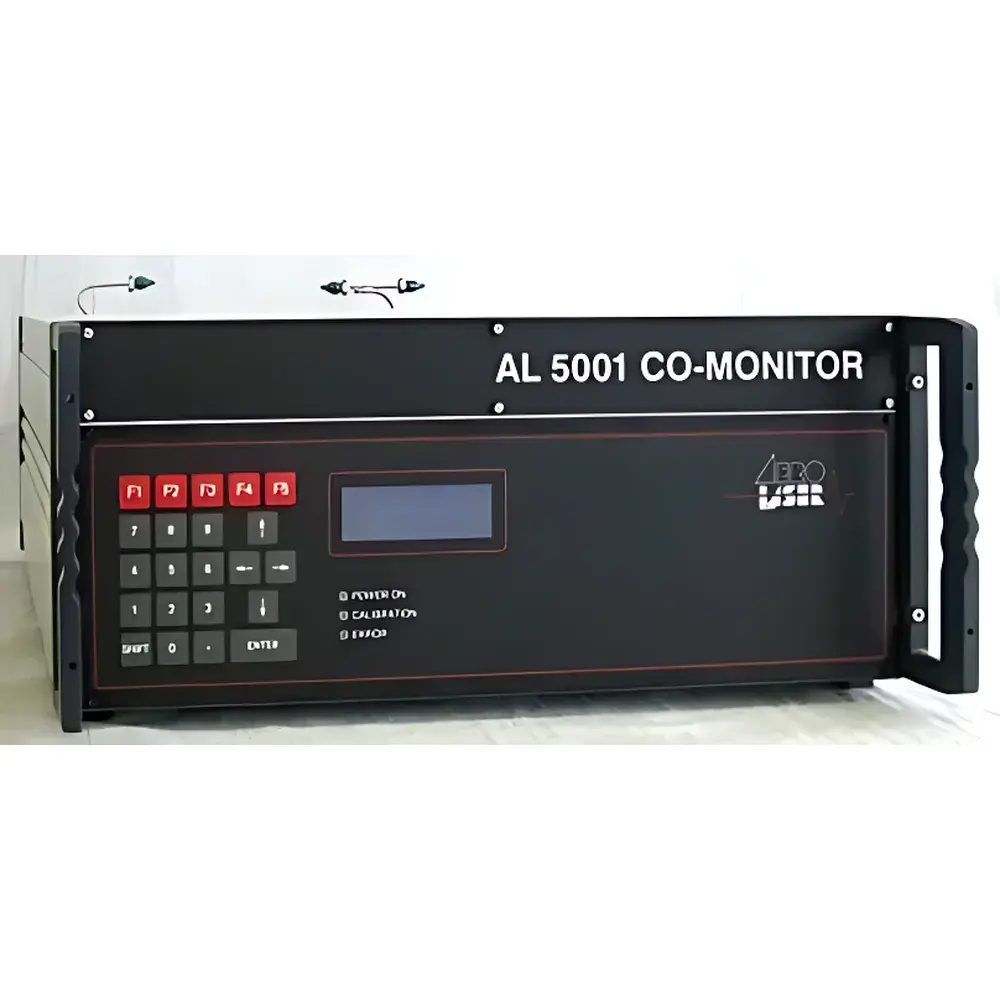
Jinhengxiang JHX AL5001 Ultra-Low-Trace Carbon Monoxide Analyzer
| Brand | Jinhengxiang/JHX |
|---|---|
| Origin | Germany |
| Manufacturer Type | Authorized Distributor |
| Origin Category | Imported Instrument |
| Model | AL5001 |
| Price | Upon Request |
| Vacuum Pump | Diaphragm Pump |
| Output | Real-Time CO Concentration (ppb–ppm) |
| Operating Mode | Fully Automated |
| Calibration | Auto-Calibration Against External Standards (Completed in <3 min) |
| Interface | RS232 Serial Port |
| Linear Range (Pulse Counting) | 0–100 ppm |
| Response Time (10–90%) | 2 s |
| Detection Limit | <2.0 ppb (1-s Integration), <0.8 ppb (10-s Integration) |
| Weight | 22 kg |
| Power Supply | 110/220 VAC or 24 VDC |
Overview
The Jinhengxiang JHX AL5001 Ultra-Low-Trace Carbon Monoxide Analyzer is a high-performance, laboratory- and field-deployable gas detection system engineered for continuous, real-time quantification of carbon monoxide (CO) in ambient air, stack emissions, and controlled environmental chambers. It employs pulsed ultraviolet fluorescence (PUVF) detection — a principle based on the photophysical excitation of CO molecules at 150–200 nm followed by highly selective emission measurement in the vacuum ultraviolet (VUV) range. This method eliminates spectral interference from common atmospheric constituents (e.g., CO₂, CH₄, NOₓ, H₂O vapor), delivering exceptional specificity and stability over extended operational cycles. Designed for applications demanding sub-part-per-trillion sensitivity and rapid temporal resolution, the AL5001 meets the metrological requirements of trace-gas monitoring networks, calibration laboratories, and regulatory compliance programs where CO concentrations span from background levels (<50 ppb) to industrial process thresholds (up to 100 ppm).
Key Features
- Sub-ppb detection capability: Achieves a validated limit of detection (LOD) of <0.8 ppb with 10-second signal integration — compliant with EPA Method TO-11A and ISO 16000-27 for ultra-low-level indoor air quality assessment.
- True real-time response: 2-second rise/fall time enables dynamic profiling of transient CO events, such as vehicle exhaust plumes, combustion start-up transients, or catalytic converter efficiency testing.
- Fully automated operation: Integrated microprocessor controls sample draw, zero/span validation, pressure regulation, and thermal stabilization without manual intervention.
- Self-calibrating architecture: Supports external standard gas delivery via dual-valve manifold; automatic calibration sequence completes within 180 seconds and logs full audit trail including reference concentration, elapsed time, and deviation metrics.
- Dual power compatibility: Operates seamlessly on either universal AC input (110–220 VAC, 50/60 Hz) or low-voltage DC (24 VDC), facilitating deployment in mobile labs, remote monitoring stations, and battery-backed emergency systems.
- Vacuum-compatible sampling train: Equipped with a corrosion-resistant diaphragm vacuum pump capable of sustaining stable flow rates between 0.5–2.0 L/min across variable backpressure conditions typical of particulate filters and diffusion scrubbers.
Sample Compatibility & Compliance
The AL5001 accepts gaseous samples at ambient temperature and pressure, with optional heated inlet modules available for moisture-sensitive or condensable-rich streams. It is compatible with standard ¼-inch PFA or stainless-steel sample lines and integrates directly into existing air quality monitoring infrastructure (e.g., EPA SLAMS, EEA AirBase). The instrument conforms to IEC 61000-6-3 (EMC emissions), IEC 61000-6-2 (immunity), and EN 14625:2012 for CO analyzers used in ambient air quality networks. Its firmware supports GLP-compliant data logging with timestamped event records, user-access control tiers, and non-volatile memory retention for ≥30 days of second-resolution measurements — fully auditable under FDA 21 CFR Part 11 when configured with digital signature-enabled software.
Software & Data Management
The analyzer communicates via RS232 serial protocol using ASCII-based command set (Modbus RTU optional upon configuration). Native PC software provides live waveform visualization, configurable averaging windows (1 s to 300 s), alarm thresholds with relay outputs, and export to CSV/NetCDF formats. All calibration events, diagnostic flags (e.g., lamp intensity decay, pump current drift), and raw pulse-count histograms are stored with SHA-256 checksum integrity verification. Remote firmware updates and parameter reconfiguration are supported through authenticated SSH session, enabling centralized fleet management across multi-site deployments.
Applications
- Ambient air quality monitoring (AAQM) networks requiring compliance with EU Directive 2008/50/EC and U.S. NAAQS for CO.
- Indoor air quality (IAQ) assessments in healthcare facilities, schools, and smart buildings per ASHRAE Standard 62.1.
- Automotive emissions testing laboratories performing cold-start CO profiling per ISO 8714 and SAE J1094.
- Calibration transfer standards for secondary reference instruments in national metrology institutes.
- Research on atmospheric chemistry kinetics, especially CO oxidation pathways in tropospheric simulation chambers.
- Process safety monitoring in hydrogen production units, syngas plants, and metal heat-treatment furnaces.
FAQ
What is the recommended maintenance interval for the UV lamp and detector window?
Lamp lifetime is rated at ≥12,000 hours under continuous operation; detector quartz window cleaning is advised every 90 days in high-particulate environments.
Does the AL5001 support analog output for PLC integration?
Yes — optional 4–20 mA isolated current loop output is available with configurable range mapping (e.g., 0–50 ppb or 0–100 ppm) and NIST-traceable linearity certification.
Can it operate unattended for extended periods?
Yes — with uninterrupted power supply (UPS) and remote watchdog functionality, the unit supports >30-day autonomous operation with periodic self-diagnostics and health-reporting via Modbus TCP.
Is ozone scrubbing required upstream of the analyzer?
No — the PUVF detection scheme is inherently insensitive to ozone; however, an optional catalytic scrubber is recommended if NO₂ interference is suspected in complex urban matrices.
How is traceability to international standards ensured?
Each unit ships with factory calibration certificate traceable to PTB (Physikalisch-Technische Bundesanstalt) primary standards, accompanied by uncertainty budget per GUM (JCGM 100:2008).







